


Listen to the article
HIV ‘Cure’ Scams Flourish on Nigerian Social Media, Investigation Reveals
Across Nigeria, self-styled healers continue to promote unverified herbal “cures” for HIV, targeting desperate patients with false promises of total healing. An investigation by The ICIR has uncovered a troubling pattern of deception, with these individuals flooding social media platforms with advertisements for miracle treatments before disappearing once payments are made.
Despite scientific consensus that no known cure exists for HIV—a virus that can only be managed through consistent use of antiretroviral (ARV) drugs—these scammers continue to find victims through sophisticated online marketing campaigns.
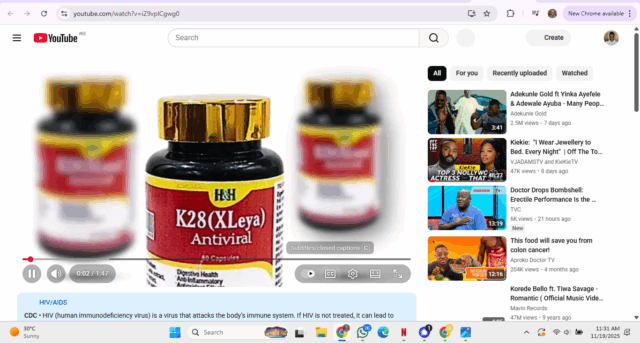
The investigation began when a reporter discovered a sponsored Facebook advertisement for a product called “K28 Xleya,” allegedly produced by a company named H & H. The advertisement urged HIV patients to “ditch ARVs” in favor of this supposed herbal cure.
“For years, people were told HIV can only be managed by taking ARV daily. But now, Nature has given us K28 Xleya which removes HIV viruses from your body completely,” the post claimed, directing users to a website where they could purchase the drug.
The ad garnered significant engagement—over 1,700 likes, 1,900 comments, and 571 shares—with many users inquiring about how to purchase the product. This level of interest is particularly concerning given that Nigeria has approximately 2 million people living with HIV, the second-highest number globally after South Africa.
Precious Ada, a drug store owner in Imo state who had commented on the post, told investigators she had intended to purchase the drug for a customer who tested positive for HIV but couldn’t afford it. “She had always been going to the General Hospital for treatment, but they said the drug would cure it, so I decided to try,” Ada explained.
Inside the Scam Operation
The website linked from the advertisement employed emotionally charged language targeting the fears and frustrations of people living with HIV: “Are you tired of taking ARVs daily? Are you afraid of the stigma? Do you want to live freely again?”
The drug was priced at ₦160,000 per bottle but “discounted” to ₦60,000, with claims that users would test negative for HIV after completing the treatment. Customers were required to send video testimonials after purchase, further perpetuating the fraud.
When the reporter submitted her details on the website, she received an automated message promising a follow-up call and providing a customer service number. After receiving no response within the promised timeframe, she contacted the number on WhatsApp. Two days later, she received only the price of the drug with no further information.
A visit to the company’s listed address in Abuja revealed it was merely a residential apartment whose occupant had no knowledge of any HIV treatment being sold.
Multiple Platforms, Same Scam
Similar advertisements for K28 Xleya appeared across TikTok and Instagram, using the same messaging and emotional appeals. The multi-platform presence gave the fraudulent claims an illusion of credibility through repeated exposure.
One account handler, who identified himself as a blogger named Gistworld, admitted to being paid to promote the product. He claimed some people had reported success with the treatment but could not provide contact information for any satisfied customers.
Following the Money
Posing as an interested buyer, the investigator contacted a supposed pharmacist named Joseph through information provided by Gistworld. Joseph explained that a single bottle cost ₦60,000 and would last 45 days, with a full treatment requiring two bottles.
After demanding upfront payment, he provided a First Bank account number bearing the name Korayom Joseph Terlumun. He claimed to have business locations in Jos, Plateau State and Gwarimpa, Abuja, promising doorstep delivery through logistics companies.
Despite making a payment, the investigator never received the product or follow-up communication.
Unmasking the Scammers
Background checks revealed that the supposed pharmacist’s bank account name matched that of a political candidate for Mata State Constituency in Benue State. The WhatsApp profile picture belonged to Hon. Saater Tiseer, the Majority Leader of the Benue State House of Assembly, suggesting potential identity theft.
A search on the Corporate Affairs Commission website showed that H&H Pharmaceuticals, though registered in January 2021, is currently inactive—either no longer in operation or failing to file annual returns.
When contacted by phone and confronted with the investigation’s findings, Joseph Korayom hung up and subsequently blocked the reporter on both WhatsApp accounts linked to his operations.
Why These Scams Persist
Mayowa Tijani, Director of Projects at The Cable, explained that such online health scams persist because enforcement is weak. “The healthcare system is not totally adequate, and so anything that can promise quick relief at low prices, people are often open to it,” he said.
He noted that regulatory bodies like the Advertising Regulatory Council of Nigeria lack the technology and manpower to monitor thousands of daily advertisements, while social media platforms make it easy for scammers to operate anonymously.
The K28 Xleya case exemplifies the dangerous intersection of health and financial scams, using official-sounding names, fake testimonials, and sponsored social media promotions to create an illusion of legitimacy while preying on vulnerable individuals seeking hope and healing.
Fact Checker
Verify the accuracy of this article using The Disinformation Commission analysis and real-time sources.

8 Comments
This is a good reminder to be extremely cautious about any health claims made online, especially for conditions like HIV that are still not fully curable. Verified information from medical experts is crucial to avoid falling for dangerous scams.
It’s disappointing to see predatory scammers taking advantage of desperate people living with HIV. Spreading misinformation about a cure, when no such thing exists, is unethical and puts lives at risk.
Agreed. HIV may not have a cure yet, but the treatments available can allow those with the virus to live healthy, full lives. Peddling snake oil cures only distracts from real solutions.
This is a concerning issue. Fraudulent claims about curing HIV can endanger vulnerable patients and undermine public health efforts. We need to be vigilant in identifying and shutting down these scams to protect people’s lives.
Absolutely. False medical claims online can spread rapidly and do real harm. Responsible social media platforms and health authorities must work to quickly debunk these dangerous lies.
This is a disturbing trend that preys on vulnerable people. Unscrupulous actors are putting lives at risk with these bogus ‘cures’. Stronger regulation and enforcement is needed to protect the public from such dangerous medical fraud.
While the desire for a cure is understandable, these fraudulent treatments are not the answer. Patients need access to legitimate, medically-proven therapies, not exploitative false promises that put their health at risk.
Absolutely right. Spreading misinformation about HIV cures is unconscionable. Public health authorities must work to shut down these scams and ensure patients receive factual, trustworthy information.