


Listen to the article
The Indian government has issued a firm rebuttal against a sophisticated disinformation campaign, warning citizens about an AI-generated deepfake video of Army Chief General Upendra Dwivedi that has been circulating on social media platforms.
On Monday, the Press Information Bureau’s Fact Check division identified and debunked several false claims being propagated by what they described as “Pakistani propaganda accounts” designed to mislead the public about India’s military leadership and foreign policy positions.
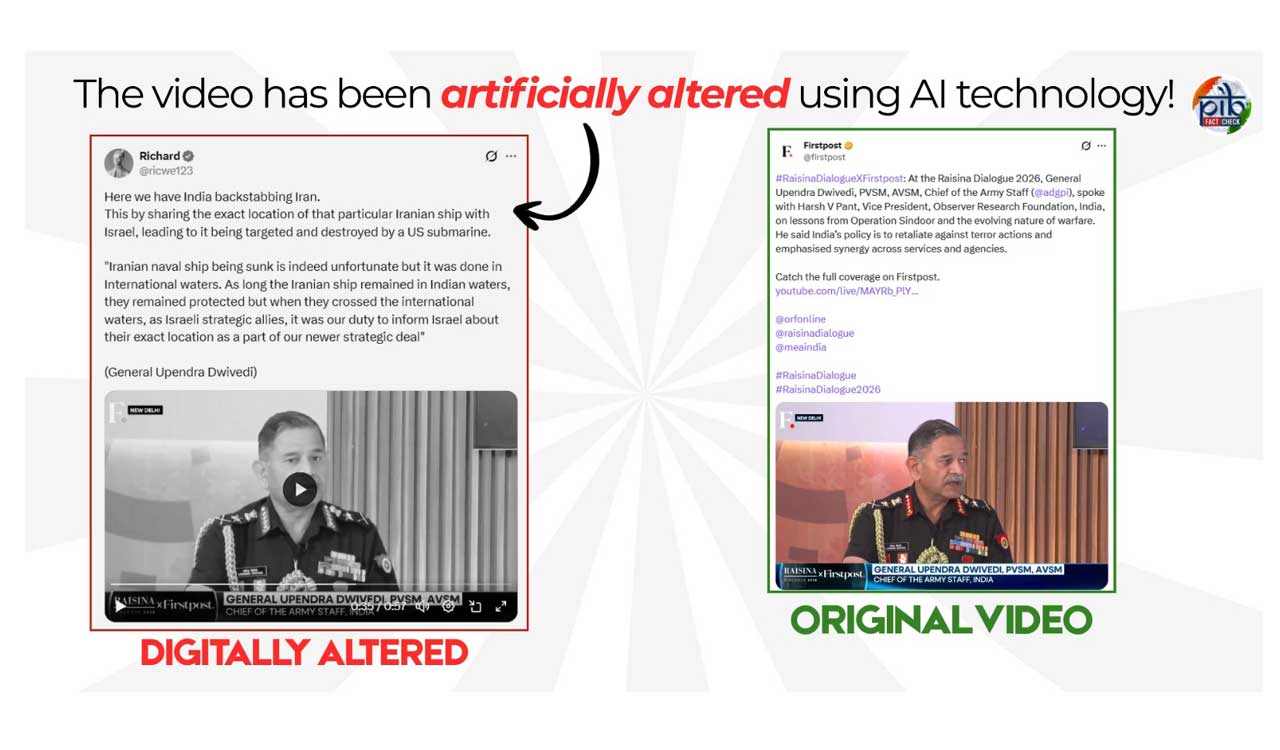
“Beware! This is an AI-generated deepfake video shared to mislead the public,” the PIB Fact Check team stated in a post on X (formerly Twitter), confirming that the video had been digitally manipulated to fabricate statements never made by the Army Chief.
The manipulated video falsely portrayed General Dwivedi claiming that India, as a strategic ally of Israel, had provided intelligence about an Iranian ship in international waters as part of a “newer strategic deal.” PIB categorically dismissed these assertions as fabricated and shared a link to General Dwivedi’s original, unaltered remarks from the Raisina Dialogue 2026 to counter the misinformation.
In the same disinformation campaign, fabricated allegations suggested that Defence Minister Rajnath Singh had ordered Vice Chief of Navy Sanjay Vatsayan to assist in an attack on an Iranian ship, and that Naval Chief Admiral Dinesh Kumar Tripathi was preparing to resign. The government emphatically labeled these claims as “fake” and part of a coordinated effort targeting India’s defense establishment.
“The allegations are completely baseless,” the PIB statement clarified, urging citizens to rely exclusively on official government sources for credible information on national security matters.
This incident highlights the growing challenge of deepfake technology and AI-manipulated content in international relations. Security analysts have noted that such sophisticated disinformation techniques are increasingly being deployed to create confusion and discord, particularly during periods of heightened geopolitical tension.
The emergence of these fabricated videos comes at a time when regional security dynamics in South Asia remain complex, with India maintaining a delicate balance in its diplomatic relationships across the Middle East while managing its historically challenging relationship with Pakistan.
Cybersecurity experts have warned that the quality of AI-generated deepfakes has improved dramatically in recent years, making detection increasingly difficult for ordinary citizens. This incident represents a concerning evolution in information warfare tactics that blend advanced technology with traditional propaganda methods.
To combat this growing threat, PIB has established dedicated channels for citizens to report suspicious content, including a WhatsApp helpline (+91 8799711259) and an email address (factcheck@pib.gov.in). The government has emphasized the importance of digital literacy and critical evaluation of online content, especially when it involves national security matters.
“If you come across such dubious content, please report it immediately,” the fact-checking unit advised, underscoring the shared responsibility in countering misinformation campaigns.
The incident serves as a reminder of the persistent tensions between India and Pakistan, where information warfare has become an increasingly prominent aspect of the broader geopolitical rivalry. Defense analysts suggest that as technology advances, distinguishing between authentic and manipulated media will remain a critical challenge for governments, media organizations, and citizens alike.
Fact Checker
Verify the accuracy of this article using The Disinformation Commission analysis and real-time sources.

8 Comments
This is a worrying trend of using advanced AI techniques like deepfakes to spread propaganda and disinformation. The Indian government’s response to call out and debunk these false claims is an important step in combating such threats to national security and public discourse.
I agree. Countering disinformation campaigns requires a multifaceted approach, including media literacy efforts to help the public identify manipulated content. Kudos to the authorities for their swift action in this case.
The use of deepfake technology to fabricate statements by India’s military leadership is a serious concern. I’m glad the government acted quickly to expose this as a Pakistani propaganda effort and provide the correct context. Vigilance against such malicious attempts to mislead the public is crucial.
The emergence of deepfake technology poses significant challenges for combating the spread of disinformation. I’m encouraged to see the Indian government taking a strong stance against this particular propaganda effort and providing the factual context. Staying vigilant against such threats is crucial for maintaining public trust.
Impressive that the Indian government was able to swiftly identify and debunk this deepfake video. Maintaining public trust in official sources is critical, especially when dealing with sophisticated disinformation campaigns. This serves as an important reminder of the need to be cautious about content shared online.
Absolutely. The government’s proactive response to address this issue head-on is commendable. Recognizing and calling out such attempts to manipulate information is key to preserving the integrity of public discourse.
Disturbing to see this blatant disinformation campaign targeting India’s military leadership. Deepfake technology is a serious threat that can be used to sow confusion and undermine public trust. The government’s swift action to debunk this fabricated video is commendable.
Absolutely. We need to be vigilant against such malicious attempts to manipulate public opinion through false information. Kudos to the government for promptly addressing this issue and providing the factual context.