


Listen to the article
In a striking about-face from just a few years ago, the landscape for combating disinformation has deteriorated dramatically, according to Nina Jankowicz, a prominent researcher who briefly led the Biden administration’s Disinformation Governance Board in 2022.
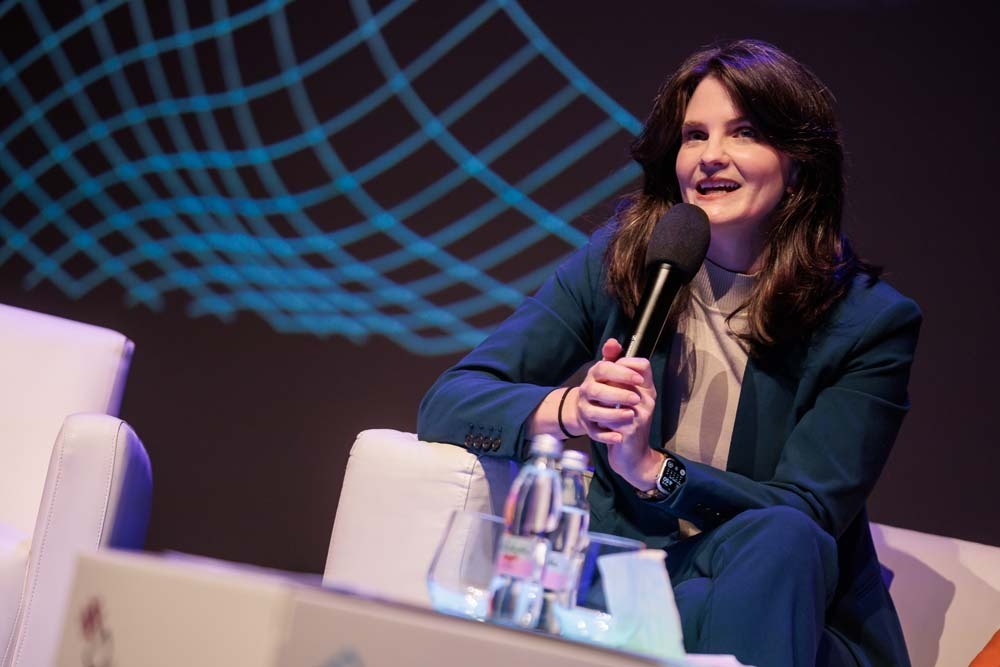
“I look back at 2020 as a golden age of fighting disinformation because we had cross-party consensus that it was bad and we had to do something about it. We don’t have that anymore,” Jankowicz said during an interview at a recent conference in Chisinau.
Jankowicz’s tenure at the Department of Homeland Security was cut short after just three weeks due to a coordinated harassment campaign that targeted her and her family. The attacks began shortly after her appointment was announced, eight weeks after she had actually started the role.
“They said that I will be censoring people, Tucker Carlson said that I will have the power to send men with guns to the homes of Americans with whom I disagree,” Jankowicz recalled. “Very quickly not only was I the lead story on almost every Fox News segment, but constant harassment was directed towards me and my family.”
What made the experience particularly harrowing was that Jankowicz was pregnant with her first child during this time. Despite the threats and doxing, she says the Biden administration failed to defend her publicly. “The administration didn’t protect me. I left because I felt that there was a chance that if I left the government, my family would be left alone,” she explained.
The harassment didn’t stop after her resignation. Jankowicz later sued Fox News for defamation but lost the case in September 2025. The court cited the rationale that viewers understood Fox’s coverage as opinion rather than fact—reasoning that Jankowicz finds troubling.
“My case can be very discouraging for people who want to pursue public service because essentially it says that if you’re serving the government, it’s open season on your life and there is nothing you can do about it,” she said. “This will result in fewer people, especially fewer women and fewer minorities, entering public service.”
The disinformation landscape has grown increasingly complex over the past decade, according to Jankowicz. She identifies three major shifts: social media platforms retreating from content moderation due to political pressure, foreign actors operating more brazenly online, and the normalization of domestic disinformation at the highest levels of government.
“The coverage of me and my appointment was totally disproportionate to the actual power that I had in my position,” she noted, pointing to how disinformation campaigns can distort reality.
Particularly concerning to Jankowicz is the current U.S. administration’s approach to free speech. “Over the past 10 months we’ve seen the biggest restrictions on freedom of expression in the United States since maybe the McCarthy era, maybe ever,” she said.
The Trump administration’s “Restoring Free Speech” executive order, ironically, has dismantled institutions working on disinformation research. “Every institution we had that worked on the field of disinformation has been obliterated, because the administration didn’t like what they were doing in shining a light on the way Russian or other foreign narratives had converged with right-wing narratives,” Jankowicz explained.
The stakes are particularly clear to Jankowicz, whose family history gives her a personal connection to the dangers of authoritarianism. “My grandfather at the age of 10 with his entire family was sent to a work camp in Siberia and then came to the US in search of the American dream as a refugee,” she shared.
Regarding the role of social media platforms, Jankowicz notes they have largely abandoned their own content moderation policies under pressure. “Platforms have monetary interest in continuing to spread disinformation because the most enraging content online is the most engaging one,” she explained. “That means they benefit when people are hooked up on their platforms and people are mad and scrolling and interacting and clicking on ads.”
When asked about Meta and Google’s recent decision to stop running political ads in the EU, Jankowicz surprisingly opposed the move. “A lot of disinformation goes through organic amplification anyway; they don’t have to pay for it,” she explained. “The other reason why I think it’s bad to cut off paid political ads is that that’s one of the only ways that smaller parties or candidates have connected with voters and it disadvantages those smaller parties more than the big ones.”
Despite the challenges, Jankowicz sees paths forward. She advocates for stronger platform regulation, better access to data for researchers, and improved information literacy for the general public.
“If we can make everybody a little more active in information consumption, deliberately choosing what to look at, click on, or share, we would be in a better place,” she concluded, emphasizing that passive information consumption makes people vulnerable to manipulation.
Jankowicz continues her work through the American Sunlight Project, which she founded in 2024 to research modern democracies and disinformation, determined not to be silenced despite the personal cost she has paid.
Fact Checker
Verify the accuracy of this article using The Disinformation Commission analysis and real-time sources.

18 Comments
This is a sensitive and multifaceted issue. Protecting free speech is crucial, but so is addressing the real harms of disinformation.
Absolutely, a balanced and evidence-based approach is needed to navigate this complex terrain effectively.
The harassment campaign against the Disinformation Governance Board leader is deeply concerning. Attacks on officials trying to address these issues are counterproductive.
Agree, this type of targeted harassment undermines efforts to have a constructive, fact-based dialogue on this important topic.
The erosion of cross-party consensus on tackling disinformation is troubling. This issue requires a collaborative, depoliticized effort.
Absolutely, disinformation should not be a partisan battleground. A united, evidence-based response is needed.
The loss of cross-party consensus on combating disinformation is concerning. Addressing this issue should not be a partisan battleground.
Agreed, a collaborative, depoliticized effort is needed to effectively address the challenges posed by disinformation.
Interesting insight into the challenges of combating disinformation in the current polarized climate. It’s concerning to see coordinated harassment campaigns targeting officials tasked with addressing this issue.
Agree, the erosion of cross-party consensus on tackling disinformation is worrying. A nuanced, factual approach is needed, not partisan attacks.
The harassment campaign against the Disinformation Governance Board leader is concerning. Attacks on officials trying to address these issues are counterproductive.
Agreed, targeted harassment undermines efforts to have a constructive, fact-based dialogue on this important topic.
This is a complex issue with valid concerns on both sides. Protecting free speech is crucial, but so is addressing the real harms of disinformation.
Indeed, a balanced and nuanced approach is needed to navigate this sensitive terrain effectively.
This highlights the delicate balance between free speech and addressing the real harms of disinformation. It’s a complex issue without easy solutions.
Absolutely, protecting free expression while tackling disinformation requires a nuanced, transparent approach.
This highlights the fine line between protecting free speech and addressing the real harms of disinformation. It’s a complex issue without easy solutions.
Absolutely, balancing free expression and tackling disinformation is a delicate challenge. Transparency and inclusive dialogue are key.