


Listen to the article
D-8 Media Forum Opens in Baku to Address Global Information Challenges
A significant international media gathering has commenced in Azerbaijan’s capital as the D-8 Media Forum on “Promoting Dialogue, Cooperation and Regional Solidarity” opened in Baku this week. The event has drawn together heads of major media structures and leading media organizations from across the D-8 Organization for Economic Cooperation’s member states.
The forum has attracted approximately 150 participants, including 71 representatives from the eight member countries and officials from the D-8 Secretariat. The D-8, also known as Developing-8, consists of Bangladesh, Egypt, Indonesia, Iran, Malaysia, Nigeria, Pakistan, and Turkey, representing a substantial economic bloc focused on strengthening cooperation among developing nations.
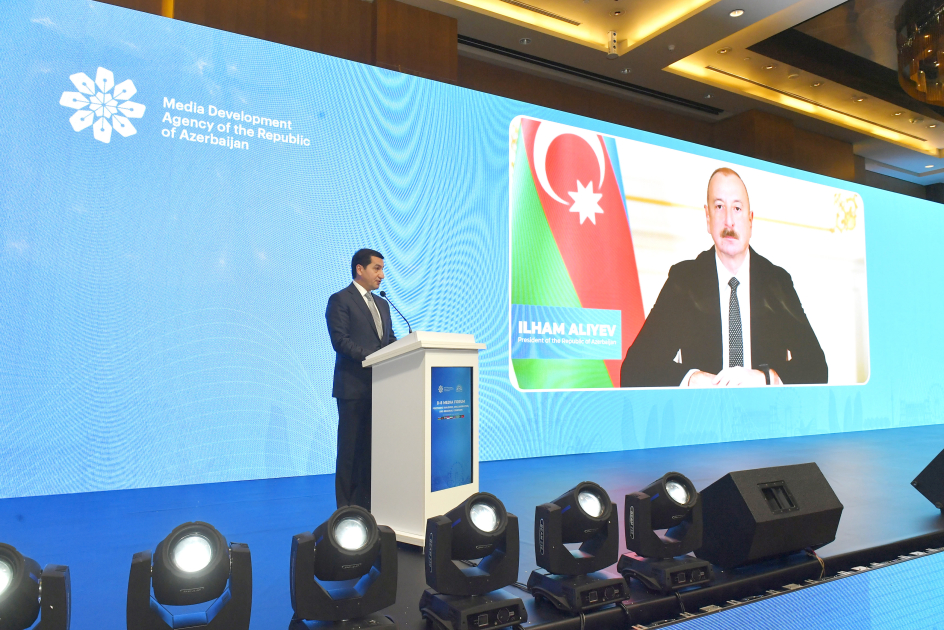
During the opening ceremony, Hikmat Hajiyev, Assistant to the President of Azerbaijan and Head of the Department for Foreign Policy Affairs of the Presidential Administration, delivered a message from President Ilham Aliyev to the forum’s attendees.
President Aliyev’s address highlighted the rapidly evolving media landscape and raised concerns about growing threats in the global information environment. “Unfortunately, the scale of disinformation, fake news, hybrid threats, deepfakes, the misuse of artificial intelligence, and other forms of manipulation is constantly growing in the global information space,” the President’s message stated.
Aliyev emphasized that these challenges extend beyond harming individual countries’ reputations and domestic affairs – they pose risks to international stability and erode interstate trust. This makes the forum’s mission especially timely, as it aims to establish robust cooperation between media organizations across D-8 member states to promote truthful, impartial, objective, and responsible information sharing.
The forum’s agenda includes two focused panel sessions addressing critical issues facing modern media. The first panel, “Responsible Journalism and Digital Innovation,” will explore how media organizations can maintain journalistic integrity while adapting to technological advancements. The second session, “Strategic Communications and Crisis Management,” will examine effective media strategies during times of crisis or rapid change.
Additionally, participants will engage in a specialized workshop titled “Media Ethics in a Digitalizing World: Technologies, Trends and Narratives.” This interactive session will delve into the ethical challenges and potential opportunities presented by the proliferation of digital platforms and artificial intelligence in news production and distribution.
The timing of this gathering is particularly relevant as media organizations worldwide grapple with unprecedented challenges, including revenue pressures, audience fragmentation, and the need to maintain credibility amidst a flood of unverified information. For developing nations represented in the D-8, these challenges can be especially acute, as media infrastructure and regulatory frameworks may still be evolving.
The forum represents a recognition that media cooperation across national boundaries has become essential in an era of borderless information flow. By bringing together media professionals from diverse regions spanning Africa, the Middle East, and Asia, the event creates a platform for knowledge sharing and potential collaboration on common challenges.
Organizers expect the forum to conclude with a set of practical recommendations designed to strengthen media cooperation among D-8 member states. These are anticipated to include frameworks for joint efforts to counter disinformation and proposals for ongoing professional exchanges and training opportunities.
The recommendations will likely address both immediate concerns in the current information environment and longer-term strategies for media development across the D-8 bloc, which collectively represents over 1 billion people across three continents.
As digital transformation continues to reshape global media, forums like this highlight the growing recognition that media resilience and integrity have become matters of national interest and international security, requiring coordinated approaches across traditional boundaries.
Fact Checker
Verify the accuracy of this article using The Disinformation Commission analysis and real-time sources.

20 Comments
The D-8 Media Forum’s focus on promoting regional solidarity is commendable. Coordinated responses are essential to counter the global challenges of disinformation.
Hopeful that the forum leads to tangible initiatives to protect the free flow of accurate information and safeguard the public interest.
Timely that the D-8 forum is focusing on promoting transparency and accountability in the media. Combating the spread of misinformation requires a collective, multinational approach.
Curious to see what concrete steps the forum proposes to enhance media integrity and public trust across the D-8 region.
The D-8 Media Forum’s emphasis on enhancing dialogue and regional cooperation is an important initiative. Strengthening media integrity is crucial in the digital age.
Hopeful that the forum leads to meaningful exchanges and the development of shared best practices among the participating media organizations.
Addressing the global information challenges is no easy task, but the D-8 Media Forum appears to be a step in the right direction. Strengthening regional ties is crucial.
Curious to see if the forum results in any policy recommendations or joint initiatives to combat disinformation in the D-8 countries.
Tackling disinformation requires a multi-stakeholder approach. The D-8 Media Forum’s efforts to bring together regional media leaders is a constructive step.
Curious to see if the forum results in any joint commitments or action plans to combat the spread of false narratives across the D-8 countries.
The D-8 forum’s emphasis on regional solidarity is encouraging. Unified messaging and fact-based reporting can counter the divisive impact of disinformation campaigns.
I hope the forum leads to meaningful collaborations and information-sharing among the participating media outlets and governments.
Combating disinformation is a global challenge that requires coordinated responses. The D-8 Media Forum’s focus on promoting regional solidarity is a welcome development.
Curious to see if the forum results in any specific policy recommendations or collaborative projects to address information manipulation in the D-8 region.
An important initiative to address disinformation challenges. Fostering regional dialogue and cooperation among media organizations is crucial in this era of information warfare.
Bringing together media leaders from the D-8 nations is a constructive step. Coordinated efforts can help strengthen regional resilience against foreign manipulation.
The D-8 Media Forum’s efforts to bring together media leaders from across the region are commendable. Strengthening cross-border dialogue and cooperation is essential.
Hopeful that the forum leads to tangible outcomes that enhance media integrity and public trust in the D-8 countries.
Bringing together media leaders from the D-8 nations is a positive move. Collective efforts to enhance dialogue and cooperation can help mitigate the spread of false narratives.
It will be interesting to see how the D-8 forum’s outcomes are implemented and the long-term impact on media integrity in the region.