


Listen to the article
The rapid spread of AI-generated satellite imagery is emerging as a significant security threat during international conflicts, with recent examples highlighting how easily manufactured evidence can be circulated to millions during times of heightened global tension.
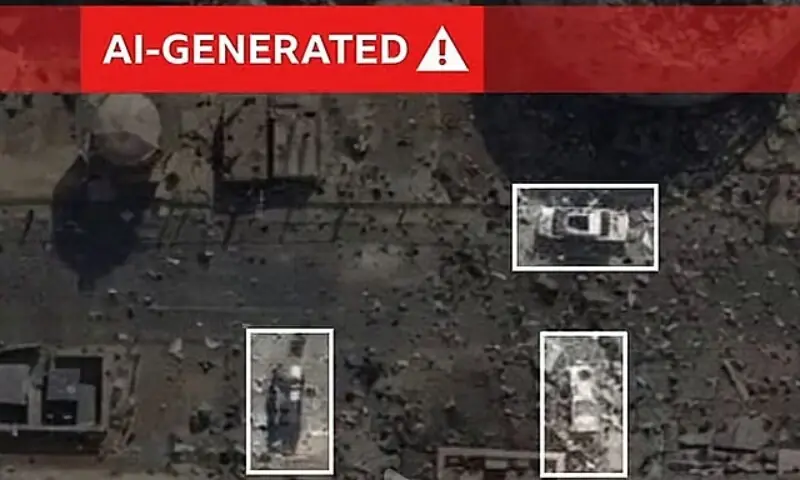
Earlier this week, the Tehran Times, an English-language Iranian news outlet with close ties to the regime, posted what it claimed were satellite images showing a U.S. military base in Qatar before and after an alleged attack. The post, which appeared on social platform X, asserted that U.S. radar equipment had been “completely destroyed,” as supposedly evidenced by the “after” image.
Security researchers and digital forensics experts quickly identified the images as sophisticated fakes. Analysis revealed that the purported “attack aftermath” was actually an AI-manipulated version of a Google Earth image from 2023 – and the original image didn’t even show Qatar, but rather a U.S. facility in neighboring Bahrain.
“The giveaway was in the details,” said Dr. Samantha Hoffman, a digital security analyst who examined the images. “A row of vehicles appeared in exactly the same positions in both the ‘before’ and ‘after’ images, which is virtually impossible in a genuine attack scenario. The AI manipulation was sophisticated, but still contained these telltale inconsistencies.”
Despite these flaws, the fabricated imagery gained remarkable traction on social media platforms, accumulating millions of views within hours. The incident has intensified concerns among security professionals about the weaponization of artificial intelligence during international conflicts.
“What we’re seeing is a quantum leap in the sophistication and speed at which disinformation can be created and disseminated,” explained Marcus Reynolds, director of the Center for Digital Conflict Studies. “Five years ago, creating convincing fake satellite imagery required significant technical skills and specialized software. Today, it can be done in minutes with consumer-grade AI tools.”
The timing of this incident is particularly significant as tensions between the United States and Iran have escalated following Iran’s unprecedented direct missile attack against Israel on April 13, which prompted concerns about potential U.S. involvement in any Israeli response.
Military intelligence experts warn that AI-generated satellite imagery poses unique challenges for verification during active conflicts. Unlike text-based disinformation, visual evidence carries inherent credibility for many viewers, especially when it appears to come from satellite imagery – a source traditionally associated with objective intelligence gathering.
“People inherently trust what they can see with their own eyes,” said Dr. Claire Wardle, who researches disinformation at the Digital Media Research Center. “When that visual information appears to come from satellite imagery – something the average person associates with military-grade intelligence – the psychological impact is particularly powerful.”
The U.S. Department of Defense has acknowledged the growing threat. In a statement released last month, Pentagon spokesperson Brigadier General Pat Ryder noted that countering AI-generated disinformation has become “a significant operational consideration” in modern conflicts.
For media organizations and intelligence agencies, the challenge of verification has never been greater. Traditional markers of authenticity in satellite imagery – shadows, relative sizing, atmospheric conditions – can now be accurately simulated by advanced generative AI models.
The Iran-Qatar incident represents just the latest example in what security analysts predict will be an accelerating trend of AI-facilitated visual disinformation during international conflicts.
“What’s particularly concerning is the potential for these fabricated images to influence decision-making during crisis situations,” said former intelligence officer Michael Hayden. “When tensions are high, visual ‘evidence’ of an attack could potentially trigger escalation before the imagery can be properly authenticated.”
As AI tools become more sophisticated and widely available, the line between genuine and manufactured evidence continues to blur, creating new challenges for maintaining factual information flows during international conflicts.
Fact Checker
Verify the accuracy of this article using The Disinformation Commission analysis and real-time sources.

14 Comments
This is a concerning trend that highlights the need for improved media literacy and critical thinking skills among the general public. Fact-checking will be key to combating the spread of AI-generated disinformation.
Agreed. Educating people on how to spot manipulated media and verify information sources should be a priority for governments and tech companies alike.
While the technology behind these AI-generated images is impressive, the potential for abuse is deeply concerning. Maintaining trust in information sources will be critical going forward.
Absolutely. Strengthening digital authentication and provenance tools should be a top priority to counter the rise of synthetic media and disinformation.
This is a troubling development. The proliferation of AI-generated satellite imagery could have serious implications for national security and global stability if not properly addressed.
Agreed. Policymakers and tech companies need to work together to find effective solutions to mitigate the malicious use of this emerging technology.
This news highlights the need for greater transparency and accountability around the use of AI-powered technologies. Policymakers and tech leaders must work together to mitigate the risks of synthetic media being used for malicious purposes.
Well said. Responsible development and deployment of these technologies, coupled with effective regulation, will be key to ensuring they are not exploited to undermine truth and trust.
Interesting how AI-generated images can be used to spread disinformation, especially during wartime. It highlights the need for robust fact-checking and digital forensics to identify manipulated media.
You’re right, the ease of creating convincing fake imagery is concerning. Rigorous verification will be crucial to combat the spread of these AI-powered deceptions.
The use of AI-generated satellite imagery to spread disinformation is a worrying development. Robust authentication processes and digital forensics will be essential to maintain trust in the information ecosystem.
Absolutely. Proactive steps to address this threat, such as developing technical solutions and strengthening media literacy, will be crucial in the years ahead.
The rapid advancement of AI-powered image generation is a double-edged sword. On one hand, it can enable new creative applications, but on the other, it poses serious risks if misused.
You raise a valid point. The challenge will be finding ways to harness the benefits of this technology while implementing robust safeguards against malicious actors.