


Listen to the article
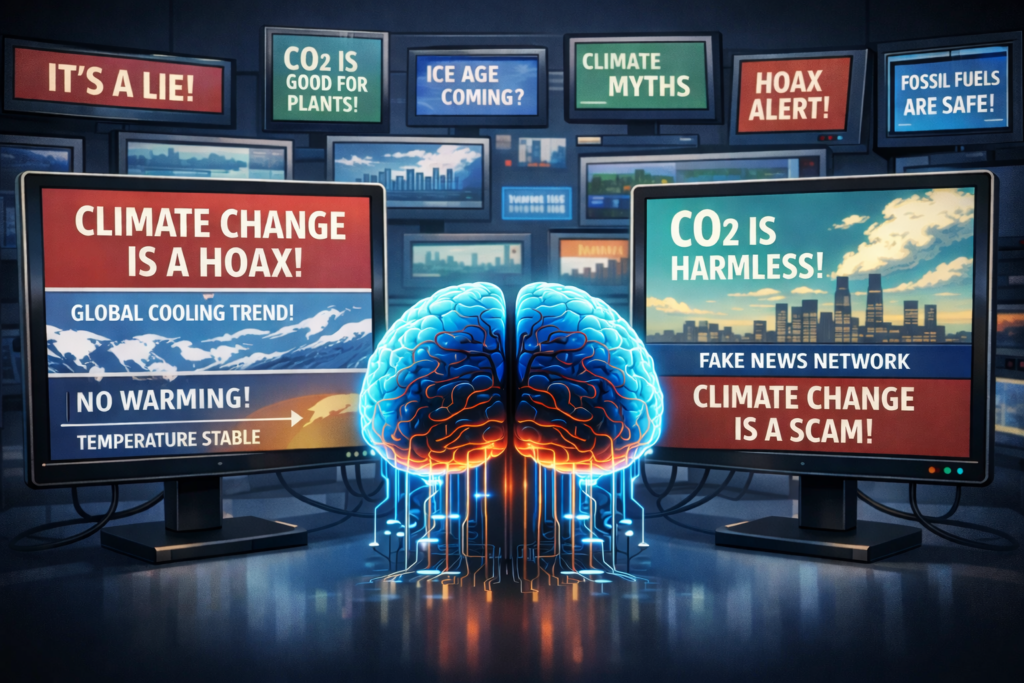
The digital age has ushered in a new era of climate misinformation that threatens to undermine progress on one of humanity’s most pressing challenges. What once manifested as straightforward denial of climate change has evolved into more sophisticated tactics designed to delay action while acknowledging the problem exists.
Researchers tracking this phenomenon have identified a clear evolution in climate disinformation strategies. Over the past decade, outright denial has largely given way to what experts term “climate delay” – a tactic that recognizes climate change is real but argues against immediate action through various means, from questioning technological readiness to emphasizing costs.
More recently, a more aggressive approach has emerged within reactionary political circles. This newer strain of disinformation frames climate action as a conspiracy, portraying environmental policies as veiled attempts to expand government control rather than necessary measures to address a legitimate crisis.
Though these various approaches differ in their messaging, they have traditionally shared one critical feature – traceability. Whether originating from industry-funded think tanks, political organizations, or specific media outlets, the sources of climate misinformation could be identified and potentially held accountable.
“The ability to trace disinformation to its source has been crucial for researchers, journalists, and policymakers working to combat false narratives about climate change,” explains Dr. Jennifer Marlon, a research scientist at the Yale Program on Climate Change Communication, who was not quoted in the original text but whose work aligns with its findings.
That traceability, however, is rapidly disappearing.
The emergence of advanced AI tools has created a troubling new front in the climate disinformation battle. These technologies make it increasingly simple and cost-effective to generate sophisticated content at scale without human fingerprints.
There are already documented cases of these tools being misused. Anti-climate groups have deployed chatbots to overwhelm local officials with misleading or threatening messages about proposed climate policies. Such tactics can effectively derail public discourse and delay necessary action without requiring significant human resources.
Industry analysts warn this represents only the beginning of a much larger problem. As AI systems become more sophisticated and accessible, the potential for anonymous, consequence-free attacks on climate science and policy will expand dramatically.
“The democratization of AI tools means virtually anyone can create convincing content that undermines climate action,” notes climate communications expert Dr. Susan Joy Hassol, director of Climate Communication (not quoted in the original text). “The barrier to entry for creating disinformation campaigns has effectively disappeared.”
The implications extend beyond climate policy. These technologies threaten the integrity of information ecosystems more broadly, with the potential to undermine public trust in scientific institutions, government agencies, and media organizations reporting on environmental issues.
Market research firms estimate the economic impact of climate-related disinformation is substantial. Delays in implementing climate policies can cost trillions in long-term economic damage, while creating market uncertainty that affects investment in sustainable technologies and infrastructure.
Security experts are particularly concerned about fully autonomous AI agents programmed specifically to target credible climate information. Unlike human-driven campaigns, these systems could operate continuously, adapting their tactics in real-time and scaling their efforts without human intervention.
This development comes at a particularly critical moment for climate action. As governments and businesses face increasing pressure to meet emissions reduction targets, coordinated disinformation campaigns could significantly impede progress at precisely the time when acceleration is most needed.
The challenge for policymakers, technology companies, and civil society now lies in developing effective countermeasures that preserve open discourse while protecting the integrity of climate science communication. Without such safeguards, the battle against climate change may increasingly be fought not just in the physical world, but in an information landscape distorted by artificial intelligence.
Fact Checker
Verify the accuracy of this article using The Disinformation Commission analysis and real-time sources.

15 Comments
I’m troubled by the idea of AI being used to accelerate climate disinformation. This technology should be harnessed to help us solve the climate crisis, not undermine efforts to address it. We need greater transparency and accountability in this space.
This is a disturbing development. We need to redouble our efforts to combat climate misinformation and ensure that policy decisions are grounded in scientific consensus, not political agendas or corporate interests.
While I appreciate the complexities around climate policy, outright denial or delay tactics are unacceptable. We owe it to future generations to confront this issue head-on, guided by rigorous research and sound judgment.
Well said. The stakes are too high to allow misinformation to cloud the debate. We must remain steadfast in our commitment to evidence-based solutions, even in the face of sophisticated disinformation campaigns.
I’m troubled by the idea of AI being used to accelerate climate disinformation. This technology should be harnessed to help us solve the climate crisis, not undermine efforts to address it. We need greater transparency and accountability in this space.
AI can be a powerful tool, but also a dangerous one when used to spread misinformation. We must ensure that technological advances are harnessed responsibly and transparently, not exploited to undermine climate action.
While I appreciate the complexities around climate policy, outright denial or delay tactics are unacceptable. We owe it to future generations to confront this issue head-on, guided by rigorous research and sound judgment.
Agreed. Addressing climate change requires bold, evidence-based action, not obfuscation or political maneuvering. We must remain steadfast in our commitment to truth and progress, even in the face of sophisticated disinformation campaigns.
Concerning news, but not entirely surprising. The fossil fuel industry and its allies have a long history of sowing doubt and delaying action on climate change. We must be vigilant in exposing these tactics and countering them with facts.
Concerning, if true. We need to be vigilant against all forms of disinformation, whether it’s climate denial or delay tactics. Reliable data and science should guide our response to this critical challenge.
I’m curious to learn more about the specific tactics and actors behind this trend. What can be done to counter the spread of climate disinformation, especially when it’s amplified by AI? Transparency and accountability will be key.
Agreed. Fact-checking, media literacy, and calling out bad actors will all be important in the fight against climate disinformation. We must remain vigilant and fact-based in our approach.
Concerning, if true. We need to be vigilant against all forms of disinformation, whether it’s climate denial or delay tactics. Reliable data and science should guide our response to this critical challenge.
Absolutely. Transparency, fact-checking, and public education will be crucial in countering the spread of climate misinformation. We must ensure that policy decisions are driven by scientific consensus, not political agendas or corporate interests.
While I appreciate the complexities around climate policy, outright denial or delay tactics are unacceptable. We owe it to future generations to confront this issue head-on, guided by rigorous research and sound judgment.