


Listen to the article
The Information War Beneath Africa’s Mining Boom
The race for Africa’s mineral wealth is evolving beyond traditional battles of capital and drilling rigs into a sophisticated digital battlefield. Across the continent’s resource-rich regions, coordinated networks of fake accounts, manufactured narratives, and automated messaging campaigns are fundamentally reshaping how mining projects are perceived, funded, and whether they survive at all.
For investors, operators, and governments, these stakes could not be higher. Africa hosts some of the world’s most significant deposits of cobalt, copper, lithium, and gold—minerals essential to the global energy transition and modern defense supply chains. As strategic interest intensifies in these resources, so does the incentive to manipulate the information environment surrounding them.
Africa’s significance in global critical mineral supply chains has grown substantially over the past decade. The Democratic Republic of Congo alone controls a dominant share of global cobalt production, while countries like Guinea hold some of the world’s largest bauxite reserves. This mineral wealth has positioned the continent as a primary theater for geopolitical competition.
What distinguishes modern resource competition from earlier eras is the growing role of narrative control as a strategic weapon. Geopolitical actors are no longer competing solely for extraction rights but are fighting to define the story surrounding who mines, under what conditions, and whether existing operators are legitimate. This shift transforms communications from a secondary business function into a frontline operational priority.
“Unlike conventional diplomatic rivalry, coordinated disinformation campaigns operate beneath the threshold of formal state conduct,” explains Tom Garnet, CEO and co-founder of Refute, a London-based AI intelligence company specializing in disinformation detection. “They are difficult to attribute, challenging to regulate, and capable of propagating across borders within hours.”
Garnet identifies a clear taxonomy of actors driving these operations, ranging from foreign state actors to armed non-state groups and commercially motivated competitors. What unites these actors is the recognition that social license to operate—the informal public acceptance of a mining project—is frequently more fragile than formal regulatory approval.
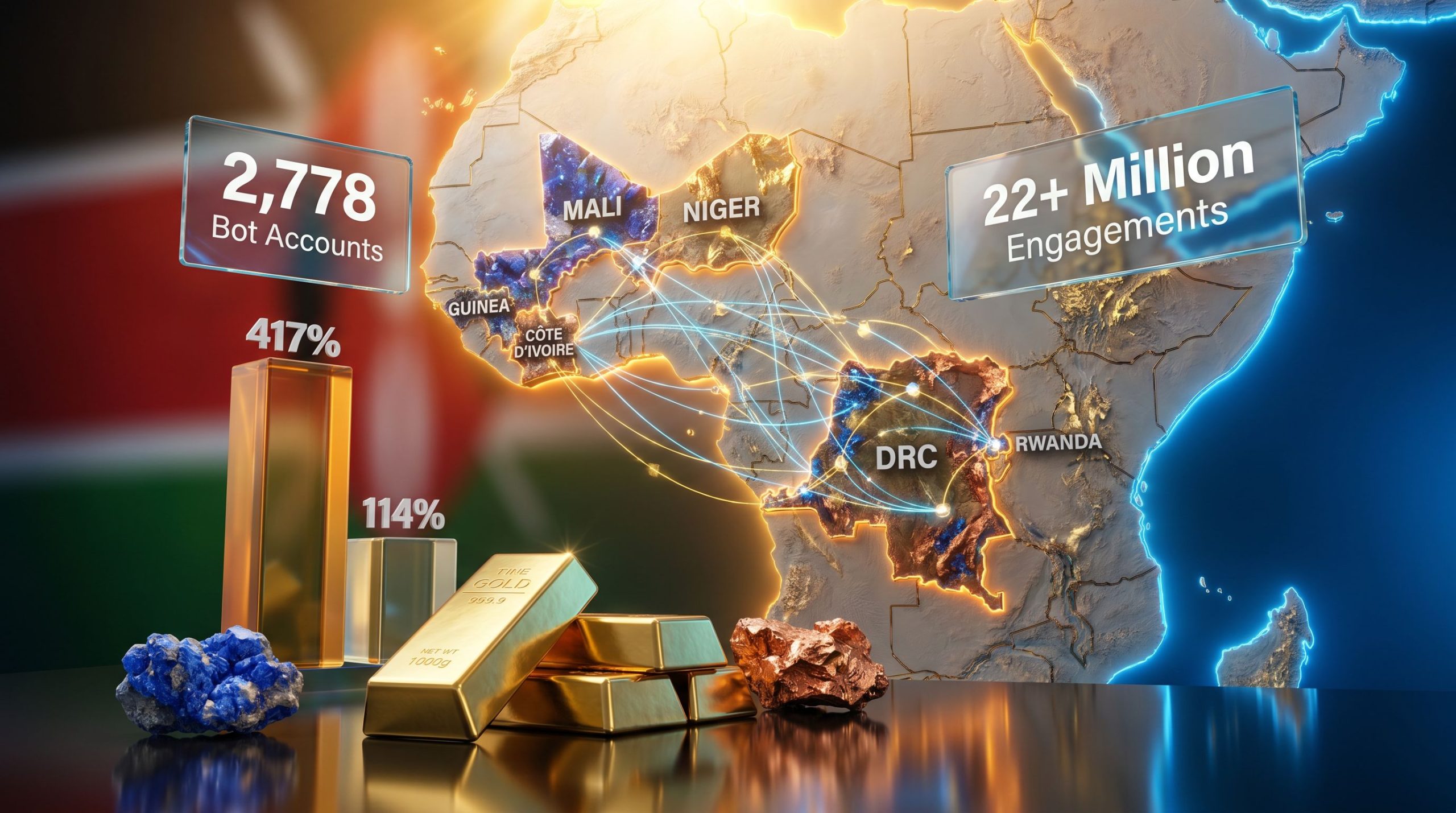
Research published in Refute’s Africa Decoded report documents the scope of coordinated disinformation activity across six African countries, identifying significant bot account networks generating tens of millions of engagements around monitored mining sites. The countries covered include the Democratic Republic of Congo, Niger, Mali, Rwanda, Guinea, and Côte d’Ivoire.
The data reveals that gold attracts disproportionately high volumes of coordinated bot traffic compared to other minerals. As Garnet explains, “Gold functions simultaneously as a globally traded financial instrument and as a physically extracted commodity subject to local political dynamics.” This creates overlapping narrative ecosystems that can be exploited simultaneously, making gold uniquely susceptible to manipulation.
One of the most significant findings is that bot activity surges are not random—they cluster tightly around specific, predictable trigger events, including regulatory announcements, commodity price movements, and conflict escalations. This pattern suggests that automated disinformation infrastructure is maintained in a pre-positioned state, ready to be activated in response to anticipated events.
Mali provides a stark example, with bot activity surging by more than 400% around key events connected to the Loulo-Gounkoto gold operation. The announced restart of this operation in early 2026 served as a trigger event that activated measurable coordinated campaign activity. A separate spike followed Mali’s revocation of foreign mining permits in October 2025.
This pre-positioning characteristic fundamentally changes the threat model for mining operators. Communications teams cannot simply wait for an incident to respond—by the time a campaign is identified through manual monitoring, it has frequently already achieved its primary audience penetration objective.
Russia has been extensively documented as the most prolific state actor conducting disinformation campaigns across Africa. Research from organizations including the Stanford Internet Observatory and the Atlantic Council has identified networks operating across multiple African countries linked to entities including the Wagner Group and its successor, the Russia Africa Corps.
The strategic logic behind Russian disinformation targeting Western mining operators is financially grounded. By disrupting or displacing Western-aligned mining companies, Russian-linked commercial entities create opportunities to assume extraction rights in high-value mineral jurisdictions. Gold is the primary commodity of interest, with financial returns from African extraction partially offsetting the economic pressures of international sanctions.
One of the most sophisticated tactics documented involves the deliberate geographic displacement of damaging narratives. In February 2025, a tailings dam failure at a Chinese-operated copper mine in Zambia created a serious environmental incident. What followed was a disinformation operation that activated not in Zambia but in Kenya, where a network of more than 30 coordinated bot accounts amplified the Zambia incident within Kenyan information spaces, framing it as evidence that Kenya should reject partnerships with Chinese mining companies.
This tactic demonstrates that disinformation campaigns do not require local grievances to be effective. Real incidents can be imported, reframed, and deployed as political leverage in entirely different jurisdictions.
The financial consequences of successful disinformation campaigns are no longer hypothetical. The Rio Tinto Jadar lithium mine in Serbia provides a significant precedent—a committed investment exceeding $2 billion was effectively mothballed following a campaign with substantial disinformation components. Similar dynamics have played out across Africa, accelerating capital reallocation toward lower-risk jurisdictions.
Current industry practice remains heavily dependent on manual analyst workflows for detecting and responding to emerging narrative threats. According to Garnet, the typical response cycle under manual protocols spans days to weeks—a timeline operationally incompatible with the speed at which bot-driven campaigns propagate across social media.
This speed asymmetry is the defining vulnerability that disinformation campaigns exploit. Campaign architects understand institutional response timelines and design operations to achieve irreversible outcomes before countermeasures can be deployed.
Closing this gap requires automation at every stage of the detection and response cycle. Automated threat detection, rapid counternarrative deployment, and platform enforcement escalation form the three integrated capabilities needed for an effective response architecture.
Forward-looking operators are beginning to treat disinformation monitoring not as a reactive crisis management tool but as a standing component of operational intelligence—embedding narrative threat monitoring within ESG frameworks and developing pre-positioned content libraries that can be deployed rapidly following predictable trigger events.
The primary recommendation from the evidence is clear: automation is not optional. Companies that invest in automated monitoring capabilities before experiencing a campaign will be substantially better positioned than those attempting to build response infrastructure reactively.
For institutional investors, disinformation exposure should be incorporated as a quantifiable risk variable in political risk assessment frameworks for African mining assets. Due diligence should assess not only conventional dimensions of political risk but also the specific disinformation exposure profile of each jurisdiction and operator.
As the battle for Africa’s mineral wealth intensifies, the ability to detect and counter coordinated disinformation will increasingly determine which projects succeed and which fail—making information resilience as critical to mining operations as traditional security or regulatory compliance.
Fact Checker
Verify the accuracy of this article using The Disinformation Commission analysis and real-time sources.

8 Comments
Fascinating insights on the disinformation challenges facing Africa’s mining sector. It’s concerning to see coordinated efforts to manipulate the narratives around critical mineral resources. Transparent and fact-based reporting will be crucial to ensure responsible development.
Disinformation targeting Africa’s mining sector is a complex challenge with far-reaching consequences. Careful analysis and fact-based reporting will be needed to navigate this information war and ensure the responsible development of critical mineral resources.
The information warfare around Africa’s mineral wealth is a troubling trend. Misinformation can have serious consequences for investment, operations, and even geopolitics. Fact-checking and media literacy will be key to combat these coordinated disinformation campaigns.
Agreed. Maintaining the integrity of information around mining projects is essential, especially for strategic resources. Governments, companies, and the public will need to be vigilant in identifying and calling out disinformation.
As Africa’s role in global critical mineral supply chains grows, the stakes for controlling the narrative around these resources are clearly high. Rigorous journalistic standards and transparency will be vital to counter the spread of disinformation.
Absolutely. Mineral wealth has long been a source of instability and conflict in parts of Africa. Ensuring accurate, unbiased reporting on mining activities is crucial to promote responsible development and prevent further exploitation.
This is a concerning development that could undermine critical mineral projects and supply chains. Disinformation campaigns erode trust and create uncertainty, which can deter investment and skew policy decisions. Robust fact-checking and stakeholder engagement will be essential.
The proliferation of fake accounts, narratives, and automated messaging around Africa’s mining sector is a worrying trend. Maintaining the integrity of information in this space is crucial, not just for investors but for the communities and environments impacted by these projects.