


Listen to the article
Escalating Border Conflict Brings Sleepless Nights to Afghan Civilians
Tensions between the Taliban and Pakistan have escalated dramatically in recent days, with military clashes intensifying across Afghanistan’s eastern provinces of Nangarhar, Paktia, Khost, and Paktika. The conflict has now reached a point where residents of Kabul report being unable to sleep at night due to the constant sound of Taliban anti-aircraft fire and Pakistani warplanes overhead.
“We are deeply alarmed,” one Kabul resident told Hasht-e Subh Daily, sharing video footage of nighttime anti-aircraft fire. Many civilians fear they could be struck by stray Taliban rounds as fighters attempt to target Pakistani aircraft.
The conflict has spawned competing narratives, with both sides claiming significant victories. The Taliban’s Ministry of Defense claims to have seized checkpoints along the border and shot down Pakistani drones, while Pakistani Information Minister Attaullah Tarar asserts that the “Azm-ul-Haq” operation has killed 415 Taliban fighters and wounded over 580.
According to Tarar, Pakistani forces have destroyed 182 Taliban outposts and seized 31 others. He also claims that 185 Taliban tanks, armored vehicles, and artillery units have been destroyed in airstrikes across Afghanistan, including reported strikes on Bagram Airbase.
Security experts question the Taliban’s military capabilities in this conflict. Besmillah Taban, former Director General for Combating Criminal Offenses at Afghanistan’s Interior Ministry under the previous government, told Hasht-e Subh Daily that the Taliban lack the necessary expertise to operate military equipment left by the former government.
“They were entirely unprepared for a situation like this,” Taban explained. “They assumed Pakistan’s strikes would be limited to targeting TTP gathering points. Now they are merely trying to give people a false sense of air defense by mounting DShK and PKM machine guns.”
The security expert added that targeting of Taliban supply depots and command centers has created “severe disarray” within the group, whose “current efforts are focused more on protecting their leadership than on the people of Afghanistan or state infrastructure.”
Meanwhile, Taliban-controlled media outlets have been accused of spreading misinformation to boost morale. Some outlets claimed Taliban drones had struck Islamabad and Peshawar in Pakistan—reports that security experts dismiss as fabricated.
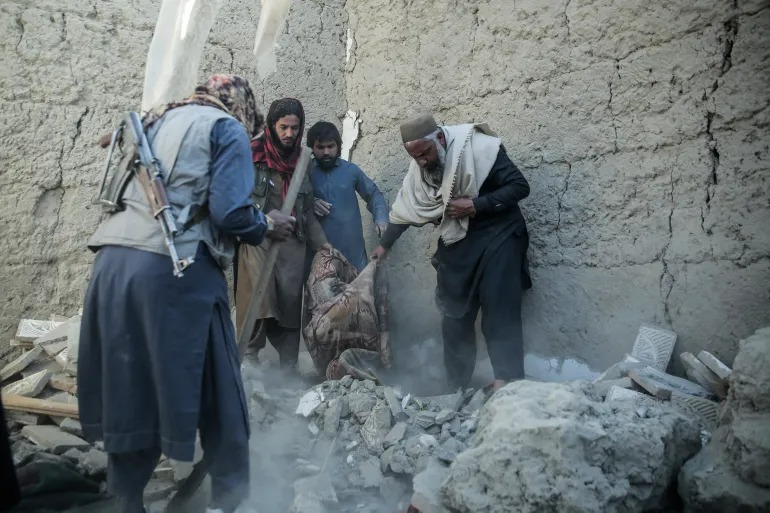
Hamdullah Fitrat, deputy spokesperson for the Taliban, described Pakistan as a “savage regime” and reported that Saturday night’s strikes on Paktia and Nangarhar killed three people, including a woman, and wounded three others. He claimed Pakistani drones targeted civilian homes in Nangarhar’s Ghanikhel district, destroying four houses.
Taliban-controlled national television reported much higher civilian casualties, claiming at least 52 civilians, including women and children, were killed in Pakistani strikes, with 66 others wounded. These figures could not be independently verified.
The escalating conflict has drawn international concern. Pope Leo XIV expressed alarm in his weekly address, calling on both sides to “enter into dialogue immediately.” He warned that “stability and peace are not built through mutual threats or with weapons that bring destruction, pain, and death, but only through reasonable, sincere, and responsible dialogue.”
The Pope urged the parties to “assume their moral responsibility to halt the cycle of violence before it becomes an irreversible abyss.”
As the crisis enters its fifth day, no mediation between the two sides has materialized. The Pakistani government announced that Prime Minister Shehbaz Sharif convened a high-level security meeting to assess the situation, attended by the Chief of Army Staff and several cabinet ministers.
For ordinary Afghans, the conflict represents yet another chapter in the country’s decades-long struggle with violence and instability. Caught between Taliban rule and Pakistani airstrikes, civilians once again find themselves bearing the heaviest burden of regional power struggles.
Fact Checker
Verify the accuracy of this article using The Disinformation Commission analysis and real-time sources.

12 Comments
The reports of sleepless nights for Kabul residents due to constant anti-aircraft fire and airstrikes are heartbreaking. Civilians should never have to live in such fear and uncertainty. This conflict must be resolved through diplomatic means, not military escalation.
I agree, the human toll is devastating. Both the Taliban and Pakistan have a responsibility to protect innocent lives and ensure the safety of Afghan civilians.
This conflict highlights the need for greater regional cooperation and conflict resolution mechanisms. The Taliban and Pakistan should be encouraged to engage in direct negotiations to deescalate tensions and find a peaceful solution that respects the rights and wellbeing of the Afghan people.
Absolutely. Unilateral military actions often make conflicts worse. A multilateral, diplomatic approach is crucial to addressing the root causes and finding a sustainable resolution.
It’s distressing to see the Taliban and Pakistan engaged in such intense fighting along the border, with civilians bearing the brunt of the violence. This conflict has the potential to destabilize the entire region if not handled carefully. I hope the international community can pressure both sides to exercise restraint and prioritize a peaceful resolution.
Yes, the regional implications are concerning. A prolonged conflict could have far-reaching consequences, both in terms of the humanitarian crisis and potential regional instability. Diplomatic efforts to broker a ceasefire and negotiate a lasting solution are urgently needed.
This is a complex situation with civilians caught in the crossfire between the Taliban and Pakistan. It’s concerning to hear about the intense fighting and disruptions to daily life in Kabul. I hope the parties can deescalate tensions and prioritize the safety of Afghan citizens.
Agreed, the civilian toll is tragic. Both sides need to exercise restraint and find a diplomatic solution to this border dispute.
The competing narratives and claims of victory by the Taliban and Pakistan make it challenging to get a clear picture of what’s really happening on the ground. Accurate, impartial reporting is crucial to understanding the full scope of this conflict and its impact on civilians.
Yes, the information war around this conflict is concerning. Independent verification of the facts is essential to cut through the propaganda on both sides.
The reports of misinformation and competing narratives around this conflict are troubling. It’s critical that the international media and fact-checkers work to verify the facts and provide accurate, impartial reporting to the public. Transparent and accountable information is essential for building a path towards peace.
Absolutely. Disinformation can prolong conflicts and make them even more intractable. Fact-based, balanced reporting is crucial for fostering mutual understanding and facilitating constructive dialogue between the parties involved.