


Listen to the article
Artificial intelligence is rapidly transforming workplaces across professions, with employees finding innovative ways to incorporate AI tools into their daily routines. From education to marketing, professionals are discovering that AI can save time, generate ideas, and enhance productivity.
Technical product manager Kristin Moore has found a unique application for AI in her role at PERQ, a digital marketing platform serving property management companies. When engineers use technical terminology she doesn’t understand during meetings, Moore uploads recorded conversations to Claude, an AI assistant created by Anthropic, asking it to simplify complex concepts.
“It picks up on all of that terminology that I don’t understand, and it can simplify it into something that I can consume,” Moore explained. She also uses the tool to analyze client communications, helping her identify what features customers want. “It’s definitely freed up hours and hours of my week,” she said.
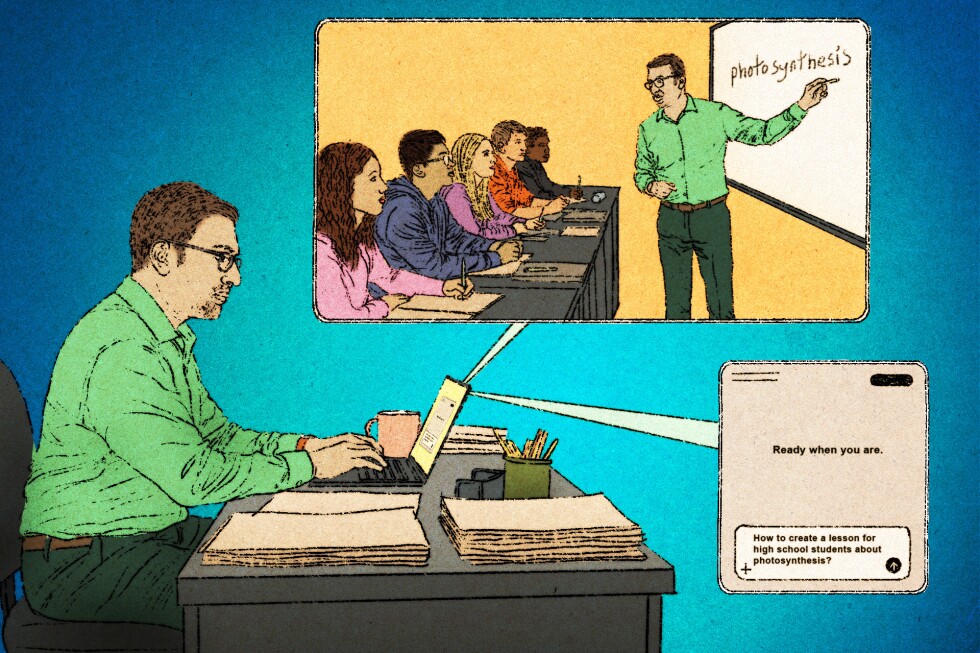
In education, elementary school teacher Kyle Weimar uses AI to streamline his responsibilities as coordinator of his Florida school’s multi-tiered support system. Before meetings about struggling students, Weimar uploads test scores, report cards, and health information to his district’s AI tool, which helps brainstorm intervention strategies.
Weimar has also transformed his grading process using AI. “I can upload 100 [papers] to an AI agent, give it a scoring guide, and let it grade and give students instant feedback,” he said. “I can do that in 30 minutes, whereas it would have taken me a week before.”
For marketing professionals, AI offers powerful analytical capabilities. Ashley Smith, head of marketing at staffing company HireQuest, built an AI dashboard that analyzes website traffic and social media trends to guide franchise owners’ business strategies. When her sales team attended a manufacturing trade show, they captured screenshots of potential client companies, which Smith fed into an AI platform to generate insights about their likely staffing needs.
“AI has not replaced anything. It’s only expanded what we’re able to offer to our franchisees,” Smith emphasized. “It allows us to do things that, candidly, we just weren’t able to deliver even as short as two years ago.”
At Georgia-Pacific, the consumer products giant behind brands like Brawny paper towels and Quilted Northern toilet paper, design leader Andrew Markle uses AI for visual brainstorming. When considering how to modernize the iconic Brawny man, his team used AI to quickly visualize different beard lengths and styles.
“It’s not replacing the creative eye of what’s good and what’s appropriate for our business,” Markle noted. “Ultimately, we knew we were going to partner with our ad agency. We have an illustrator that’s going to do the final vision.”
Kenneth Lynch, a special education coach in Tulsa who teaches life skills to developmentally disabled students, creates customized learning materials using AI. For a student interested in automotive work, Lynch uploaded mechanical instruction manuals to an AI tool that generated chapter-by-chapter quizzes. However, he remains cautious about AI’s limitations, particularly when it comes to complex psychological conditions.
In higher education, University of Michigan CIO Ravi Pendse uses AI to anticipate questions before meetings, making him “a lot more efficient” and giving him “more time to focus on my own mental health and wellness.” The university has also developed an AI tutor that faculty can customize to assist students with course material around the clock.
Despite these benefits, Pendse warns about potential downsides. “We all should be thinking about how we ensure that AI does not erode our critical thinking skills, especially those of our children,” he cautioned. “As we grew up, we learned from our mistakes. We wrote bad papers, and we got better.”
Bob Jones, Michigan’s assistant VP of emerging technology, values AI for refining his communications. “If I’m communicating about a particularly sticky topic, I want to make sure that I’m neutral and thoughtful,” he explained. “AI is really good at that.”
Marketing director Natalie Blythe of SumnerOne, which provides printing and IT services, creates targeted campaigns by using AI to develop customer personas. When planning to sell printing services to universities, she asked ChatGPT to profile a typical admissions director and predict their challenges, then identify how her company’s products could address those issues.
“When it first started up, I was in the camp of, ‘Oh my God, this is the end for us,'” Blythe recalled of AI’s emergence. Instead of just fearing the technology, she embraced it. “The efficiencies gained out of it have been tremendous,” she concluded.
As AI continues to evolve, professionals across industries are finding that these tools, when used thoughtfully, can enhance rather than replace human capabilities, allowing them to work smarter and focus on higher-value activities.
Fact Checker
Verify the accuracy of this article using The Disinformation Commission analysis and real-time sources.

7 Comments
I’m curious to learn more about how AI is being used across different professions to enhance productivity and workflow. Glad to see real-world examples of the technology making an impact.
Agreed, the use cases highlighted are intriguing. I’m particularly interested in how AI could streamline administrative tasks in education and other fields.
It’s great to see AI being leveraged to benefit workers and improve workplace efficiency. Simplifying complex terminology and automating tedious tasks sounds immensely helpful.
While AI integration in the workplace raises some concerns, these examples demonstrate how it can be a valuable tool when used responsibly. I’m curious to see how adoption evolves across industries.
A fair point. Responsible implementation and oversight will be crucial as AI becomes more widespread in the workplace. Proper guidelines and safeguards will be key.
Impressed by how the professionals in this article are finding creative ways to leverage AI in their day-to-day work. Seems like a promising trend that could boost productivity across many sectors.
Fascinating how AI can help workers save time and clarify technical jargon. Seems like a real productivity boost, especially for roles that require translating complex info.