


Listen to the article
For decades, presidents avoided even the appearance of profiting from their office. Harry Truman refused to lend his name to any business, even in retirement. Richard Nixon so feared a brother might profit off their ties, he had his phone tapped. And George W. Bush dumped his individual stock holdings before taking office.
President Donald Trump is taking a different approach.
The family real estate business is undergoing the fastest overseas expansion since its founding a century ago, each deal potentially shaping everything from tariffs to military aid. Led by Eric, and his brother, Donald Jr., the family business has expanded into cryptocurrencies with ventures that brought in billions of dollars but raised questions about whether some big investors received favorable treatment in return.
The brothers have also joined or invested in a number of companies that aim to do business with the government their father runs. Last month, they struck a deal giving them stakes worth millions in an armed drone maker seeking contracts with the Pentagon and with Gulf states under attack by Iran and dependent on the U.S. military led by their father.
The White House and the Trump Organization deny there are any ethical problems. Asked about the issue at a recent crypto conference, Donald Jr. said, “Frankly, it’s gotten old.”
Government ethics experts and historians argue the conflicts of interest are more pressing than ever as they pile up in Trump’s second term.
“I don’t think there’s any line right now between policy decisions and political calculations and the interest of the Trump family,” said Julian Zelizer, a presidential historian at Princeton University.
In Trump’s first term, the Trump Organization did zero deals in foreign countries. In a little over a year into his second term, it has completed eight, all ostensibly complying with the Trump Organization’s self-imposed rule not to do business directly with foreign governments.
But governments in authoritarian and one-party states rarely take a hands-off approach — especially when the business belongs to a sitting president.
In Qatar, a Trump golf club and villa project is being developed in part by a company owned by the Qatari government. In Vietnam, where The New York Times reported the government pushed farmers off their land to make way for a Trump resort, the country’s deputy prime minister signed off on the deal at a ceremony. And in Saudi Arabia, a planned “Trump Plaza” resort on the Red Sea is being built by a Saudi real estate developer close to the ruling family.
Whether the deals played any role in changing U.S. policies in ways these countries sought is difficult to determine, but the countries did get what they wanted – access to advanced U.S. technology for Qatar, tariff relief for Vietnam and fighter jets for Saudi Arabia. Meanwhile, the Trump Organization received tens of millions in fees.
When asked about these projects, the Trump Organization said it has done no deals with governments, noting that the Saudi company was private and it is “collaborating” with the Qatari business rather than forming a “partnership” that would break its self-imposed rules.
Another deal raising conflict questions involved the Trump family selling nearly half of its World Liberty Financial crypto business to a UAE government-linked company run by a member of the UAE royal family for $500 million. A second UAE entity, a government fund, invested in the cryptocurrency exchange Binance using $2 billion worth of a digital currency issued by World Liberty.
Shortly after, the Trump administration reversed a Biden-era restriction and granted the UAE access to advanced U.S. chips. Binance’s founder, Changpeng Zhao, later received a pardon from Trump, despite having pleaded guilty to failing to stop criminals from using his platform to move money connected to illegal activities.
A lawyer for Zhao denied any connection between Binance’s business with the Trump family and the pardon, while the White House said federal authorities had unfairly punished Zhao in what it called “The Biden Administration’s war on crypto.”
The Trump family has also benefited from cryptocurrency ventures that have generated substantial income. World Liberty raised $2 billion last year through sales of “governance tokens,” translating into hundreds of millions for the Trumps through their ownership stake and a separate side deal allowing them a cut of these sales.
One significant token investor was cryptocurrency billionaire Justin Sun, who as a foreign citizen would be banned under U.S. law from making political donations to U.S. politicians. Sun spent $75 million on the tokens between Trump’s election and inauguration. A federal lawsuit charging Sun with duping investors was paused before being settled last month for a $10 million fine.
The family’s crypto ventures have generated remarkable returns. Over just four months, Trump-related “meme” coins generated $320 million, more than double the money collected in four years running Trump’s Washington D.C. hotel during his first term.
Another family cryptocurrency business, American Bitcoin, went public in September, giving Donald Jr. and Eric about $1 billion in paper wealth at that time. Months earlier, their father announced a new national bitcoin reserve, sending cryptocurrency prices soaring to record levels.
Forbes estimates Trump’s net worth is now $6.3 billion, soaring 60% from before he returned to office – a striking development given the Trump Organization’s previous struggles. The Trump International Hotel in D.C. never turned a profit before being sold, and two Trump hotel chains catering to middle-class travelers shut down for lack of demand during his first term.
Donald Jr. has opened a private club called “Executive Branch” in the Georgetown section of Washington that charges initiation fees as high as $500,000 for founding members. One of the few clubs with comparable fees, the Yellowstone Club in Montana, offers access to multiple resorts, 50 ski trails and more than a dozen restaurants across a members-only area the size of Manhattan. Donald Jr.’s club is in the basement of a building but offers something else — proximity to power.
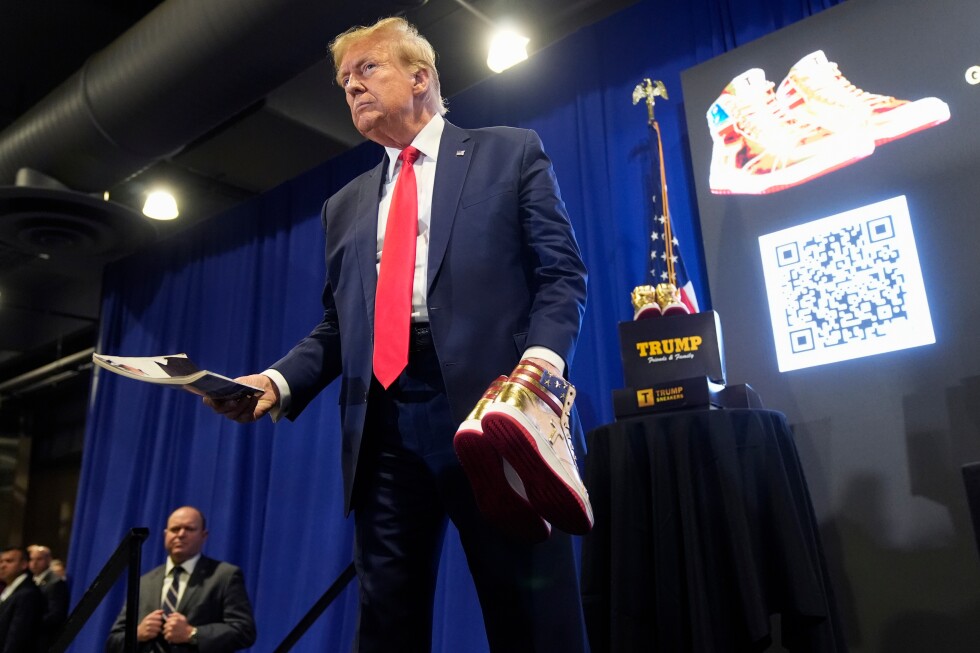
Meanwhile, Trump himself has been marketing products including $59.99 Bibles, $399 sneakers, and electric guitars priced up to $11,500.
In the first months of 2024, the momentum hasn’t let up. In January, the Trump Organization announced its third deal involving Saudi Arabia in less than a year, this time a “collaboration” with a company owned by the country’s sovereign wealth fund chaired by Crown Prince Mohammed bin Salman.
When asked by the AP whether this violated the company’s pledge not to strike deals with foreign governments, the Trump Organization said it doesn’t “conduct business with any government entity” but didn’t address the project specifically.
“He has shown politically there is no price to be paid to making money,” Zelizer said of the precedent being set. “You know you can go there.”
Fact Checker
Verify the accuracy of this article using The Disinformation Commission analysis and real-time sources.

33 Comments
Silver leverage is strong here; beta cuts both ways though.
Good point. Watching costs and grades closely.
Exploration results look promising, but permitting will be the key risk.
Good point. Watching costs and grades closely.
The cost guidance is better than expected. If they deliver, the stock could rerate.
Good point. Watching costs and grades closely.
The cost guidance is better than expected. If they deliver, the stock could rerate.
Good point. Watching costs and grades closely.
Good point. Watching costs and grades closely.
Silver leverage is strong here; beta cuts both ways though.
Good point. Watching costs and grades closely.
Uranium names keep pushing higher—supply still tight into 2026.
Good point. Watching costs and grades closely.
Production mix shifting toward Business might help margins if metals stay firm.
Good point. Watching costs and grades closely.
I like the balance sheet here—less leverage than peers.
Good point. Watching costs and grades closely.
Production mix shifting toward Business might help margins if metals stay firm.
Silver leverage is strong here; beta cuts both ways though.
Good point. Watching costs and grades closely.
Good point. Watching costs and grades closely.
Silver leverage is strong here; beta cuts both ways though.
Good point. Watching costs and grades closely.
Good point. Watching costs and grades closely.
Uranium names keep pushing higher—supply still tight into 2026.
Good point. Watching costs and grades closely.
Nice to see insider buying—usually a good signal in this space.
Good point. Watching costs and grades closely.
Good point. Watching costs and grades closely.
The cost guidance is better than expected. If they deliver, the stock could rerate.
Good point. Watching costs and grades closely.
Good point. Watching costs and grades closely.
Nice to see insider buying—usually a good signal in this space.