


Listen to the article
Toxic Mining Runoff Threatens Mekong River Basin, Endangering Millions
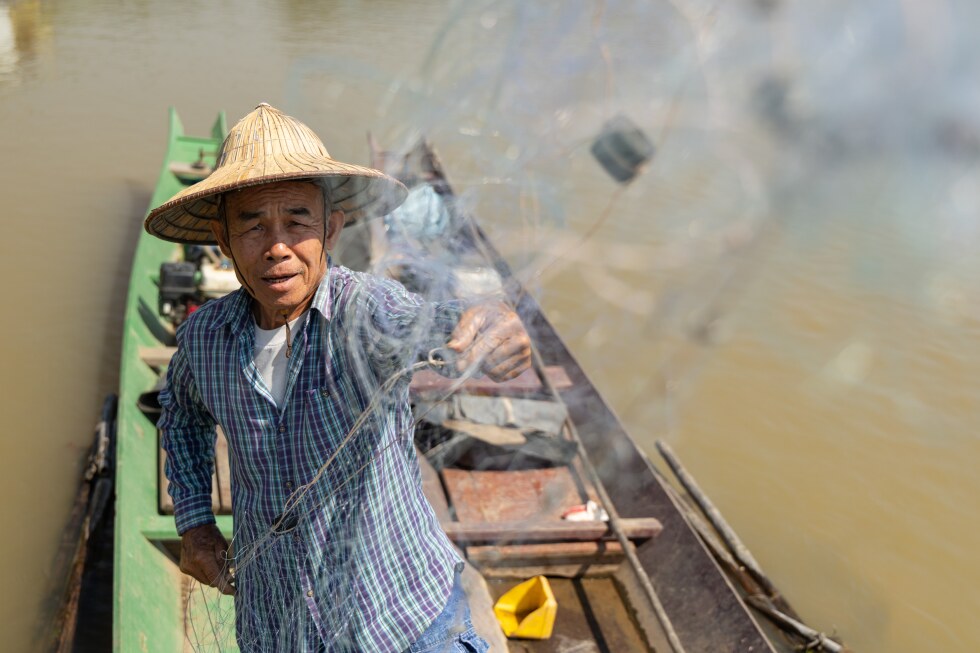
In northern Thailand’s fishing hub of Chiang Saen, 75-year-old fisherman Sukjai Yana inspects his meager catch with growing concern. Some days he earns nothing, as demand for fish plummets amid worries over toxic contamination in the Mekong River and its tributaries.
“I don’t know where else I’d go,” says Yana, whose family has called this region home for decades.
The cause of this contamination is an unregulated mining boom for rare earth materials centered in war-torn Myanmar and spreading into neighboring Laos. The toxic runoff from these operations is threatening the livelihoods and health of approximately 70 million people who depend on the nearly 5,000-kilometer (3,100-mile) Mekong River system.
While the Mekong has long faced multiple environmental pressures — from plastic pollution to hydropower dams and sand mining — experts warn that toxic mining runoff could pose an existential threat to the entire ecosystem.
Heavy metals including arsenic, mercury, lead and cadmium are being detected at alarming levels in river systems. Exposure to these toxins significantly increases risks of cancer, organ failure, and developmental problems, particularly for children and pregnant women.
Thailand is bearing the immediate brunt of this crisis, with toxins threatening its critical agricultural exports — from rice shipped to American supermarkets to edamame served in Japan and garlic used across Malaysia. The contamination could devastate Southeast Asia’s agricultural sector, which serves as the economic backbone for the region.
“The rare earth mines are destroying the world’s kitchen,” warns Suebsakun Kidnukorn of Mae Fah Luang University in Thailand’s northern Chiang Rai province.
Contamination Spreads Through Water Systems
In the hillside Thai village of Tha Ton, 63-year-old farmer Lah Boonruang counts on his fingers the toxin-exposed crops he harvests — rice, garlic, corn, onion, mangoes, and bananas. He irrigates his fields using water from the Kok River, a Mekong tributary flowing from Myanmar that is now laden with heavy metals.
“Everyone is afraid of the toxins,” Boonruang says. “If we can’t export, a farmer is the first to die.”
The stakes are enormous for Thailand’s agricultural sector. The country ranks among the world’s top rice exporters alongside India and Vietnam, with over $10 billion worth of rice and fruits exported in 2024. The United States is Thailand’s top rice importer, highlighting the global reach of potential contamination.
For ethnic minorities living in northern Thailand, like the Lahu people, the contaminated rivers have severed cultural lifelines. Lahu elder Sela Lipo, 56, laments that warnings to avoid river water have devastated his community, known for their fishing traditions.
“The Lahu’s way of life is always with a river,” he says. “The contaminated river has cut off our lifeline.”
Limited Solutions Amid Regional Complexity
Thailand’s government acknowledges it has little leverage against mining operations across its borders, especially in Myanmar where civil war has created regulatory vacuums. The Thai response has been constrained by limited expertise, information, and funding, according to Aweera Pakkamart of Thailand’s Pollution Control Department.
Instead, local universities, regional governments, and organizations like the Mekong River Commission have focused primarily on monitoring contamination levels and educating communities about health risks.
Warakorn Maneechuket, a researcher at Thailand’s Naresuan University, has found alarming evidence of contamination. In her laboratory, she points out tumor-like growths, discolored scales, and unusual eye coloration in fish caught from the Kok River before dissecting them to examine internal damage.
The cumulative health effects of these toxins are severe. Arsenic can cause organ failure, mercury damages the nervous system, lead impairs cognition, and cadmium harms the kidneys. Over time, these heavy metals accumulate in both ecosystems and human bodies.
To help address the crisis, Tanapon Phenrat of Naresuan University has developed a smartphone fish safety app. The tool enables local fishers to identify and upload images of suspicious fish, building a citizen-science database that helps quantify contamination patterns.
“Each and every sample is very important,” Phenrat emphasizes.
Rising Global Demand Drives Mining Expansion
Despite their name, rare earth elements are relatively common in the earth’s crust. What makes them “rare” is the costly mining and complex refining process, historically concentrated in China. These elements are essential for modern technology — from smartphones and electric vehicles to sophisticated military equipment like missiles and fighter jets.
The U.S.-based Stimson Center has identified nearly 800 suspected unregulated mining sites along Mekong tributaries in Laos, Myanmar, and Cambodia using satellite imagery analysis. Many sites in Myanmar operate in active conflict zones, which has driven a geographic “diversification of mines” into neighboring countries, with researcher Regan Kwan tracking expansion to 26 new sites along rivers in Laos.
Myanmar has become China’s leading supplier of heavy rare earths, exporting more than $4.2 billion worth of materials to China between 2017 and 2024, with exports increasing significantly after Myanmar’s 2021 military takeover.
The United States has also prioritized securing critical mineral supplies, particularly for military applications in fighter jets, submarines, and missile systems. As global powers replenish and expand military stockpiles, demand for these materials continues to grow.
Brian Eyler of the Stimson Center describes the toxic runoff as an “atomic bomb” for the Mekong basin, potentially more devastating than any other environmental threat the region faces.
“It’s far more damaging than other threats like large dams,” Eyler warns, “and it is not stopping.”
For the millions who depend on the Mekong’s waters for their livelihoods and cultural identity, the consequences of this mining boom could reshape life along one of the world’s most productive and important river systems for generations to come.
Fact Checker
Verify the accuracy of this article using The Disinformation Commission analysis and real-time sources.

10 Comments
Rare earth elements are crucial for many green technologies, but the mining processes described seem to be causing unacceptable environmental harm. Is there potential for more sustainable extraction methods or alternatives that could reduce the impact on vulnerable ecosystems like the Mekong?
This is a sobering reminder of the potential consequences of unfettered resource extraction. The long-term damage to the Mekong ecosystem could be catastrophic if these issues are not swiftly addressed. The rights and livelihoods of local communities must be prioritized.
I agree, the stakes are incredibly high. Policymakers need to take a comprehensive, evidence-based approach to regulate the rare earth mining industry and safeguard the Mekong River basin.
This is a concerning issue that deserves more attention. Unregulated rare earth mining is causing significant environmental damage and threatening the livelihoods of millions who depend on the Mekong River. More oversight and sustainability measures are urgently needed to protect this vital ecosystem.
You’re right, the Mekong River basin is a critical global resource that must be safeguarded. Stricter controls on mining operations and better pollution monitoring are essential to prevent further degradation.
It’s alarming to hear about the high levels of toxic heavy metals being detected in the Mekong. This poses serious risks to public health and food security across Southeast Asia. Governments in the region need to take strong action to crack down on irresponsible mining practices.
Absolutely, the contamination of the Mekong is a regional crisis with global implications. Urgent international cooperation is required to address the root causes and mitigate the environmental damage.
The article highlights the complex tradeoffs involved in the global rare earth supply chain. While these materials are essential, the human and environmental costs of unregulated mining are clearly unsustainable. Creative solutions are needed to balance economic and ecological priorities.
Agreed, this is a complex challenge that requires a multi-stakeholder approach. Balancing resource needs with environmental protection will be crucial, as will ensuring the rights and livelihoods of local communities are protected.
The article highlights a complex challenge at the intersection of economic development, environmental protection, and human welfare. While rare earth minerals are essential for many modern technologies, the mining practices described are clearly unsustainable. A more balanced approach is needed.