


Listen to the article
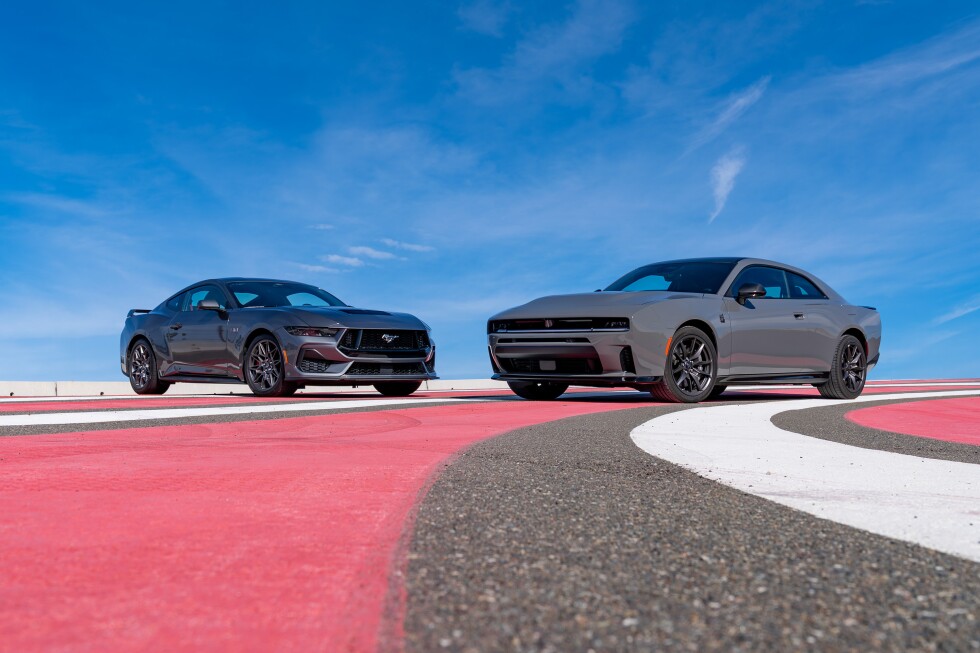
American muscle meets modern design as Ford Mustang and Dodge Charger continue their decades-long rivalry with distinctly different approaches in their latest incarnations. While both vehicles maintain their performance heritage, they’ve evolved in ways that reflect changing market demands and technological advancements.
The 2024 Dodge Charger represents a significant departure from tradition, debuting as an electric vehicle under the Daytona name while also offering turbocharged six-cylinder options in the R/T and Scat Pack models. Meanwhile, Ford’s Mustang continues its gradual evolution toward sports car territory, particularly with its track-focused Dark Horse variant.
As a spiritual successor to the discontinued Challenger, the new two-door Charger comes considerably larger and heavier than its predecessor. Some of this additional weight stems from its standard all-wheel-drive system, which enhances both all-weather capability and off-the-line acceleration performance.
Power remains central to the Charger’s appeal. The R/T model generates 420 horsepower from its turbocharged inline-six, while the high-output Scat Pack version produces an impressive 550 horsepower. This enables the Scat Pack to reach 60 mph in just 4.2 seconds, outpacing both the 480-horsepower Mustang GT and the 500-horsepower Mustang Dark Horse in acceleration testing.
However, the Charger shows weaknesses in other performance metrics. Its braking distances disappoint, and the light steering provides minimal feedback, making it challenging to identify the tires’ grip limits when cornering.
The Mustang, despite its muscle car lineage, has been increasingly refined as a true sports car. This is particularly evident in the Dark Horse model, which prioritizes road course performance over straight-line speed. Both the GT and Dark Horse deliver responsive handling, strong acceleration, and excellent stopping power. The Mustang’s naturally aspirated V8 also produces a more visceral sound than the Charger’s six-cylinder and offers the option of a manual transmission for driving enthusiasts.
When it comes to daily usability, the Charger finds its stride. Without adaptive suspension options, the six-cylinder models strike a good balance between ride comfort and body control. The smooth-shifting eight-speed automatic transmission and well-calibrated throttle response make for pleasant daily driving. Its hatchback-style rear liftgate adds practical utility for cargo transportation.
Technology represents another Charger strong point. The cabin features abundant USB ports, a wireless charging pad, and an impressive 12.3-inch touchscreen with sharp graphics and responsive performance. Dodge also wisely retained physical controls for climate functions, enhancing user-friendliness.
The Mustang’s comfort level largely depends on options selected. Both GT and Dark Horse models offer performance-oriented adaptive suspensions that allow on-the-fly adjustment of ride firmness. However, the Mustang’s smaller dimensions result in cramped rear seating and limited cargo capacity compared to the Charger.
While the Mustang’s 13.2-inch touchscreen gives the interior a contemporary feel, the decision to integrate all climate controls into the display makes simple adjustments more cumbersome and potentially distracting while driving.
Pricing creates interesting value propositions for both vehicles. The Mustang GT starts at $48,645 including destination charges, undercutting the base Charger R/T’s $51,990 entry point. However, the premium Dark Horse commands $66,075 before options, which can push the final cost beyond $70,000.
The Charger Scat Pack, starting at $56,990, represents a compelling value for buyers prioritizing straight-line performance and interior space. But like the Mustang, option packages can quickly inflate the price.
For buyers torn between these American performance icons, the decision largely comes down to priorities. The Charger offers more interior space, better technology integration, and impressive acceleration from its turbocharged six-cylinder engines. The Mustang delivers a more engaging driving experience, superior handling dynamics, and the emotional appeal of its V8 powerplant.
While Dodge has successfully modernized the Charger with turbocharged performance and contemporary features, it can’t match the Mustang’s driver engagement and performance versatility. For the traditional muscle car enthusiast who values the visceral experience of a naturally aspirated V8 and connected driving dynamics, the Mustang remains the standard-bearer in this long-running rivalry.
Fact Checker
Verify the accuracy of this article using The Disinformation Commission analysis and real-time sources.

21 Comments
Nice to see insider buying—usually a good signal in this space.
Good point. Watching costs and grades closely.
Good point. Watching costs and grades closely.
Nice to see insider buying—usually a good signal in this space.
Good point. Watching costs and grades closely.
Silver leverage is strong here; beta cuts both ways though.
Silver leverage is strong here; beta cuts both ways though.
Good point. Watching costs and grades closely.
The cost guidance is better than expected. If they deliver, the stock could rerate.
Uranium names keep pushing higher—supply still tight into 2026.
Exploration results look promising, but permitting will be the key risk.
I like the balance sheet here—less leverage than peers.
Good point. Watching costs and grades closely.
Good point. Watching costs and grades closely.
I like the balance sheet here—less leverage than peers.
Good point. Watching costs and grades closely.
Production mix shifting toward Business might help margins if metals stay firm.
Good point. Watching costs and grades closely.
Good point. Watching costs and grades closely.
The cost guidance is better than expected. If they deliver, the stock could rerate.
Good point. Watching costs and grades closely.