


Listen to the article
The CIA’s Cryptic Sculpture: 35-Year Mystery Headed to Auction
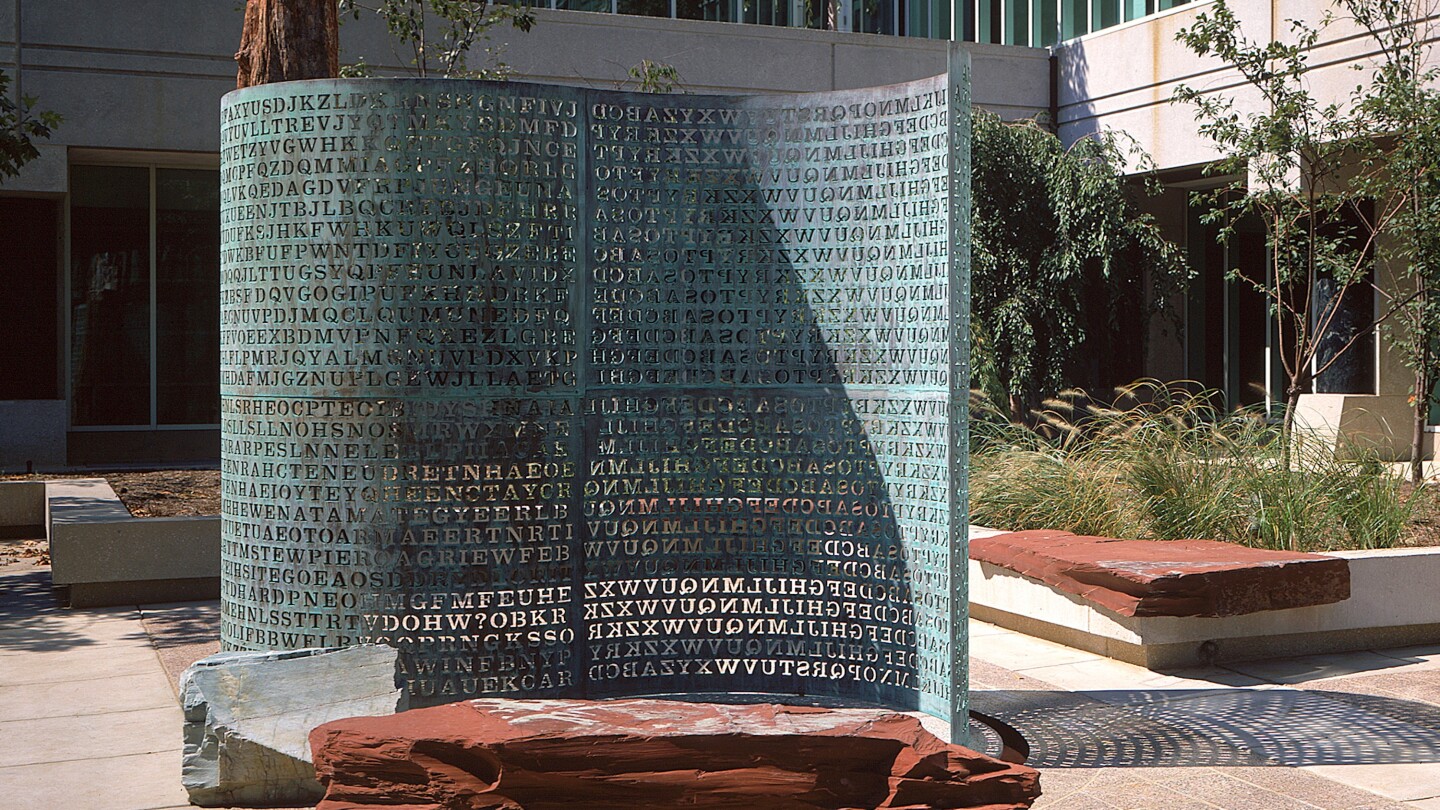
When Jim Sanborn installed his copper sculpture “Kryptos” at CIA headquarters in 1990, he created more than just a piece of art. The 10-foot-tall, S-shaped screen featuring four encrypted messages has become one of the world’s most enduring cryptographic puzzles.
“At the time, codes and encoding was an esoteric subject,” Sanborn explained. “I wanted it to be less so, and I wanted it to be fun. Any artist’s goal when they make an artwork is to have the viewer’s attention for as long as possible.”
Sanborn certainly achieved that goal. While the first three encrypted passages—known as K1, K2, and K3—were solved relatively quickly, the fourth section, K4, has stumped even the most skilled code breakers for 35 years. The sculpture has inspired thousands of amateur and professional cryptographers worldwide, with one person contacting Sanborn weekly for the past 20 years attempting to solve it.
Now 79 and facing health concerns, Sanborn has decided to auction off the solution to K4 through Boston-based RR Auction. The auction, which runs through November 20, has already reached a top bid of $201,841 for what’s being called the “Kryptos archive.”
“Since its installation in 1990, ‘Kryptos’ has become a worldwide phenomenon,” said Bobby Livingston, executive vice president at RR Auction. “K4 has stumped professional cryptologists and code breakers as well as amateurs who have tried to solve it and read the message. The winner of this archive is now going to possess the secrets of ‘Kryptos.'”
The winning bidder will receive everything needed to solve K4, along with an alternate paragraph that Sanborn calls K5. The archive also includes the original coding charts for K1, K2, and K3, as well as the original scrambled texts that Sanborn shared with the CIA’s Department of Historical Intelligence to ensure there was nothing “untoward” on the sculpture.
Over the decades, “Kryptos” has permeated popular culture, with snippets appearing on the dust jacket of Dan Brown’s bestseller “The Da Vinci Code” and receiving mention in Brown’s “The Lost Symbol.” The sculpture’s enduring mystery has cemented its place in cryptographic history.
The auction nearly derailed in September when writer Jarett Kobek and playwright Richard Byrne discovered Sanborn’s original scrambled texts in the Smithsonian’s Archives of American Art after being tipped off by the auction listing. Sanborn was initially “shocked” by their discovery and considered canceling the auction.
“It was miserable, and it’s still miserable,” Sanborn said. “There’s a lot of regret and anguish.”
However, he decided to proceed, emphasizing that while Kobek and Byrne found the text, they did not discover the method to decipher it. “The important distinction is that they discovered it. They did not decipher it,” Sanborn explained. “They do not have the key. They don’t have the method with which it’s deciphered. To the entire cryptographic community, that method is the real deal, and nobody has the method but me.”
The auction has sparked debate within the “Kryptos” community. Elonka Dunin, co-moderator of the largest group of “Kryptos” enthusiasts, noted that most people she’s spoken with want K4 to remain a secret, though many wonder if it’s even solvable.
Taking no chances, RR Auction attempted to have Kobek and Byrne sign a nondisclosure agreement and has sent numerous emails threatening legal action over potential trade secret violations. Despite this, Kobek, a self-described fan of “Kryptos” and Sanborn’s work, has stated he has no plans to release the text publicly, though he did share it with a New York Times journalist.
“I’m the first person to say that it was not a mathematically cryptographic solve. 100%. There’s no way that it was,” Kobek said. “But to pretend that this has no connection to the history of cryptography is little more than advertising for an auction.”
Sanborn hopes the auction winner will become a new “Kryptos keeper” who will maintain its secret and continue engaging with the sculpture’s devoted following. For the artist, the legacy of his most famous work is now in the hands of whoever is willing to pay the highest price for one of cryptography’s most tantalizing unsolved mysteries.
Fact Checker
Verify the accuracy of this article using The Disinformation Commission analysis and real-time sources.

6 Comments
The Kryptos sculpture sounds like a remarkable work of art and a true test of cryptographic skill. I’m impressed by the artist’s vision and the dedication of the code breakers who have tried to unravel its mysteries. The auction will certainly be one to watch.
The Kryptos sculpture is a true enigma, and I admire the artist’s vision in creating such a captivating and thought-provoking work. The fact that the final encrypted message has eluded solution for so long is both frustrating and fascinating. I’ll be watching the auction with great interest.
What an intriguing piece of art and cryptography! The Kryptos sculpture must be an incredible sight to behold at the CIA headquarters. I can understand why it has become such an enduring challenge for code breakers over the years.
As someone fascinated by codes and ciphers, I’m eager to see if the auction reveals the long-elusive solution to the Kryptos sculpture’s final encrypted message. It would be an incredible achievement to crack this decades-old puzzle.
Fascinating story! The Kryptos sculpture has captivated code breakers for decades. I’m curious to see if the auction reveals the long-sought solution to the final encrypted message. It would be a remarkable achievement after all this time.
As an avid puzzler, I’m intrigued by the enduring mystery of the Kryptos sculpture. The fact that the CIA’s own code breakers haven’t cracked the final section speaks to the ingenious complexity of the puzzle. I wonder what secrets it holds.