


Listen to the article
Peru’s defense and foreign ministers have resigned following a contentious decision by the country’s interim president to postpone a major military acquisition, creating tension in both domestic politics and U.S.-Peru relations.
The crisis unfolded Wednesday when Defense Minister Carlos Díaz and Foreign Minister Hugo de Zela stepped down after interim President José María Balcázar announced he would defer a $3.5 billion deal to purchase 24 F-16 fighter jets from U.S. defense contractor Lockheed Martin.
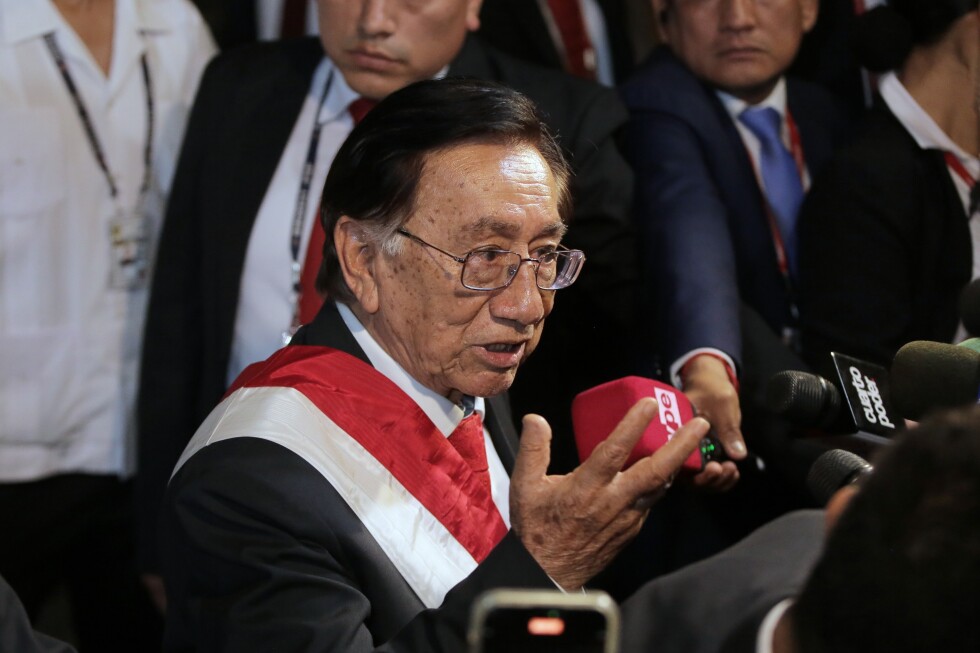
Balcázar, who took office in February as Peru’s eighth president in just a decade, justified the postponement by citing his temporary status. “For us to commit such a large sum of money to the incoming government would be a poor practice for a transitional government,” he said last week.
The decision prompted immediate diplomatic friction. U.S. Ambassador Bernie Navarro responded sharply on social media, warning that if Peru “negotiates in bad faith” or undermines U.S. interests, he would take unspecified measures at his disposal.
In his resignation letter obtained by The Associated Press, Díaz stated that delaying the purchase “could compromise” Peru’s national interests. Both ministers revealed at a news conference that they had unsuccessfully attempted to persuade Balcázar to honor the agreement.
Adding to the controversy, Díaz disclosed that despite Balcázar’s position, Defense Ministry officials had already signed the contract on Monday as required under the terms of the deal. Meanwhile, former Foreign Minister de Zela accused the interim president of misleading the public about the contract’s details.
The military procurement has been in development since earlier this year when then-President Dina Boluarte’s government announced plans to allocate $3.5 billion for the fighter jets through domestic borrowing—$2 billion in 2025 and $1.5 billion in 2026. Lockheed Martin faced competition from Sweden’s Saab and France’s Dassault Aviation in the bidding process.
Military analysts note that Peru has been working to modernize its aging air force fleet, much of which dates back to the Soviet era. The F-16 acquisition would represent the largest defense procurement for Peru in decades and significantly enhance its regional air capabilities.
The political fallout comes at a sensitive time for Peru, which continues to navigate vote counting from the first round of presidential elections held on April 12. The country is scheduled to hold a presidential runoff on June 7, with Balcázar’s successor inheriting this unresolved diplomatic and defense procurement issue.
Peru’s political instability has been a persistent challenge for international investors and defense contractors. Balcázar himself replaced another interim leader who was removed over corruption allegations just four months into his term, highlighting the country’s volatile governance situation.
Defense industry experts suggest the postponement could potentially reopen bidding discussions with European manufacturers Saab and Dassault, who might view this delay as an opportunity to re-engage with Peruvian officials about their competing offers.
The resignations signal deepening rifts within Peru’s caretaker government and raise questions about the country’s commitment to previously negotiated international agreements. The dispute also underscores the challenges facing Peru’s next elected leader, who will need to address both the diplomatic tension with the United States and the urgent need to modernize the nation’s military capabilities.
As vote counting continues and Peru prepares for its June runoff election, this high-stakes defense procurement controversy adds another layer of uncertainty to the country’s already complex political landscape.
Fact Checker
Verify the accuracy of this article using The Disinformation Commission analysis and real-time sources.

10 Comments
The $3.5 billion F-16 deal seems like a significant investment for Peru. I can understand the interim president’s hesitation to commit such a large sum during a transitional period. But the diplomatic fallout is concerning.
You’re right, major defense procurement decisions can be tricky for interim governments. Peru will need to carefully balance its interests and relations with the US as this plays out.
Interesting development in Peru’s defense procurement. Delays in major military acquisitions can often create tensions between partners. I wonder how this will impact Peru’s defense capabilities and relations with the US.
The resignation of the defense and foreign ministers suggests this is a complex issue with political implications. It will be important to see how the new government navigates this situation.
This highlights the challenges of military procurement, especially for countries undergoing political transitions. I’m curious to see if Peru can find a diplomatic solution that meets its defense needs while maintaining good ties with the US.
Agreed. Navigating these types of sensitive defense deals requires nuance and compromise on all sides. Hopefully cooler heads can prevail and a mutually acceptable path forward can be found.
The resignation of the defense and foreign ministers suggests deep divisions over this F-16 deal. Peru’s interim government will need to tread carefully to avoid further escalation with the US while also addressing its national security priorities.
Absolutely. This is a delicate balancing act, and Peru will need strong diplomatic skills to manage the competing interests at play. The outcome could have significant implications for the country’s defense posture and its relationships abroad.
This situation in Peru highlights the complexities of major defense procurement decisions, especially during periods of political uncertainty. Both sides will need to show flexibility and pragmatism to find a solution that works for Peru’s security needs and maintains its international partnerships.
Well said. These types of issues often require compromise and creative problem-solving. It will be interesting to see how Peru and the US navigate this challenge and whether they can find a mutually acceptable path forward.