


Listen to the article
Peruvians face a presidential runoff election after Sunday’s national vote failed to produce an outright winner among the 35 candidates, with electoral authorities still counting ballots three days after polling day.
With 77 percent of votes tallied by Tuesday afternoon, conservative Keiko Fujimori leads with 16.86 percent, followed by ultraconservative former Lima mayor Rafael López Aliaga at 12.66 percent. Jorge Nieto Montesinos remains within striking distance at 11.74 percent, still possessing a narrow chance to qualify for the June 7 runoff. A candidate needs more than 50 percent to win outright in the first round.
The sluggish vote count mirrors Peru’s 2021 presidential election, when final results weren’t determined until five days after polls closed. The winner of this election will become Peru’s ninth president in just a decade, highlighting the country’s ongoing political instability.
The election has been plagued by significant logistical challenges. Thousands of voters both within Peru and abroad were initially unable to cast ballots because materials weren’t delivered to polling stations on time. This prompted authorities to extend voting into Monday for over 52,000 Lima residents and Peruvians registered in Orlando, Florida, and Paterson, New Jersey.
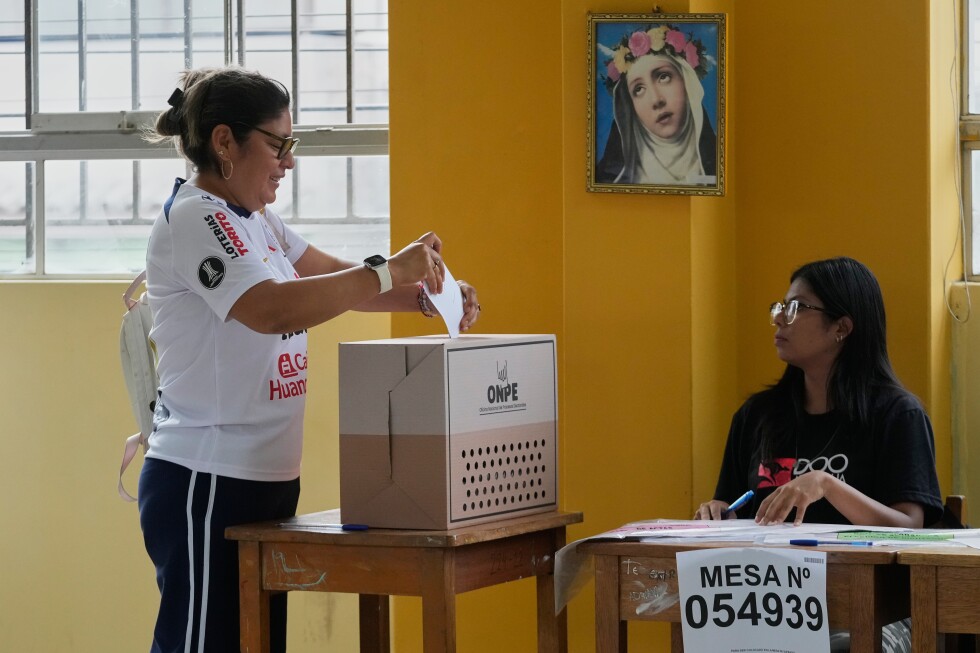
“I’m fed up,” said Iris Valle, 56, as she waited to vote Monday at a Lima school, concerned her employer would reduce her pay for arriving late while fulfilling her mandatory voting obligation. In Peru, voting is compulsory for citizens between 18 and 70 years old, with non-compliance resulting in fines up to $32.
López Aliaga has alleged election fraud, though without providing evidence to support his claims. In response, a European Union election observation mission stated Tuesday it saw no “sufficient grounds” supporting such allegations.
The election takes place against a backdrop of surging violent crime and widespread corruption that has fueled deep voter discontent. Most Peruvians view the candidates as dishonest and unprepared for the presidency, according to recent polls.
Despite political turmoil that has seen three presidents since October alone, Peru’s economy has shown remarkable resilience. As one of the world’s largest copper producers, the country has maintained economic growth above 3 percent in 2024 and projections for 2025 remain positive.
Will Freeman, a Latin American Studies fellow at the Council on Foreign Relations, credits part of this economic stability to the country’s central bank leadership. “Although Peru has had all these presidents, it has had only one central bank president since the mid-2000s, Julio Velarde,” Freeman explained. “He’s been a real source of stability and given investors some confidence that there is an institutional core that remains from one presidency to the next.”
However, Freeman cautions that Peru cannot afford complacency. Current growth rates are lower than the robust 5-6 percent annual expansion the country enjoyed during the 2000s. Additionally, recent congressional decisions suggest a shift toward “a more conservative economic populism” that could affect future growth.
Fujimori, daughter of disgraced former president Alberto Fujimori, is making her fourth bid for the presidency. She has campaigned on promises to crack down on crime while defending controversial laws that experts claim make criminal prosecution more difficult. These laws, backed by her party in recent years, eliminated preliminary detention in certain cases and raised thresholds for seizing criminal assets. If elected, she plans to implement anonymous judges for criminal cases and require prisoners to work for their food.
López Aliaga’s platform includes proposals to build prisons in Peru’s Amazon region, support measures allowing judges to conceal their identities, and expel undocumented foreigners.
This election also marks a significant shift in Peru’s legislative structure. For the first time in over 30 years, voters selected members of a bicameral Congress following recent reforms that concentrate substantial power in the new upper chamber.
The outcome of this election will be pivotal for Peru’s governance amid ongoing challenges of crime, corruption, and economic uncertainty. While the country has demonstrated remarkable economic resilience despite political instability, the next president will face considerable pressure to address deep-rooted institutional problems while maintaining the growth that has characterized Peru’s economy in recent decades.
Fact Checker
Verify the accuracy of this article using The Disinformation Commission analysis and real-time sources.

10 Comments
With 35 candidates, this election is clearly fragmented. The runoff will be pivotal in determining Peru’s next direction on key issues like mining, energy, and the environment. Voters will have a stark choice between the conservative and ultraconservative candidates.
It’s concerning to see Peru’s political instability continue, with nine presidents in just a decade. Whichever candidate prevails in the runoff, they’ll need to prioritize restoring faith in the country’s democratic institutions.
This election comes at a critical time for Peru’s mining and energy sectors, which are vital to the country’s economy. Voters will be looking for a steady hand to guide these industries through the challenges ahead.
Agreed, the new president’s approach to the mining and energy industries will be pivotal. Maintaining an attractive investment climate while addressing social and environmental concerns will be a delicate balancing act.
Peru’s mining industry is a major driver of its economy, so the new president’s policies on the sector will be closely watched. Balancing economic growth, environmental protection, and community relations will be a key challenge.
Absolutely, Peru’s mining future is at stake in this election. The candidates’ stances on issues like permitting, taxation, and indigenous rights will be crucial.
The extended voting due to logistical challenges is concerning. Reliable electoral processes are essential for Peru’s democratic institutions and economic future. I hope the runoff can be conducted smoothly.
Yes, the vote count delays raise red flags. Transparent and efficient elections are critical, especially for a resource-dependent economy like Peru’s.
Interesting to see Peru’s political landscape remain so volatile. This runoff election will be closely watched, given the country’s recent history of presidential turmoil. I’m curious to see how the final candidates position themselves on key mining and energy issues.
Agreed, Peru’s political stability is crucial for its vital mining sector. The new president will need to balance economic development with environmental and social concerns.