


Listen to the article
In Stephen King’s 1982 novel “The Running Man,” the author envisioned a dystopian America set in the year 2025 – a society divided between haves and have-nots, with pervasive surveillance and realistic video propaganda. Now, as we actually find ourselves in 2025, Edgar Wright’s new adaptation of King’s work arrives at an awkward moment in cultural history.
The timing presents a peculiar challenge: many of the dystopian elements that seemed far-fetched four decades ago are increasingly commonplace today. This unavoidable reality leaves Wright’s film feeling somewhat behind the curve despite its energetic action sequences.
“The Running Man” already spawned one cinematic adaptation in 1987, starring Arnold Schwarzenegger as Ben Richards, a desperate father who enters a lethal reality show with the promise of a billion-dollar payout for surviving 30 days. That version was set in 2017, another dystopian vision that time has overtaken.
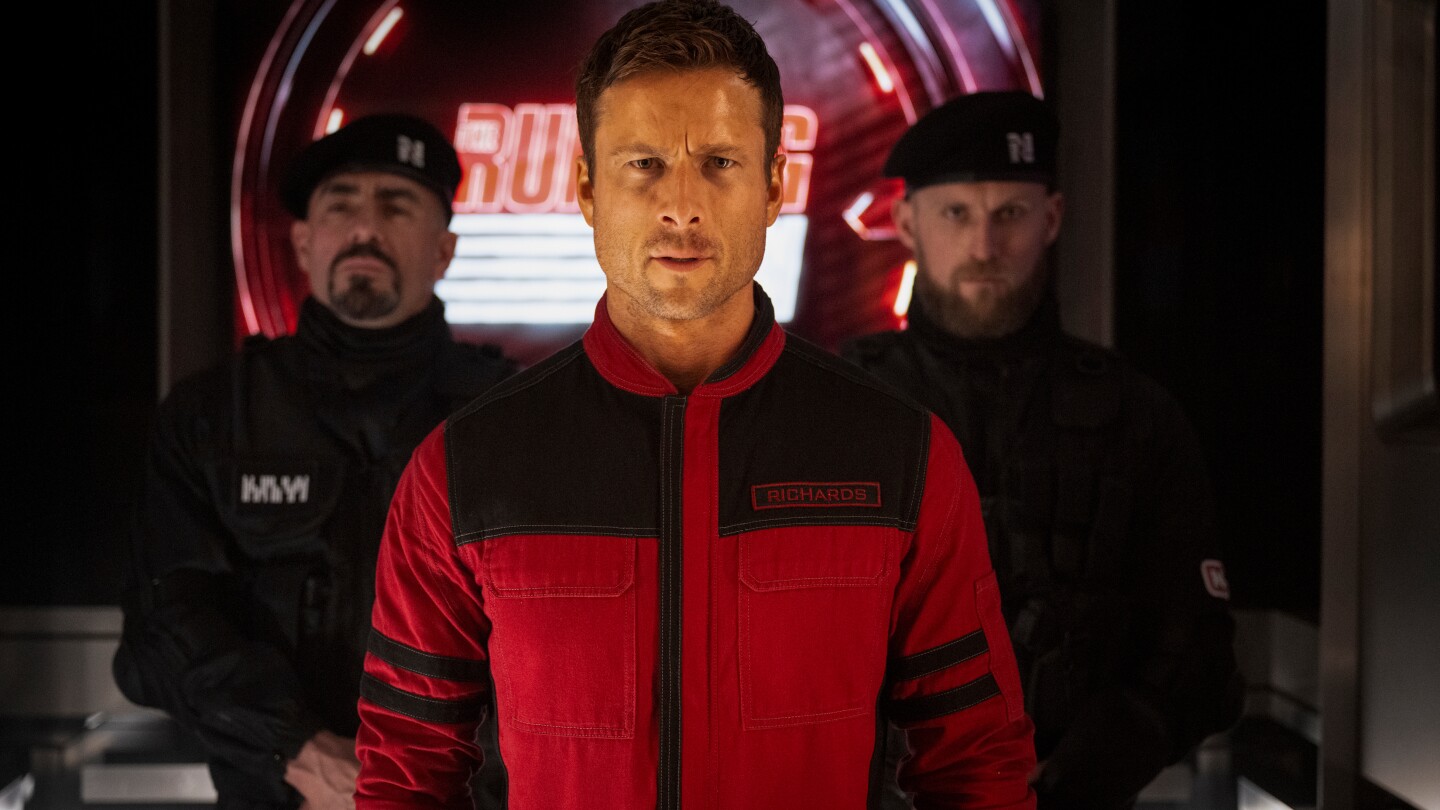
Wright’s remake casts Glen Powell as Richards, bringing significantly more charisma and polish to the role. Powell’s casting represents just one aspect of the film’s generally lighter approach compared to both King’s novel and the 1987 film. Wright, known for his playful genre subversion in films like “Shaun of the Dead,” steers away from the brutal nihilism of the Schwarzenegger version in favor of satirical commentary that unfortunately lacks genuine bite.
The new film introduces Richards as a young man running out of employment options. After being repeatedly labeled as insubordinate and showing too much interest in union representation for radiation-exposed colleagues, he faces a difficult choice. With a sick baby at home and his wife (Jayme Lawson) considering work at a dangerous nightclub, Richards reluctantly auditions for the Network, an all-powerful, government-controlled media conglomerate.
Though he initially rejects participation in “The Running Man,” his particular combination of rage and sarcasm makes him an ideal candidate for the show. The Network head, Dan Killian (played with slick menace by Josh Brolin), offers him the role. Brolin excels as the duplicitous executive, adding another memorable authority figure to his gallery of villains, from the studio fixer in “Hail, Caesar!” to the police officer in “Inherent Vice” and the cosmic villain Thanos in “Avengers: Endgame.”
Even more captivating is Colman Domingo as Bobby Thompson, the show’s flamboyant host. Domingo brings grand showmanship to the role, though some of his thunder has inevitably been stolen by similar characters in productions like “The Hunger Games” (Stanley Tucci’s Caesar Flickerman comes to mind).
The game’s premise remains familiar: contestants are released into the world with a head start before armed hunters pursue them. Anyone who recognizes a contestant can turn them in for a reward. The hunters are led by the masked Evan McCone (Lee Pace in an unfortunately underutilized role), while drone cameras capture the action for live broadcast.
The resulting chase – stretching from New York to Boston to Maine – initially offers entertaining cat-and-mouse dynamics and features some enjoyable cameos. Michael Cera appears as what could be described as an adult Kevin McCallister, if the “Home Alone” character had grown up to become a paranoid anarchist with the same fondness for booby traps.
Despite maintaining forward momentum, the film struggles because Powell’s Richards isn’t compelling enough to carry the narrative. Powell has previously shined in looser films like Richard Linklater’s “Everybody Wants Some!!” and “Hit Man,” but here the character lacks sufficient depth.
Wright, who co-wrote the script with Michael Bacall, has recently gravitated toward darker stories and larger scales, with varying degrees of success. While he has long demonstrated skill at genre hybridization, “The Running Man” never successfully balances comic elements with weightier themes of inequality and anti-authoritarianism. These concepts feel hollow in what amounts to a big-budget reboot that avoids King’s bleakest plot developments.
The film’s most relevant aspect may be its media commentary. Rather than focusing on the Network itself (which feels trapped in an outdated paradigm where mass audiences simultaneously watch the same programming), the film explores AI-adjacent concerns. As Richards’ survival extends into weeks, Killian employs increasingly sophisticated digital manipulation to portray him as a villain to the public. This raises a pertinent question when Richards asks: if the Network can digitally make him do or say anything, why does it need human contestants at all? Killian’s simple answer – that real humans generate better ratings – offers one of the film’s few genuinely thought-provoking moments about our current media landscape.
Unfortunately, this insight isn’t enough to make “The Running Man” the act of creative resistance it aspires to be. Like many dystopian visions, it finds itself outpaced by the very reality it meant to warn against.
Fact Checker
Verify the accuracy of this article using The Disinformation Commission analysis and real-time sources.

11 Comments
Interesting take on the dystopian themes in “The Running Man.” It’s fascinating how fiction can sometimes foreshadow real-world developments, even if the timing is off. I wonder how the new adaptation will tackle the contemporary parallels.
Interesting to see how the mining and commodities sectors could factor into the themes and social commentary of this new “Running Man” adaptation. Those industries often grapple with complex issues of power, inequality, and the role of technology.
While the original novel and 1987 film may have felt more cutting-edge, I’m curious to see how the new version will update the story for modern audiences. The casting of Glen Powell sounds like a good choice to bring more charisma to the lead role.
Ah, the classic tale of “The Running Man” getting another adaptation. I’m always intrigued by how these types of stories evolve over time to reflect the changing societal landscape. Curious to see if this new version can offer a fresh perspective.
The juxtaposition of a dystopian future with the current reality sounds quite thought-provoking. I wonder if the filmmakers will lean into the unsettling nature of how some of those elements have become all too familiar. Could make for a fascinating viewing experience.
The fact that the original dystopian vision has become increasingly commonplace is a bit unsettling. I wonder if the new film will lean into that discomfort or try to maintain more of an escapist tone. Either way, it seems like a timely exploration of these themes.
I’m a fan of Edgar Wright’s work, so I’ll be interested to see his take on this classic sci-fi story. The shift in tone from the prior adaptations could make for a refreshing perspective, though I hope they still capture the core themes and social commentary.
Agreed, Wright’s unique style could breathe new life into the material. It will be intriguing to see how he balances the action and social commentary.
With the mining and energy sectors grappling with their own challenges around inequality and technological disruption, I’m curious to see if the filmmakers draw any parallels. Could be an interesting layer to explore alongside the main narrative.
The mining and commodities sectors often grapple with similar themes of haves vs. have-nots and the role of technology/surveillance. I’m curious if the film will draw any parallels there. Regardless, it sounds like an entertaining watch, even if the dystopian elements feel a bit too real these days.
While the original material may have felt more speculative, it’s telling that the new adaptation arrives at a time when many of those dystopian elements have come to pass. I’m curious to see how the filmmakers approach that shift in context.