


Listen to the article
Global Markets Rally as Tech Stocks Rebound from AI Concerns
Global stock markets advanced Wednesday, with European and most Asian indices posting gains following the Dow Jones Industrial Average’s climb to a fresh record. Technology shares showed signs of recovery after last week’s downturn, which was triggered by concerns about the future of artificial intelligence investments.
In European trading, France’s CAC 40 rose 0.5% to 8,193.98, while Germany’s DAX surged nearly 1.1% to 24,357.28. Britain’s FTSE 100 edged up 0.1% to 9,906.82. Futures for U.S. markets indicated a positive opening, with S&P 500 futures up 0.4% and Dow Jones Industrial Average futures gaining 0.2%.
Asian markets largely followed the positive trend. Japan’s benchmark Nikkei 225 added 0.4% to finish at 51,063.31, though SoftBank Group’s shares fell 3.5% after the company announced it had sold its entire stake in AI chip company Nvidia for $5.83 billion last month to raise funds for other investments. SoftBank’s shares had dropped as much as 9% earlier in the day.
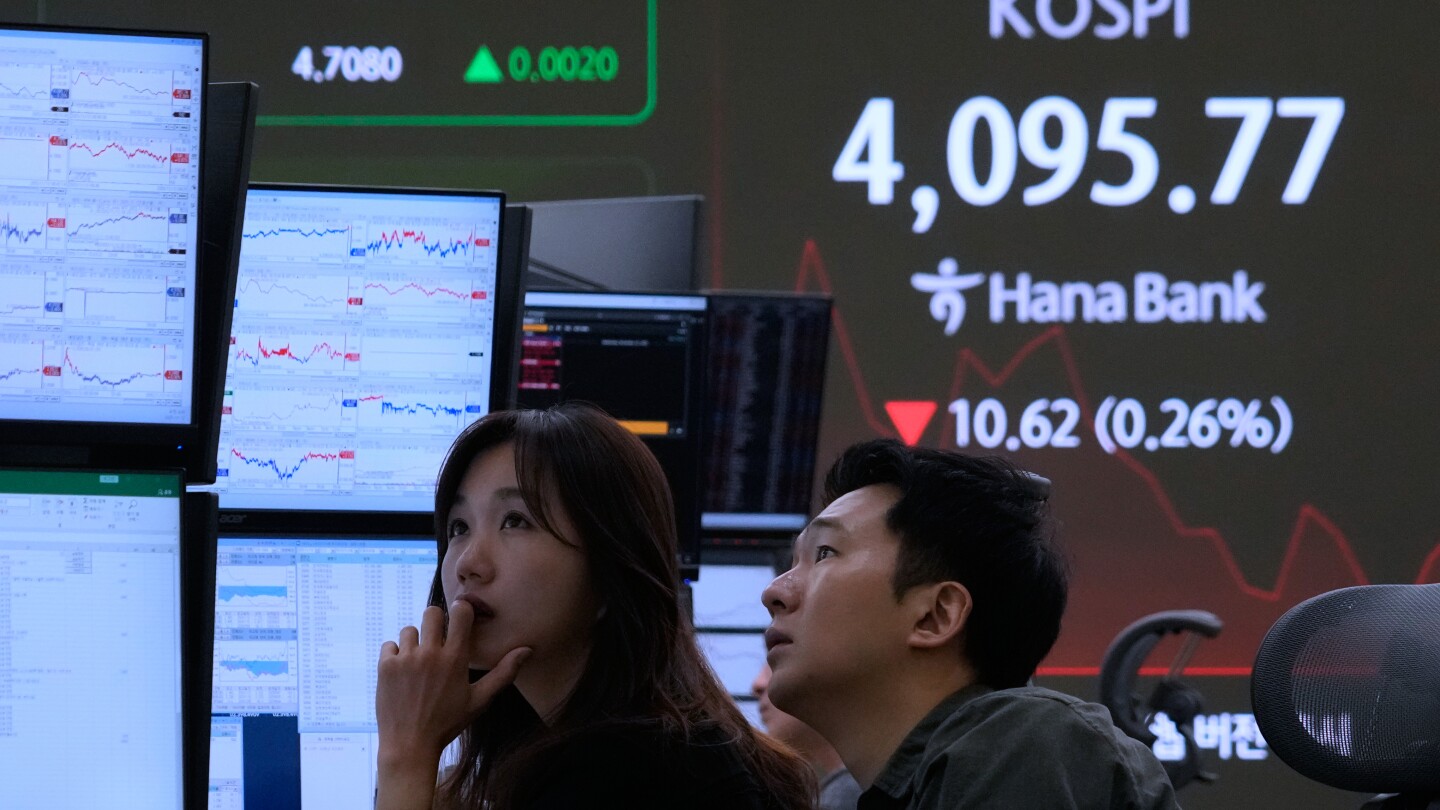
Hong Kong’s Hang Seng rose 0.9% to 26,922.73, while the Shanghai Composite edged down marginally to 4,000.14. South Korea’s Kospi added a robust 1.1% to 4,150.39, while Australia’s S&P/ASX 200 bucked the trend, shedding 0.2% to 8,799.50.
The market recovery comes amid ongoing debate about the sustainability of AI-related stock valuations. The AI investment craze has been a primary driver of U.S. market records despite underlying economic concerns, including a slowing job market and persistent inflation. Critics have increasingly drawn parallels between current tech valuations and the dot-com bubble of 2000, which ultimately collapsed and dragged the S&P 500 down by nearly 50%.
On Tuesday, the S&P 500 added 0.2%, continuing Monday’s strong rebound after its first weekly loss in four weeks. The Dow Jones Industrial Average surged 1.2% to a record close of 47,927.96, surpassing its previous all-time high set two weeks ago.
The tech-heavy Nasdaq composite underperformed relative to other indices as Nvidia, a bellwether for AI stocks, slipped 3%. This decline reflects persistent investor concerns that stocks caught up in the artificial intelligence frenzy may have become overvalued after their meteoric rise.
Adding to market uncertainty is the ongoing U.S. government shutdown, which has delayed important economic data releases on employment and other critical indicators. This information gap complicates the Federal Reserve’s decision-making process regarding interest rates. Although the Senate has made moves to end what has become the longest shutdown in U.S. history, a resolution is not yet assured.
In commodities markets, benchmark U.S. crude declined 34 cents to $60.70 a barrel, while Brent crude, the international standard, lost 31 cents to $64.85 a barrel. Currency markets saw the U.S. dollar strengthen slightly to 154.76 Japanese yen from 154.16 yen, while the euro edged down to $1.1579 from $1.1583.
The current market dynamics represent a delicate balance between enthusiasm for technological innovation and concerns about sustainability. As global markets navigate this uncertainty, investors remain watchful for signs that could indicate whether the AI boom will continue driving market growth or whether a correction similar to previous tech bubbles might be on the horizon.
Fact Checker
Verify the accuracy of this article using The Disinformation Commission analysis and real-time sources.

14 Comments
The resiliency of the mining and commodities sectors will be critical in the months ahead. With global economic uncertainties, these industries could provide a stabilizing influence.
That’s a fair assessment. Commodities have historically served as a hedge against inflation and market volatility, so their performance could be a key factor in the overall market outlook.
Interesting to see the global markets bouncing back after the recent AI-related tech stock slump. Curious to see how the mining and commodities sectors respond to this broader market rebound.
Yes, the mining and commodities space will be an important bellwether. Investors will be watching closely for signs of renewed demand and price strength in key minerals and metals.
SoftBank’s decision to sell its Nvidia stake is an interesting move. I wonder if this signals a broader pullback from AI investments or simply a reallocation of capital to other opportunities.
Good point. SoftBank’s move could be a sign of caution, or it could simply be part of their broader portfolio management strategy. It will be worth watching for similar actions by other major investors in the AI space.
While the tech sector’s rebound is positive, I’m more interested in seeing how the energy and materials companies fare. These industries are closely tied to the broader economic cycle.
Agreed. The energy and materials sectors will be a crucial barometer of the global economic climate. Their performance could have far-reaching implications for the markets as a whole.
The recovery in tech stocks is a positive sign, but I remain cautious about the long-term outlook for AI investments. Prudent risk management is key in this volatile environment.
I agree. While AI is transformative, the hype and speculation around it needs to be balanced with realistic assessments of the technology’s capabilities and limitations.
The Dow hitting a fresh record is encouraging, but I’m more interested in seeing how the broader commodities complex fares. Miners, energy producers, and related equities will be the ones to watch.
Absolutely. Commodity markets tend to be a leading indicator, so their performance could provide valuable insights into the overall health of the global economy.
The mining and commodities space is always fascinating to follow. With the ongoing geopolitical tensions and supply chain disruptions, I’ll be closely watching for any shifts in pricing and production trends.
Absolutely. The geopolitical landscape and supply chain dynamics will be critical factors in determining the trajectory of the mining and commodities sectors in the months ahead.