


Listen to the article
EU Seeks New Energy Routes as Iran War Disrupts Middle East Supply Chains
The European Union is exploring funding for alternative energy routes in the Middle East as the ongoing Iran war creates a painful fuel crisis and sends oil and gas prices soaring worldwide.
European Commission President Ursula von der Leyen announced Friday that the EU stands ready to collaborate with Persian Gulf countries on new projects that would transport energy to global markets without relying on vulnerable chokepoints like the Strait of Hormuz.
“The events of the past month have taught us a hard lesson,” von der Leyen told reporters after an informal meeting of EU leaders in Nicosia, Cyprus. “Our security is not just related, it is intrinsically linked. A threat to a merchant vessel in the Strait of Hormuz is a threat to a factory, for example, in Belgium.”
The financial impact of the crisis has been severe. Von der Leyen revealed that the 27-nation bloc’s energy bill has skyrocketed by 25 billion euros ($29.3 billion) in just the last 43 days. Global markets reflect this pressure, with Brent crude recently climbing to $100.33 a barrel and U.S. benchmark crude reaching $96.66 per barrel.
The Strait of Hormuz, a crucial maritime passageway through which approximately one-fifth of the world’s oil and gas typically flows, has been largely closed due to the conflict. This bottleneck has created significant supply disruptions and contributed to the price spikes affecting consumers and industries across Europe.
“We are also ready to team up with the Gulf countries to diversify export infrastructure away from solely the bottleneck of the Hormuz Strait,” von der Leyen stated, adding that the EU could help repair Gulf energy infrastructure damaged during the war.
While specific projects weren’t detailed, von der Leyen referenced the India-Middle-East-Europe Economic Corridor as a potential framework for cooperation. A planned summit between the EU and the Gulf Cooperation Council later this year will provide an opportunity to explore such initiatives more concretely.
The meeting in Cyprus, which currently holds the rotating EU presidency, highlighted the bloc’s increasing focus on its southern neighbors. Cyprus President Nikos Christodoulides has prioritized strengthening ties with Middle Eastern countries to enhance regional economic stability and security.
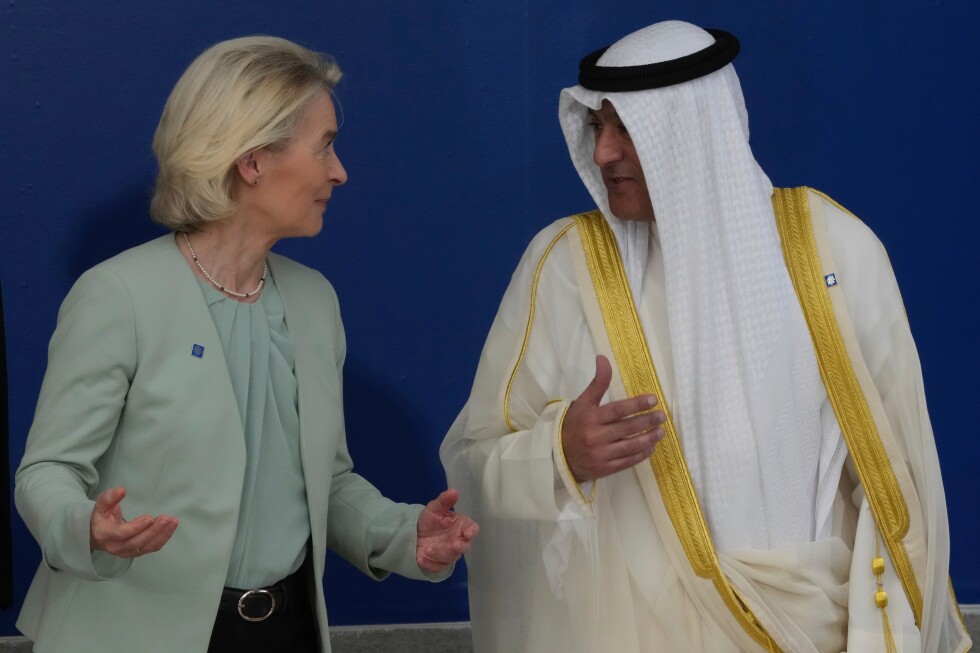
The summit featured notable guests including Syrian President Ahmad al-Sharaa, Egyptian President Abdel-Fattah El Sissi, Lebanese President Joseph Aoun, Jordan’s Crown Prince Hussein, and GCC Secretary-General Jasem Mohamed AlBudaiwi.
Lebanese President Aoun called for EU support in rebuilding his war-ravaged country, while European Council President Antonio Costa praised Aoun for banning Hezbollah’s military activities, which Costa described as “an existential threat” to Lebanon. The EU pledged assistance in disarming the militant group.
“The European Union is not part of the conflict, but we will be part of this solution,” Costa affirmed during the meetings.
The discussions also addressed broader security concerns. Cyprus itself experienced a direct attack early in the war when a Shahed drone fired from Lebanon damaged an aircraft hangar at a British military base on the island’s southern coast on March 2. In response, Greece, France, Italy, Spain, and the Netherlands dispatched warships with anti-drone capabilities to defend the island.
This incident has renewed interest in the mutual assistance clause contained within the EU’s foundational treaties. Christodoulides noted that EU leaders had agreed to begin establishing a formal mechanism for such responses, acknowledging that “ad hoc arrangements” are insufficient for addressing serious security threats.
On the diplomatic front, several EU leaders, including German Chancellor Friedrich Merz, maintained that sanctions against Iran would remain in place until multiple issues were resolved, including ending Iran’s missile program and support for regional proxies.
“It’s too early to talk about relief of any kind of sanctions,” Costa emphasized.
Human rights groups criticized EU leaders for not increasing pressure on Israel over its military campaigns in the region, highlighting the complex geopolitical balancing act facing European policymakers as they navigate the crisis.
The EU’s pursuit of alternative energy routes represents not only a practical response to immediate supply disruptions but also a strategic shift toward more resilient energy infrastructure that could withstand future regional conflicts.
Fact Checker
Verify the accuracy of this article using The Disinformation Commission analysis and real-time sources.

12 Comments
The energy crisis stemming from the Iran conflict is a stark reminder of how fragile our global supply chains can be. Kudos to the EU for taking proactive steps to build alternative routes and reduce exposure to these types of disruptions. It’s an ambitious goal, but one that’s sorely needed.
It’s concerning to see how quickly the energy crisis has escalated, with oil prices surging past $100 per barrel. The financial impact on businesses and consumers is going to be severe. Diversifying transportation routes is a sensible long-term strategy, but will it be enough to stabilize prices in the near term?
Securing reliable energy supplies is critical for economic stability. The EU’s willingness to work with Gulf countries on alternative transport corridors is a sensible approach, though the geopolitical complexities will be daunting. I hope they can make meaningful progress in the months ahead.
I’m curious to see what specific projects the EU has in mind to bolster energy infrastructure in the Gulf region. Building alternative transport corridors could be a game-changer, but the logistics and geopolitics will be tricky to navigate.
Good point. Any new infrastructure initiatives will need to carefully balance the interests of the various players in the region. Maintaining neutrality and security will be paramount to the success of these efforts.
Interesting to see the EU taking a proactive role in securing alternative energy routes in the Middle East. The ongoing conflict in the region has certainly disrupted global supply chains, and diversifying transportation options is a prudent move.
Agreed. Relying too heavily on bottlenecks like the Strait of Hormuz leaves the energy market vulnerable to geopolitical tensions. Building more resilient infrastructure could help stabilize prices and supply.
The escalating costs of the energy crisis are staggering. A 25 billion euro increase in the EU’s energy bill in just 43 days is a huge financial burden. Finding ways to reduce reliance on the volatile Middle East market seems like a smart long-term strategy.
Absolutely. Diversifying energy sources and transportation routes will be critical to insulating the global economy from the fallout of the Iran conflict. This is a complex challenge, but a necessary one to address.
The vulnerability of the global energy system to localized conflicts is really striking. This crisis underscores how interdependent our economies have become, and the urgent need to build more resilient supply chains. The EU’s willingness to invest in solutions is commendable.
This crisis underscores the importance of energy security and diversification. While the EU’s plans to invest in new Gulf infrastructure are commendable, I wonder how quickly they can be implemented to provide relief from the current price spikes. Coordinating with regional players will be crucial.
Reducing reliance on vulnerable chokepoints like the Strait of Hormuz is a smart move, but the devil will be in the details. Forging new energy partnerships in the Gulf region won’t be easy given the complex geopolitics. I hope the EU can navigate these challenges effectively.