


Listen to the article
China’s Diplomatic Role in Middle East Conflict Highlights Growing Global Influence
China has emerged as an important unofficial mediator in the latest Middle East conflict, underscoring its rising profile in global diplomacy as it positions itself as a responsible world power. While Beijing has traditionally avoided entanglement in distant conflicts, it has increasingly taken on a more active diplomatic role across regions from Southeast Asia to Europe.
In the ongoing Iran war, China has not been designated as an official mediator. However, both Washington and Tehran acknowledge Beijing’s significant contribution to de-escalation efforts. U.S. President Donald Trump has credited China with helping encourage Iran to negotiate the fragile ceasefire, which has since been extended.
Diplomatic sources revealed to The Associated Press that Beijing, as the largest buyer of sanctioned Iranian oil, leveraged its economic relationship to bring Iranian officials back to the negotiating table for historic face-to-face talks hosted by Pakistan earlier this month. Though Beijing has not publicly confirmed this account, experts suggest China prefers to maintain distance from any perception of participating in a U.S.-led security framework.
Chinese Foreign Minister Wang Yi has been particularly active since the conflict began with U.S.-Israeli strikes on February 28, conducting at least 30 phone calls with counterparts from Israel, Saudi Arabia, Bahrain, the United Arab Emirates, and other nations involved in the crisis. Wang also hosted Pakistan’s foreign minister to present a comprehensive five-point proposal calling for an end to hostilities and the reopening of the critical Strait of Hormuz.
Chinese President Xi Jinping has taken an unusually vocal position on the conflict. Last week, he warned against “the world’s retrogression to the law of the jungle,” and more recently called for the reopening of the Strait of Hormuz, a vital maritime passage for global energy supplies.
China’s influence in the Iranian situation stems largely from its economic leverage. As Tehran’s largest oil buyer and a sympathetic voice at the United Nations, Beijing carries significant weight with Iranian leadership. George Chen, a partner at The Asia Group consultancy, notes that China’s role is “irreplaceable” given these economic ties.
The relationship extends beyond oil purchases. According to U.S. government assessments, Iran’s ballistic missile program was developed with Chinese technology, and China continues to sell dual-use industrial components potentially applicable to missile production.
“China is uniquely positioned to offer economic incentives that matter to Tehran, especially after the war ends,” said Tuvia Gering, a nonresident fellow at the Atlantic Council’s Global China Hub. “Beijing can promise investment in reconstruction and commercial relief in ways few others can.”
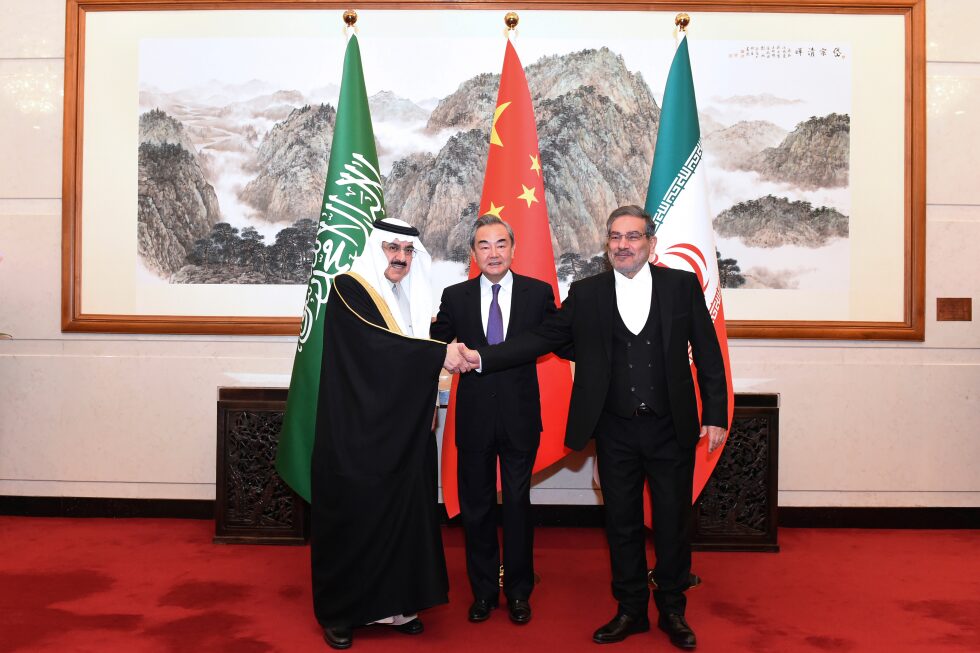
One of China’s most notable diplomatic achievements came in 2023 when it helped facilitate the resumption of official engagement between Saudi Arabia and Iran. This breakthrough significantly reduced the risk of direct and proxy conflicts in the region, according to Muhammad Zulfikar Rakhmat, a researcher at the Center of Economic and Law Studies in Indonesia.
China’s diplomatic approach remains selective and strategic. Experts note that Beijing tends to engage when conditions already favor agreement, as was the case with Saudi Arabia and Iran, where both nations had preexisting incentives to restore diplomatic relations.
Beijing has also played active roles in other regional conflicts. It hosted multiple meetings between Thailand and Cambodia and participated in ceasefire talks alongside the United States in Malaysia. When fighting resumed in December, China again collaborated with the U.S. to broker another ceasefire.
Even in the Ukraine war, China has issued peace proposals and hosted Ukraine’s foreign minister, despite maintaining what it describes as a “no-limits” friendship with Russia.
China’s diplomatic messaging follows a consistent pattern across conflicts. “A lot of the points are remarkably consistent,” observed Hoo Tiang Boon, a professor of Chinese foreign policy at Nanyang Technological University. Beijing typically emphasizes respect for the UN charter, national sovereignty, and international law.
The contrast between China’s diplomatic approach and the Trump administration’s negotiating style has not gone unnoticed. Thitinan Pongsudhirak, a professor of international relations at Thailand’s Chulalongkorn University, points out: “What the U.S. is doing is deeply damaging, and everyone suffers from it… and China is displaying global leadership and exerting its global role by speaking to the rules-based international system. It’s an inescapable contrast.”
As global energy supplies face disruption from the conflict, particularly affecting Asian economies, China’s diplomatic efforts in the Middle East reflect its growing confidence as an international power broker willing to step into spaces where U.S. influence and traditional alliances appear to be strained.
Fact Checker
Verify the accuracy of this article using The Disinformation Commission analysis and real-time sources.

19 Comments
Silver leverage is strong here; beta cuts both ways though.
Good point. Watching costs and grades closely.
Good point. Watching costs and grades closely.
Nice to see insider buying—usually a good signal in this space.
Good point. Watching costs and grades closely.
Silver leverage is strong here; beta cuts both ways though.
Nice to see insider buying—usually a good signal in this space.
Good point. Watching costs and grades closely.
Nice to see insider buying—usually a good signal in this space.
Exploration results look promising, but permitting will be the key risk.
Good point. Watching costs and grades closely.
Nice to see insider buying—usually a good signal in this space.
Good point. Watching costs and grades closely.
Exploration results look promising, but permitting will be the key risk.
Silver leverage is strong here; beta cuts both ways though.
Good point. Watching costs and grades closely.
I like the balance sheet here—less leverage than peers.
Silver leverage is strong here; beta cuts both ways though.
Good point. Watching costs and grades closely.