


Listen to the article
Oil Pipeline Reopens in California Amid Federal-State Clash Over Environmental Concerns
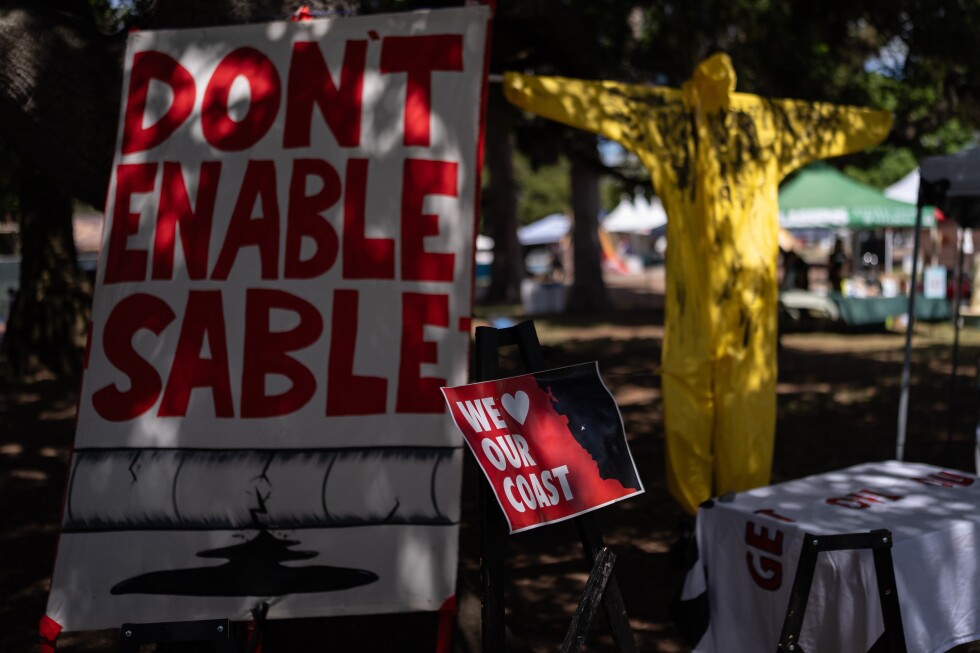
Crude oil is flowing again through a controversial pipeline crossing California state park land for the first time in over a decade, following a Trump administration order that has sparked a heated legal battle with state officials.
The federal government directed Texas-based Sable Offshore Corp. to restart drilling operations off Santa Barbara’s coast, citing national security concerns related to the ongoing Iran war. Energy Secretary Chris Wright invoked the Defense Production Act on March 13, ordering the company to resume production despite multiple state legal challenges and environmental concerns.
California officials have labeled the operation illegal trespassing and are asking a federal judge in Los Angeles to halt the pipeline’s use and order its removal from Gaviota State Park. The hearing on this request is scheduled for Monday.
“We’ve never seen an oil company operate so openly outside of the law,” said Alex Katz of the Environmental Defense Center, a Santa Barbara advocacy group originally formed in response to the catastrophic 1969 oil spill that helped launch the modern environmental movement.
The pipeline at the center of the dispute has been idle since 2015, when a rupture caused one of California’s worst oil spills, blackening beaches along a 150-mile stretch from Santa Barbara to Los Angeles. That disaster devastated local ecosystems, killing scores of pelicans, seals, and dolphins while severely damaging the region’s fishing industry.
The federal government contends that restarting domestic oil production is critical for reducing dependence on foreign oil, particularly given tensions in the Middle East. Energy Secretary Wright emphasized that over 60% of California’s refined oil comes from overseas, with a significant portion traveling through the Strait of Hormuz, where Iranian forces have disrupted shipping.
“More than 60% of the oil refined in California comes from overseas, with a significant share traveling through the Strait of Hormuz — presenting serious national security threats,” Wright stated when issuing the order.
The Department of Energy claims Sable’s operation will boost California’s in-state oil production by 15%, replacing nearly 1.5 million barrels of imported crude monthly. Sable Chairman and CEO Jim Flores announced on April 20 that the pipeline had already produced more than 1 million barrels of oil since restarting operations.
“We are working tirelessly to provide American oil from American soil to consumers in California and the U.S. military,” Flores stated.
Energy policy experts question these claims. Paasha Mahdavi, an associate professor at the University of California, Santa Barbara, points out that the crude extracted by Sable is heavy and costly to refine. He adds that the estimated production of 50,000 barrels daily represents a minimal fraction of global supply and will have no meaningful impact on domestic gas prices.
California Attorney General Rob Bonta dismissed the national security justification, stating, “The U.S. already produces significantly more oil and gas than we use — it’s a completely fabricated claim intended to curry favor with the oil industry.”
The legal battle hinges on both property rights and questions of federal authority. California officials maintain that Sable’s permission to use the pipeline on state land expired in 2016, making current operations unauthorized. Earlier this month, Santa Barbara County Superior Court Judge Donna Geck maintained an injunction she imposed last year following the California Coastal Commission’s record $18 million fine against Sable for ignoring cease-and-desist orders.
Sable contends that Wright’s federal order supersedes state authority. The company is seeking hundreds of millions in damages and pursuing legal action “to curb state and county regulatory overreach.” Meanwhile, the U.S. Department of Justice is asking the court to modify or terminate a binding federal court decree signed after the 2015 spill that gave California final approval authority over restarting operations.
Legal experts suggest this case represents an unprecedented expansion of Cold War-era emergency powers. Deborah Sivas, a Stanford Law School professor, notes the dispute centers on property rights and federal overreach — “It’s not out in the ocean, in federal waters. This is actually on state property. We have a say on that — you can’t just override that.”
The Defense Production Act, signed by President Harry S. Truman during the Korean War, grants the president broad authority to mobilize resources during crises. While previous administrations have used these powers during energy emergencies, critics argue this application against state regulations marks a significant and concerning expansion.
As litigation continues, the case highlights escalating tensions between federal and state authorities over environmental protection and energy development priorities, with profound implications for coastal communities and the future of offshore drilling along U.S. shores.
Fact Checker
Verify the accuracy of this article using The Disinformation Commission analysis and real-time sources.

10 Comments
I’m glad to see California taking legal action to challenge this pipeline operation. Protecting state lands and the environment should be a top priority, even in the face of federal directives.
You make a good point. State sovereignty and environmental stewardship are important principles that shouldn’t be overridden without strong justification.
It’s concerning to hear about this dispute over the pipeline on state land. I hope the courts can find a solution that protects the environment while also considering national security needs.
The federal government invoking national security to restart this pipeline is troubling. California has valid environmental concerns that shouldn’t be brushed aside. I hope a fair compromise can be reached.
Agreed. It’s important to find a balance between meeting energy needs and protecting sensitive ecosystems. This case highlights the ongoing tensions between states and the federal government on such issues.
This is a concerning situation. I hope the courts can resolve the dispute between California and the federal government over this pipeline. Environmental protection needs to be balanced with energy security concerns.
You raise a good point. This seems like a complex issue without an easy solution. I’m curious to see how it plays out in the courts.
The federal government’s invocation of the Defense Production Act to restart this pipeline is worrying. I hope the courts carefully weigh the environmental and energy security concerns at play.
Agreed. It’s a delicate balance, and I’m curious to see if a reasonable compromise can be reached that addresses both sets of priorities.
This seems like a complicated situation with valid arguments on both sides. I’ll be following this case closely to see how the courts rule on the pipeline’s future use.