


Listen to the article
President Trump Approves “Keystone Light” Oil Pipeline, Reversing Biden-Era Energy Policy
President Donald Trump has granted a crucial approval for a major new oil pipeline that would transport Canadian crude oil through Montana and Wyoming. The Bridger Pipeline Expansion, informally dubbed “Keystone Light,” received presidential authorization Thursday to cross the U.S.-Canada border in northeastern Montana.
The three-foot-wide pipeline would carry up to 550,000 barrels of oil daily from Saskatchewan, connecting to existing pipeline infrastructure in the U.S. At full capacity, the 650-mile pipeline would transport roughly two-thirds the volume of the controversial Keystone XL pipeline, which President Joe Biden canceled on his first day in office in 2021.
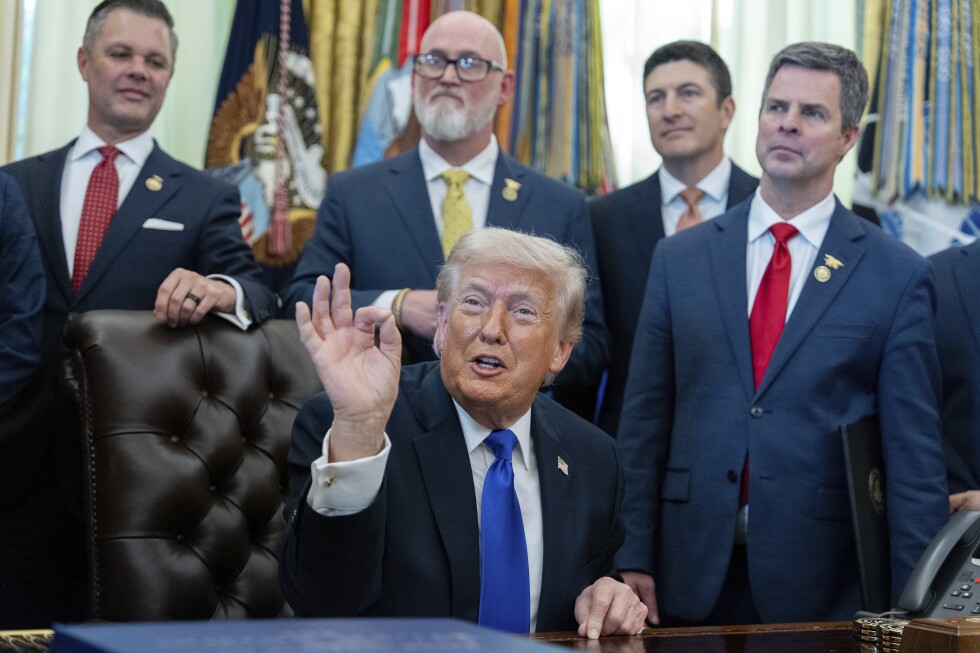
“Slightly different from the last administration. They wouldn’t sign a pipeline deal. And we have pipelines going up,” Trump remarked after signing the border-crossing permit.
The approval marks a significant contrast in energy policies between the two administrations. When Trump first approved Keystone XL in 2020, the decision was celebrated by Canadian officials and the oil industry but drew criticism from environmental groups and Native American tribes concerned about potential spills and climate impacts. Biden’s subsequent cancellation frustrated Canadian leaders, particularly after Alberta had invested more than $1 billion in the project.
According to Bridger Pipeline LLC, more than 70% of the new pipeline would be constructed within existing pipeline corridors, with 80% on private land. Unlike Keystone XL, the expansion would not cross any Native American reservations. Company spokesperson Bill Salvin stated the line would transport various crude grades, including oil from Canada’s oil sands region, for export or refining in the United States.
The presidential permit also authorizes the transportation of other petroleum products including gasoline, kerosene, diesel, and liquified petroleum gas, though Salvin indicated the company remains primarily focused on crude oil.
To avoid potential reversal by a future administration, Bridger Pipeline hopes to complete construction before Trump’s term ends on January 20, 2029. The company aims to begin construction in fall 2027 with completion targeted for late 2028 or early 2029.
Environmental concerns remain significant, especially given the track record of Bridger Pipeline and its parent company, True Company. The company has been responsible for several major pipeline accidents, including a 2015 spill that released more than 50,000 gallons of crude into the Yellowstone River, contaminating drinking water in a Montana city. In 2022, one of True’s subsidiaries was responsible for a 45,000-gallon diesel spill in Wyoming, and in 2016, another subsidiary spilled over 600,000 gallons of crude in North Dakota, polluting the Little Missouri River and a tributary.
True Company subsidiaries agreed to pay a $12.5 million civil penalty to settle a federal lawsuit over the North Dakota and Montana spills.
Addressing these concerns, Salvin noted that Bridger Pipeline has developed an AI-based leak detection system since the Yellowstone spill to enable faster notification of problems. The company also plans to bore 30 to 40 feet beneath major rivers, including the Yellowstone and Missouri, to reduce accident risks. The 2015 spill occurred on a line constructed in a shallow trench at the river bottom.
“We designed the pipeline with integrity and safety in mind. We have emergency response plans should something happen where oil happens to get out of the line, which is fairly rare,” Salvin said.
Based in Casper, Wyoming, the company currently operates more than 3,700 miles of gathering and transmission pipelines across the Williston Basin of North Dakota and Montana and the Powder River Basin of Wyoming.
Environmental organizations, including the Montana Environmental Information Center and WildEarth Guardians, continue to oppose the project. Jenny Harbine, an attorney with environmental law firm Earthjustice, expressed ongoing concerns: “The biggest concern we see right now is the concern inherent in all pipeline projects which is the risk of spills. Pipelines rupture and leak. It’s just a fact of pipelines.”
Before construction can begin, the project still requires additional state and federal environmental approvals, which the company expects to secure next year.
Fact Checker
Verify the accuracy of this article using The Disinformation Commission analysis and real-time sources.

12 Comments
This new pipeline seems like it could be a win for the Canadian oil industry, but I wonder about the environmental tradeoffs. What kind of safeguards or mitigation measures might be put in place to address concerns?
That’s a great question. The environmental impact assessment and regulatory approval process will be crucial to ensure proper safeguards are in place. Balancing economic and environmental priorities is always a challenge.
This pipeline approval seems to signal a shift back towards more traditional fossil fuel infrastructure under the Trump administration. I’m curious to hear perspectives on whether this is the right move for energy policy.
That’s a fair observation. There are valid arguments on both sides regarding the role of fossil fuels versus renewable energy sources. It’s a complex issue without easy answers.
Interesting move by Trump to approve this new Canada-US oil pipeline. It’ll be important to see how it impacts energy security and the environment. I wonder what the arguments for and against the pipeline are.
You raise a good point. The environmental impacts will be a key consideration, along with the potential economic benefits. It’ll be worth following the debate closely.
Reversing the Biden administration’s energy policy, this pipeline approval by Trump is a significant move. I’m curious to see how it plays out in terms of energy supply, prices, and the broader climate change debate.
Absolutely, the policy reversal and its ramifications will be worth tracking closely. Energy and environmental issues are so interconnected and politically charged.
The stark contrast between the Trump and Biden administrations’ energy policies is really highlighted by this pipeline approval. I’m curious to see how it shapes the broader energy and climate change debate going forward.
Absolutely, this decision will have ripple effects across the energy landscape. It’ll be interesting to see how various stakeholders respond and how it impacts the long-term energy transition.
The ‘Keystone Light’ pipeline could be a big boost for the Canadian oil industry, but I wonder how it will be received by environmental groups that opposed the earlier Keystone XL project. Balancing energy needs and environmental concerns is an ongoing challenge.
You’re right, the environmental impact will be a major point of contention. It’s important to carefully weigh the various factors at play here.