


Listen to the article
Ukraine Strikes Russian Oil Infrastructure in Escalating Economic Warfare
Ukraine launched a series of coordinated drone attacks against Russian oil infrastructure on Sunday, targeting a major Baltic Sea export terminal and multiple vessels allegedly used to circumvent Western sanctions, according to Ukrainian officials.
The nighttime strike hit Russia’s largest oil exporting port on the Baltic Sea at Primorsk, located over 1,000 kilometers from Ukraine between the Russian-Finnish border and St. Petersburg. The port, operated by state oil firm Transneft, handles hundreds of thousands of barrels of crude oil daily and represents a critical node in Russia’s energy export network.
Alexander Drozdenko, the regional governor, confirmed the drone attack but stated it did not cause an oil spill. He provided no immediate details on casualties or the extent of damage to port facilities.
Ukrainian President Volodymyr Zelenskyy offered a different assessment, claiming the strikes successfully damaged oil port infrastructure and destroyed several military targets. “One more Russian carrier of Kalibr missiles is out of action,” Zelenskyy wrote on Telegram, adding that Ukrainian forces hit a Karakurt missile ship, a patrol boat, and a tanker belonging to Russia’s “shadow oil fleet.”
In a separate operation, Ukrainian forces reportedly struck two additional tankers near the Russian Black Sea port of Novorossiysk. “These tankers were actively used to transport oil. Now they won’t,” Zelenskyy stated, attributing the operation to Ukrainian general staff chief Andrii Hnatov.
Moscow has not immediately confirmed or commented on Ukraine’s claims regarding the strikes on its shipping assets or port infrastructure.
The attacks represent a significant escalation in Ukraine’s campaign against Russian energy infrastructure. Kyiv has intensified such operations in recent months, arguing that oil revenue directly finances Moscow’s invasion of Ukraine, now entering its fifth year. By targeting export facilities and the shadow fleet—vessels used to evade Western sanctions and price caps on Russian energy—Ukraine aims to disrupt the economic engine powering Russia’s war effort.
Energy analysts note that Russia has adapted to previous Western sanctions by redirecting exports to markets like China and India while developing alternative shipping and payment mechanisms. These Ukrainian strikes appear designed to increase the logistical challenges and costs associated with Russia’s energy exports.
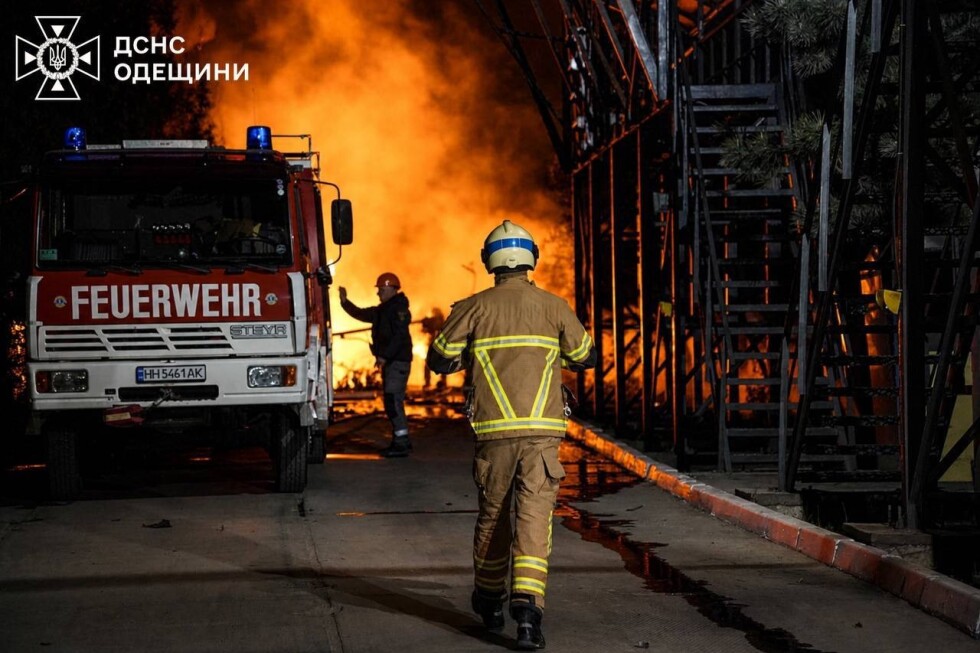
As the economic dimension of the conflict intensifies, civilian casualties continue to mount on both sides from conventional attacks. In Ukraine’s southern Odesa region, Russian drones killed two people and wounded three others overnight, damaging residential buildings and port infrastructure, according to Ukraine’s Emergency Service.
Russian strikes also wounded six people in Ukraine’s central Dnipropetrovsk region, including an attack that damaged a passenger bus transporting 40 children, though no children were reported injured.
Inside Russia, a Ukrainian drone strike killed a 77-year-old man near Volokolamsk, approximately 120 kilometers west of Moscow, according to regional governor Andrei Vorobyov. Russian officials reported that six drones were shot down over the Moscow region, with at least five more intercepted approaching the capital itself.
In Russia’s western Smolensk region, drone debris struck an apartment building, injuring three people including a child, regional governor Vasiliy Anokhin reported.
Russia’s Defense Ministry claimed to have downed 334 Ukrainian drones overnight over Russian territory and occupied Crimea. Meanwhile, Ukrainian forces reported intercepting 249 of 269 Russian drones and ballistic missiles, with strikes recorded in 15 locations across Ukraine.
The intensifying drone warfare and targeting of economic infrastructure signals a new phase in the conflict, as both sides seek strategic advantage while conventional frontlines remain largely static across eastern Ukraine.
Fact Checker
Verify the accuracy of this article using The Disinformation Commission analysis and real-time sources.
