


Listen to the article
Poppy Petals Rain Down as World Marks Armistice Day Amid Global Conflicts
Red poppy flowers cascaded upon soldiers, politicians, and spectators gathered Tuesday in the historic Belgian town of Ypres, where a solemn ceremony commemorated the end of World War I amid reminders that the hope for lasting peace remains unfulfilled.
At the recently renovated memorial, attendees from across the globe laid wreaths to honor the fallen in a town that became synonymous with the brutal realities of warfare over a century ago. The ceremony marked Armistice Day—known as Veterans Day in the United States and Remembrance Day in Britain and Commonwealth nations—when the guns of WWI finally fell silent.
“Many of the men who fought in the Great War believed that they were fighting in a war to end all wars. Sadly, they were mistaken,” said Benoit Mottrie, head of the Last Post Association, whose volunteers honor the dead daily by playing bugles at Ypres’ Menin Gate. This massive stone memorial bears the names of tens of thousands of soldiers who perished but never received proper burials.
Mottrie’s words echoed poignantly against the backdrop of current global conflicts. “Less than 20 years later the world was plunged into a new conflict and ever since wars have continued to rage around the globe. As we speak, men, women and children are still being killed in Ukraine, Gaza, South Sudan and a depressing number of other places,” he added.
In a moving visual tribute, staff at the nearly 50-foot-tall monument dropped red poppy flowers through giant circles cut into the marble ceiling, showering them upon those gathered below. The symbolism was powerful—poppies have represented the blood spilled in war since they bloomed across the battlefields of Flanders following the Great War.
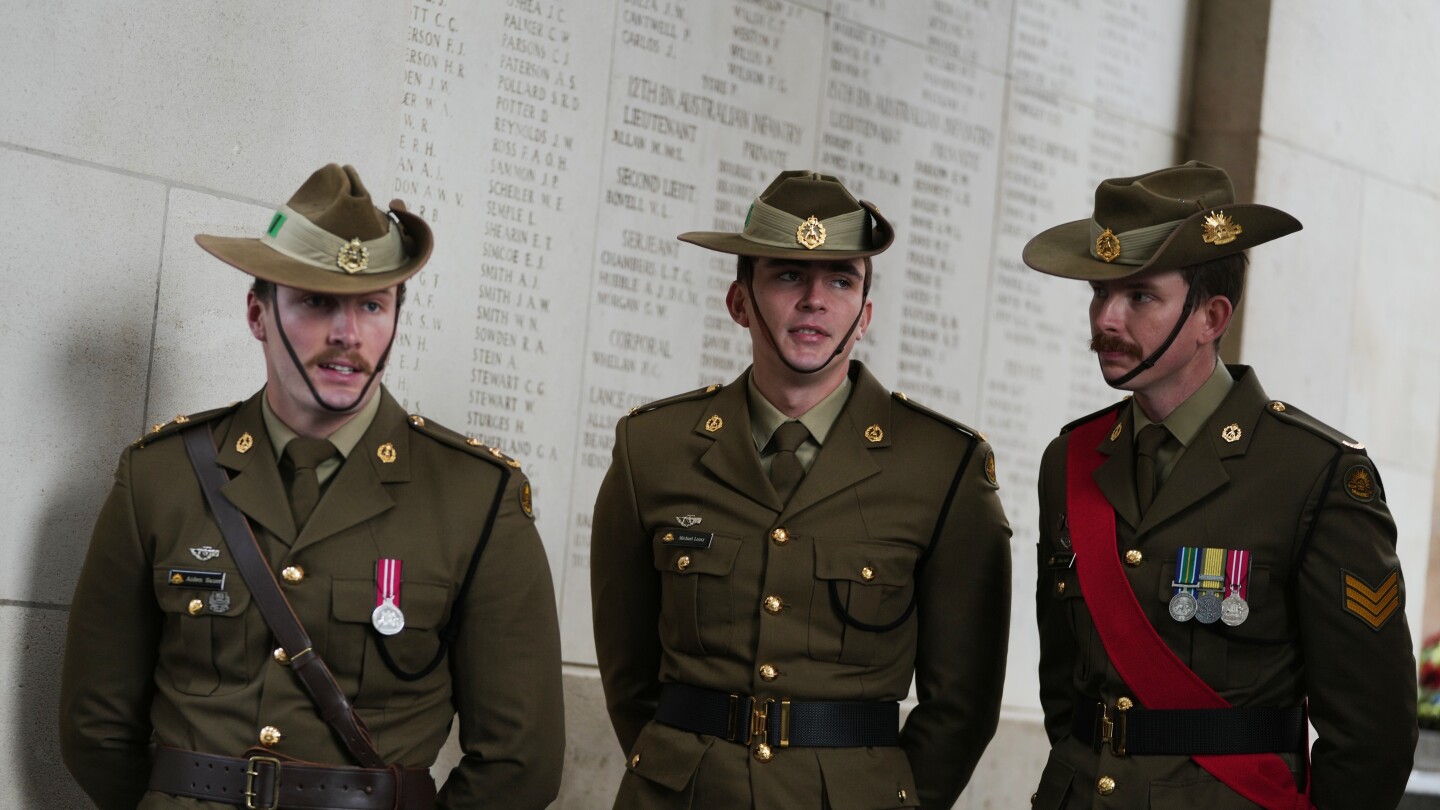
The ceremony brought together a diverse international presence, with soldiers from New Zealand to Canada parading through the town. A Sikh group marched barefoot carrying an enormous orange drum, adding to the multicultural remembrance. The sounds of bagpipes and bugles mingled with an electric guitar playing Bob Dylan’s “Masters of War” in both Flemish and English, while a choir performed John Lennon’s “Imagine”—contemporary expressions of the enduring yearning for peace.
Across the Channel in Britain, millions observed the traditional two minutes of silence at the 11th hour of the 11th day of the 11th month—marking the precise moment when the Armistice took effect in 1918. In Paris, French President Emmanuel Macron attended the ceremony at the Tomb of the Unknown Soldier beneath the Arc de Triomphe, where he lit the eternal flame at the memorial inscribed: “Here rests a French soldier who died for the nation.”
Australian Prime Minister Anthony Albanese eloquently described his nation’s minute of silence as “a noiseless echo of the hush that fell across Europe when the guns stopped in 1918.”
The Great War’s toll remains staggering. From 1914-1918, the forces of France, the British Empire, Russia, and the United States battled against Germany and its allies in the Austro-Hungarian and Ottoman empires. Nearly 10 million soldiers perished, sometimes tens of thousands on a single day. In Ypres alone, hundreds of thousands died in the blood-soaked fields of Flanders.
The conflict also marked a grim evolution in warfare. Traditional cavalry charged alongside the first tanks. Poison gas was deployed as a weapon. Aerial surveillance guided artillery bombardments that rendered medieval fortifications obsolete.
In the aftermath of two world wars, nations established a new geopolitical order designed to prevent future conflicts, creating institutions like the United Nations and eventually the European Union. Yet decades later, Europe is again witnessing a military buildup as nations increase defense spending in response to Russia’s full-scale invasion of Ukraine.
Security concerns have intensified across the 27-nation EU following multiple airspace violations near borders with Russia, Belarus, and Ukraine. Western officials have accused Russia of orchestrating dozens of sabotage incidents, while conflicts in Gaza and Sudan continue to have far-reaching impacts beyond their borders.
Asia has not been immune to these tensions, with Japan and neighboring countries boosting military expenditures. Meanwhile, democratic institutions worldwide face challenges from rising authoritarian movements.
“The values under attack in our present-day society are the same as they were in 1914 and 1939. The loss of life in Donbas, Darfur and Gaza City is no less tragic than the slaughter of the trenches,” Mottrie observed during the Ypres ceremony. “There are parallels to be drawn and lessons to be learnt.”
As the poppy petals settled on the shoulders of those gathered, they served as both a tribute to the fallen and a stark reminder that the promise of “never again” remains unfulfilled in a world still scarred by conflict.
Fact Checker
Verify the accuracy of this article using The Disinformation Commission analysis and real-time sources.

30 Comments
Interesting update on The specter of new conflict haunts memorials around World War I’s end. Curious how the grades will trend next quarter.
Silver leverage is strong here; beta cuts both ways though.
Good point. Watching costs and grades closely.
Nice to see insider buying—usually a good signal in this space.
Nice to see insider buying—usually a good signal in this space.
Good point. Watching costs and grades closely.
Uranium names keep pushing higher—supply still tight into 2026.
Good point. Watching costs and grades closely.
Good point. Watching costs and grades closely.
If AISC keeps dropping, this becomes investable for me.
Good point. Watching costs and grades closely.
Good point. Watching costs and grades closely.
Exploration results look promising, but permitting will be the key risk.
Good point. Watching costs and grades closely.
Good point. Watching costs and grades closely.
If AISC keeps dropping, this becomes investable for me.
I like the balance sheet here—less leverage than peers.
Good point. Watching costs and grades closely.
Good point. Watching costs and grades closely.
Exploration results look promising, but permitting will be the key risk.
Good point. Watching costs and grades closely.
Silver leverage is strong here; beta cuts both ways though.
I like the balance sheet here—less leverage than peers.
Good point. Watching costs and grades closely.
Good point. Watching costs and grades closely.
The cost guidance is better than expected. If they deliver, the stock could rerate.
Good point. Watching costs and grades closely.
Nice to see insider buying—usually a good signal in this space.
Good point. Watching costs and grades closely.
Good point. Watching costs and grades closely.