


Listen to the article
Palestinian Schoolchildren Face New Barriers Amid Rising West Bank Tensions
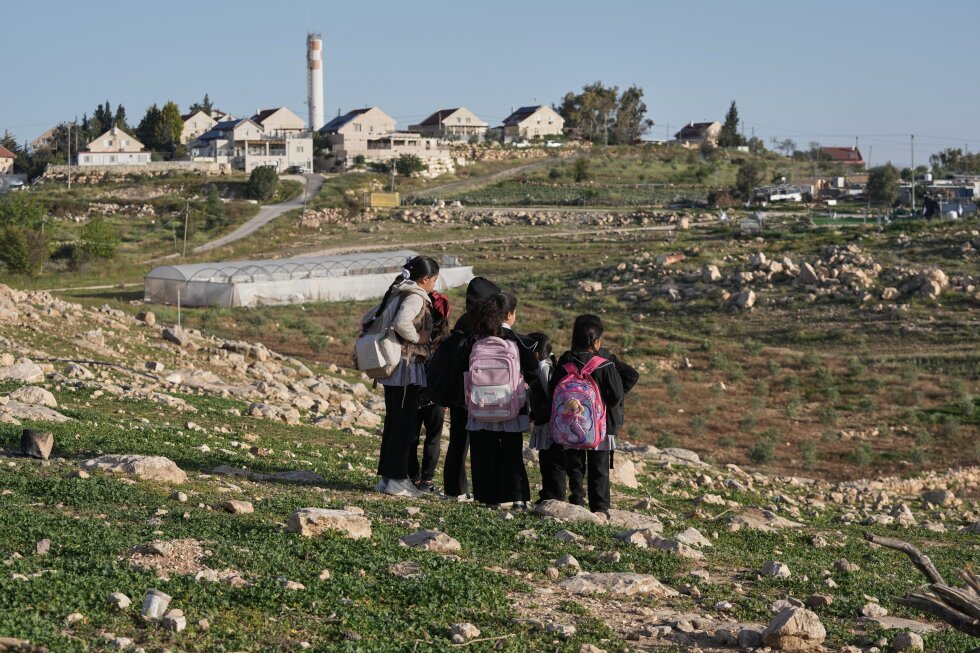
Siblings Hajar and Rashid Hathaleen’s walk to school in Umm al-Khair took an unexpected turn this week when they encountered a barbed wire fence blocking their traditional path to the village center. The barrier, allegedly installed overnight by Israeli settlers, represents the latest development in an ongoing territorial struggle in the occupied West Bank.
According to video evidence provided to The Associated Press, the improvised fence appeared just as classes resumed following a pause during the recent Iran war. For residents of Umm al-Khair, this incident fits into a broader pattern of land encroachment, where state-backed demolitions, arson, and vandalism have become commonplace.
“It was a good chance for settlers to do what they want, with no rules,” said Khalil Hathaleen, head of the village council, explaining how he believes settlers have exploited wartime conditions to accelerate land seizures, cut down olive groves, and conduct nighttime raids on nearby Palestinian villages.
The situation garnered international attention through the 2024 Oscar-winning documentary “No Other Land,” yet residents say this spotlight has done little to prevent continued encroachment and violence in the area. Palestinians argue that Israel has used the recent conflict as cover to tighten control over the territory, implementing additional movement restrictions under the guise of security concerns.
When children attempted to attend school this week, they were met with resistance. Video footage shows that on Monday, as students waited near the newly erected barrier, armed men in an unmarked white truck—some in military uniforms—dispersed tear gas and deployed sound grenades. Israel’s military acknowledged using “riot dispersal means” but claimed these measures targeted adults in the area, not the children.
The 3-kilometer (1.8-mile) path has been used by Bedouins and other villagers for decades. “We are determined to keep it,” Khalil Hathaleen affirmed. The military’s civil administration unit reportedly suggested diverting students to an alternative route, but parents object, saying it’s twice as long and potentially more dangerous as it passes near the Carmel settlement.
Al-Mutasim Hathaleen, a parent from the village, expressed deep concerns about the safety of students attempting to reach school: “We have deep concerns as parents and as residents that the occupation and soldiers will attack students.”
The fence exemplifies a recurring strategy in the West Bank, where Palestinians report that settlers often establish physical barriers or claim farmland, then enforce these new boundaries with military backing. While Israeli forces occasionally restrain settlers, Khalil Hathaleen claims they more frequently support them, leaving Palestinians with few options.
Most of the international community considers Israeli settlements in the West Bank illegal, though Israel describes the territory as disputed, subject to future negotiations. Many outpost settlements begin without official Israeli permission but are later tolerated or even retroactively legalized.
The incident occurs against a backdrop of escalating violence in the West Bank. Israeli officials have recently expressed alarm about intensifying extremist settler activity, including arson and deadly attacks. At least 35 Palestinians have been killed by Israeli soldiers and settlers across the territory in 2026, with settlers responsible for eight deaths—matching the total for all of 2025.
Following the killing of a 23-year-old Palestinian man by a settler, the Israeli rights group B’Tselem condemned what it described as “daily unbridled violence” as government policy, noting many involved are army reservists. “These militias are fully backed by the state of Israel and enjoy complete impunity for killing, assaulting and looting Palestinian residents,” the organization stated.
Despite the obstacles, the community remains determined. Though classes were partially empty this week and Wednesday saw no school due to Palestinian Authority salary cuts, Khalil Hathaleen confirmed that children will again attempt to use their traditional route on Thursday—a test of wills that carries significant risk in this volatile environment.
Fact Checker
Verify the accuracy of this article using The Disinformation Commission analysis and real-time sources.

18 Comments
Production mix shifting toward World might help margins if metals stay firm.
Nice to see insider buying—usually a good signal in this space.
Good point. Watching costs and grades closely.
I like the balance sheet here—less leverage than peers.
Exploration results look promising, but permitting will be the key risk.
Good point. Watching costs and grades closely.
Nice to see insider buying—usually a good signal in this space.
Good point. Watching costs and grades closely.
Uranium names keep pushing higher—supply still tight into 2026.
If AISC keeps dropping, this becomes investable for me.
Good point. Watching costs and grades closely.
Interesting update on Palestinians say Israel is using the Iran war to tighten its grip on the occupied West Bank. Curious how the grades will trend next quarter.
Good point. Watching costs and grades closely.
The cost guidance is better than expected. If they deliver, the stock could rerate.
Good point. Watching costs and grades closely.
Silver leverage is strong here; beta cuts both ways though.
Silver leverage is strong here; beta cuts both ways though.
Good point. Watching costs and grades closely.