


Listen to the article
French President Macron and Lebanese PM Call for Ceasefire Negotiations as Regional Diplomacy Intensifies
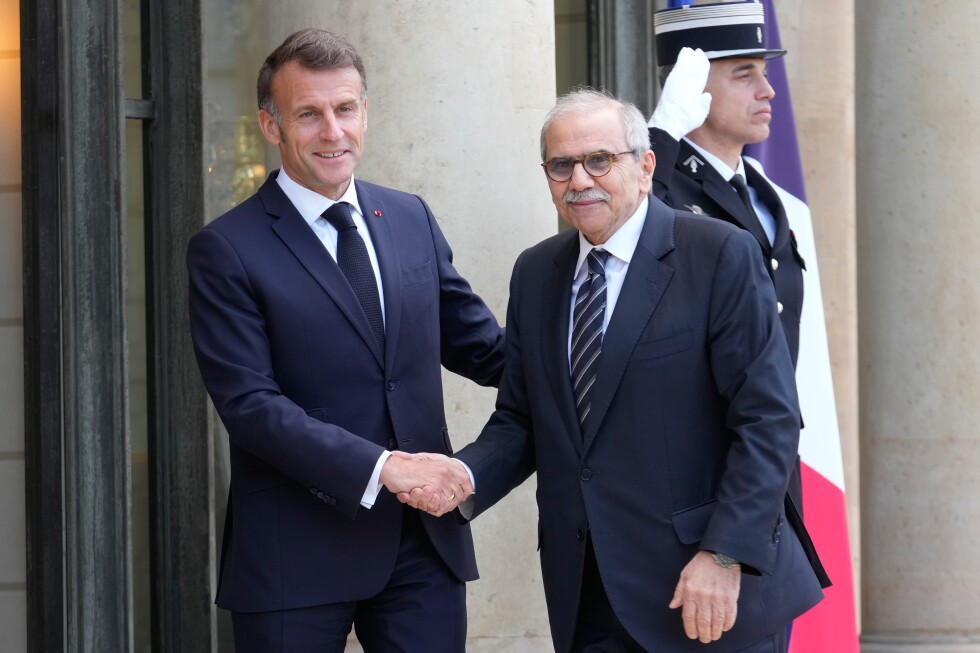
French President Emmanuel Macron and Lebanese Prime Minister Nawaf Salam issued a joint call Tuesday for continued negotiations to strengthen the fragile ceasefire between Israel and Hezbollah following talks at the Elysée Palace in Paris.
“We should allow time for negotiations and not let the war resume,” Macron stated, emphasizing that consolidating the Lebanon truce remains an immediate priority for regional stability. The French president added that lasting peace “can only be achieved through an Israeli withdrawal from Lebanese territory and the disarmament of Hezbollah.”
The Paris meeting comes at a crucial juncture in the diplomatic effort to prevent renewed hostilities in Lebanon. The ceasefire, which was set to expire Wednesday, has been extended by U.S. President Donald Trump at Pakistan’s request, as Islamabad prepares to host a new round of talks between the United States and Iran.
However, diplomatic momentum appeared to falter late Tuesday when U.S. Vice President JD Vance, expected to lead the American delegation, canceled his trip to Pakistan. Iranian officials simultaneously expressed uncertainty about their participation in the talks, raising questions about the viability of this diplomatic channel.
In Washington, a separate track of direct Lebanese-Israeli negotiations is scheduled to continue this week. These talks represent a historic breakthrough, marking the first direct diplomatic engagement between the two countries in decades.
Prime Minister Salam reaffirmed Lebanon’s commitment to this diplomatic process during the Paris meeting. “We are continuing along this path, convinced that diplomacy is not a sign of weakness but a responsible act,” he said, while emphasizing that “there can be no lasting stability without a complete Israeli withdrawal” from Lebanese territory.
The high-stakes diplomatic efforts follow more than a month of intense conflict between Israel and Hezbollah, which began in early March when the Iran-backed militant group started firing missiles into Israel, prompting Israeli bombardment and a ground invasion of southern Lebanon.
The Paris meeting was overshadowed by Saturday’s attack on the United Nations Interim Force in Lebanon (UNIFIL), which resulted in the death of a French peacekeeper and injured three others, two seriously. Both France and UNIFIL have attributed the attack to Hezbollah, though the group denies involvement.
Despite the incident, Macron expressed France’s readiness to maintain its military presence in a potential follow-up mission after UNIFIL’s mandate expires at the end of the year. The current peacekeeping mission’s extension was approved by the UN Security Council in August.
Earlier on Tuesday, Salam attended a meeting of European Union foreign ministers in Luxembourg, where Middle East policy discussions revealed continuing divisions within the 27-member bloc regarding its approach to Israel.
The path to the current ceasefire has been complex. Lebanese President Joseph Aoun had initially proposed direct negotiations with Israel in exchange for a halt in hostilities—an offer Israel initially rebuffed. The diplomatic landscape shifted following the announcement of U.S.-Iran talks and Pakistan’s brokered discussions between the parties.
While the U.S. has framed the current ceasefire as a result of direct Israel-Lebanon talks, Hezbollah—which opposed and did not participate in those negotiations—has attributed the pause in fighting to pressure from Iran rather than the diplomatic engagement.
Iran’s role remains pivotal, as Tehran has insisted any ceasefire agreement must extend to Lebanon and has threatened to keep the strategic Strait of Hormuz closed otherwise—a move that would significantly impact global oil markets and shipping routes.
The convergence of these diplomatic initiatives represents a complex web of regional and international interests, with multiple tracks proceeding simultaneously in Paris, Washington, and potentially Islamabad. The success of these efforts remains uncertain as stakeholders navigate competing interests and deep-seated regional tensions.
Fact Checker
Verify the accuracy of this article using The Disinformation Commission analysis and real-time sources.

45 Comments
The ceasefire extension brokered by the US and Pakistan is a positive development, but the diplomatic challenges ahead should not be underestimated. Regional powers must remain engaged to consolidate the truce.
Macron’s emphasis on the need for an Israeli withdrawal and Hezbollah disarmament highlights the complexities involved in achieving a lasting peace in Lebanon. Careful negotiation and compromise will be required.
I’m hopeful that the regional powers can find a way to balance their competing interests and reach an agreement that stabilizes the situation in Lebanon.
I like the balance sheet here—less leverage than peers.
Good point. Watching costs and grades closely.
Good point. Watching costs and grades closely.
Nice to see insider buying—usually a good signal in this space.
Good point. Watching costs and grades closely.
Good point. Watching costs and grades closely.
Macron’s emphasis on an Israeli withdrawal from Lebanese territory and Hezbollah disarmament as prerequisites for lasting peace is a pragmatic assessment of the complex dynamics at play. Careful mediation will be required.
If AISC keeps dropping, this becomes investable for me.
Good point. Watching costs and grades closely.
Good point. Watching costs and grades closely.
Maintaining a ceasefire in Lebanon is critical for regional stability. Macron’s call for negotiations to strengthen the truce is a prudent diplomatic approach to prevent further conflict escalation.
Disarmament of Hezbollah will be a key sticking point, but a political solution is essential to achieve lasting peace.
Production mix shifting toward World might help margins if metals stay firm.
Good point. Watching costs and grades closely.
Macron’s joint call with the Lebanese PM for continued negotiations is a constructive step to shore up the fragile ceasefire. Maintaining open channels of communication between all parties will be crucial.
I’m curious to see how the diplomatic efforts unfold in the coming weeks and whether a more durable peace agreement can be reached.
The cost guidance is better than expected. If they deliver, the stock could rerate.
Good point. Watching costs and grades closely.
Silver leverage is strong here; beta cuts both ways though.
Good point. Watching costs and grades closely.
Uranium names keep pushing higher—supply still tight into 2026.
Good point. Watching costs and grades closely.
I like the balance sheet here—less leverage than peers.
Good point. Watching costs and grades closely.
Good point. Watching costs and grades closely.
Interesting update on Macron urges negotiations to shore up ceasefire in Lebanon. Curious how the grades will trend next quarter.
Nice to see insider buying—usually a good signal in this space.
The cost guidance is better than expected. If they deliver, the stock could rerate.
Good point. Watching costs and grades closely.
Silver leverage is strong here; beta cuts both ways though.
Good point. Watching costs and grades closely.
Good point. Watching costs and grades closely.
Production mix shifting toward World might help margins if metals stay firm.
Good point. Watching costs and grades closely.
The cancelation of the US delegation’s trip to Pakistan is disappointing, as it could disrupt the delicate diplomatic process. I hope the parties can find a way to re-engage and build on the ceasefire progress.
The cancelation of the US delegation’s trip to Pakistan is concerning, as it could disrupt the diplomatic momentum to consolidate the Lebanon ceasefire. Continued regional diplomacy is crucial at this juncture.
I hope the US and Iran can find common ground to support the ceasefire negotiations and prevent a resurgence of hostilities in Lebanon.
Production mix shifting toward World might help margins if metals stay firm.
Good point. Watching costs and grades closely.
I like the balance sheet here—less leverage than peers.
Good point. Watching costs and grades closely.
Good point. Watching costs and grades closely.