


Listen to the article
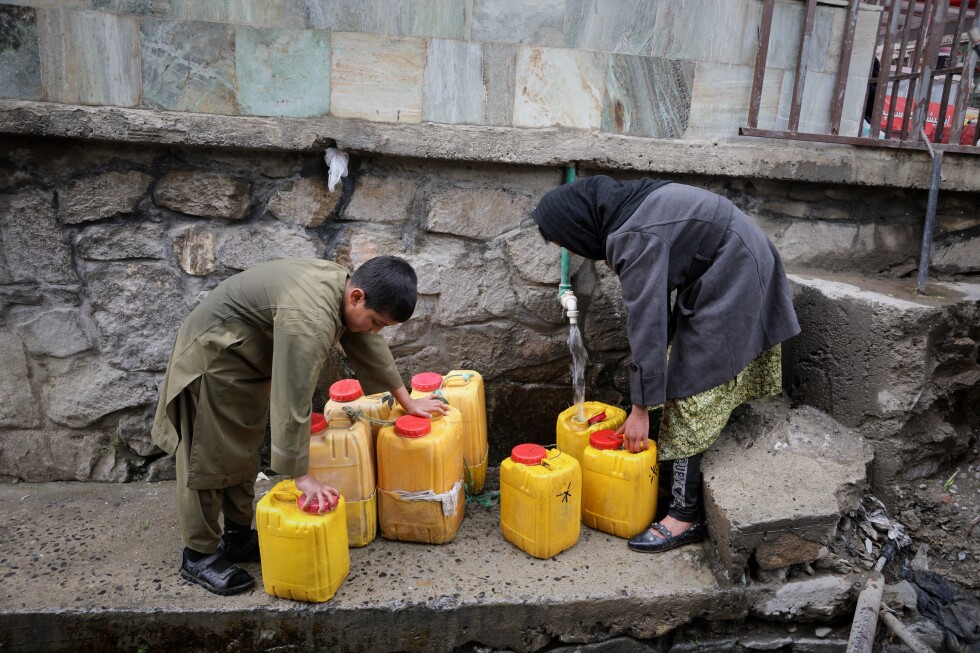
In the muddy lanes of Kabul’s Deh Mazang neighborhood, 52-year-old Marofa pulls aside her headscarf, revealing her grey-white hair in frustration. “Even I with my white hair, I have to carry water,” she says. “These containers are heavy. We have no strength left in our backs, no strength left in our legs.”
Her plight reflects a growing crisis in Afghanistan’s capital. While a nearby mosque provides well water for free, it’s yellow and brackish—undrinkable. Potable water arrives on three-wheeled motorcycles, but at prices many residents simply cannot afford.
“We have no money for food. How can we get water?” asks 90-year-old Wali Mohammad, anger evident in his voice.
Some residents claim that shortly after taking power in 2021, Taliban authorities cut pipes that had been laid to channel water from a communal well to homes. “They cut off our water. They are powerful and they don’t even give us a reason why,” Mohammad laments.
But the situation is more complex than it appears. Najibullah Rahimi, 32, explains that the home-connected pipes caused water levels to drop, leaving those living higher on the hill with no access at all. “So the government came and cut the pipes,” he says.
This neighborhood’s struggles exemplify a catastrophic water crisis engulfing Kabul. Situated in a high-altitude valley of the Hindu Kush mountains, the city relies predominantly on groundwater from wells. However, this crucial resource is vanishing at an alarming rate, with some wells requiring depths of 150 meters—nearly 500 feet—to reach water.
A 2025 report from Mercy Corps documented a 25-30 meter (80-100 foot) decline in Kabul’s aquifers over the preceding decade. “Without large-scale changes to Kabul’s water management dynamics, the city faces an unprecedented humanitarian disaster within the coming decade, and likely much sooner,” the report warned.
Climate change has accelerated the crisis. Reduced snowfall from repeated droughts means less gradual melting to replenish groundwater. Instead, Kabul experiences sudden, heavy downpours that cause flooding but contribute little to aquifer restoration.
“Even without climate change Kabul would have seen this crisis, with the enormous, unprecedented increase in population and urbanization,” explains Najibullah Sadid, a water resources expert with the Afghanistan Water and Environment Professionals Network.
Kabul’s population has more than doubled since 2001, swelling from approximately 2.5 million to an estimated 6 million today. Major influxes occurred after the Taliban’s fall in 2001 and again when Pakistan and Iran began expelling Afghan refugees in 2023.
The city’s rapid urbanization has created another problem. “Even if it is raining every day, it will not impact groundwater levels anymore, because there is no place to impact the groundwater,” Sadid notes. The concrete and asphalt covering Kabul prevent water from penetrating to recharge aquifers, while beverage companies and commercial agriculture operations continue drawing heavily from the dwindling supply.
Ministry of Water and Energy spokesman Qari Matiullah Abid acknowledges the severity of the situation. “The water situation in Kabul city is in a critical state,” he says. “The main reasons are that the population has increased significantly, rainfall has decreased and consumption has increased.”
The government has implemented several measures: restricting groundwater extraction by commercial users, installing water meters with usage quotas for businesses, and constructing check dams and absorption wells to help manage stormwater. The Shah wa Arous Dam, completed in 2024 with a capacity of 10 million cubic meters, and the removal of sediment from the Qargha Dam represent recent infrastructure improvements.
However, two major projects that could significantly alleviate the crisis remain delayed. A 200-kilometer pipeline from the Panjshir River north of Kabul and the planned Shah Toot Dam southwest of the city could together provide water for approximately 4 million people.
“A combination of both would be a sustainable solution for the future,” says Sadid. While the dam would require several years to complete, the pipeline could be finished relatively quickly.
Shafiullah Zahid, Kabul Zone Director for Afghanistan’s Urban Water Supply and Sewage state corporation, confirms that the Panjshir pipeline’s $130 million budget has been approved, though the project awaits final review before construction can begin. The Shah Toot Dam, originally planned as an Afghan-Indian joint project, faces funding delays and would require six to seven years to complete once started.
Sadid criticizes the priorities of both current and previous Afghan governments. “Numerous roads are being built, flyovers are being built with a lot of money. But there is no priority for water projects,” he says. “They are just doing the projects which are eye-catching and not the projects which are fundamental to the people’s health and people’s fundamental rights. Water is essential. Water is more important than roads.”
For residents like Marofa and Mohammad, these long-term solutions offer little immediate relief as they continue their daily struggle for this most basic necessity of life.
Fact Checker
Verify the accuracy of this article using The Disinformation Commission analysis and real-time sources.

16 Comments
This is a very concerning development. Access to clean water is essential for public health and human dignity. I hope the authorities in Kabul can work quickly to restore reliable, affordable water access for all residents, especially the most vulnerable. Long-term, equitable solutions are crucial.
The water crisis in Kabul is deeply troubling. While the government’s rationale for cutting pipes may have seemed logical, the human toll on vulnerable populations is unacceptable. I hope urgent action can be taken to restore equitable water access and prevent further suffering.
Absolutely. The human right to water must be protected, even in resource-constrained environments. I hope the authorities can work with NGOs and aid groups to identify sustainable, community-based solutions that meet the needs of all Kabul residents.
This is a concerning development, as access to clean water is crucial for public health and well-being. I’m curious to learn more about the underlying causes – was this a misguided attempt at water rationing, or are there deeper systemic issues at play? Addressing the root problems will be key to resolving this crisis.
The water crisis in Kabul highlights the complex challenges of urban water management, especially in resource-constrained environments. Cutting off pipes may have seemed like a temporary fix, but it has left many vulnerable residents without access to this basic necessity. Long-term, equitable solutions are urgently needed.
You’re right, sustainable water infrastructure is crucial. I hope the government can work with international aid agencies to invest in new water sources, distribution networks, and affordability programs for low-income households.
This is a heartbreaking situation. Access to clean water is a fundamental human right, yet many in Kabul are struggling to afford or access it. I hope the government can find a sustainable solution to ensure all residents have affordable, potable water.
This water crisis in Kabul is a sobering reminder of the fragility of urban water systems, especially in conflict-affected regions. While the details are complex, the human impact is clear – residents are struggling to meet their most basic needs. Innovative, community-based solutions may be required to address this challenge.
The water crisis in Kabul is a sobering reminder of the complex challenges facing many cities in the developing world. While the government’s rationale may have seemed logical, the human impact is devastating. I hope this situation spurs renewed international attention and investment in sustainable urban water infrastructure.
Cutting off water access is an alarming step, even if the intention was to manage scarce resources. The impacts on vulnerable populations like the elderly are distressing. I hope the authorities can find an equitable solution that restores clean, affordable water for all Kabul residents.
The water crisis in Kabul is deeply concerning. While the government’s rationale for cutting pipes may have seemed logical, the human impact on vulnerable populations is unacceptable. I hope urgent, collaborative action can be taken to restore reliable, affordable water access for all residents.
This is a heartbreaking situation. Clean, affordable water should be a basic right, not a luxury. I hope the authorities in Kabul can work with international partners to find innovative, community-based solutions that restore reliable access for all residents, especially the most vulnerable.
Access to clean water is a fundamental human right, yet this report highlights the immense challenges many Kabul residents face in obtaining this basic necessity. I hope the authorities can work quickly with international aid groups to identify sustainable, equitable solutions that meet the needs of all.
The water crisis in Kabul is deeply troubling. Access to clean, affordable water is a fundamental human right, yet many residents are now struggling to obtain this basic necessity. I hope the authorities can work quickly with international partners to find sustainable, equitable solutions.
This is a sobering reminder of the fragility of urban water systems, especially in conflict-affected regions. While the details are complex, the human toll is clear – residents are struggling to meet their most basic needs. I hope this spurs innovative, community-based solutions to address this crisis.
Access to clean water is a fundamental human right, yet this report highlights the immense challenges many Kabul residents face in obtaining this basic necessity. I hope the authorities can work with international partners to quickly restore reliable, affordable water access for all.