


Listen to the article
US and Iran Clash at UN Nuclear Treaty Review Over Tehran’s Program
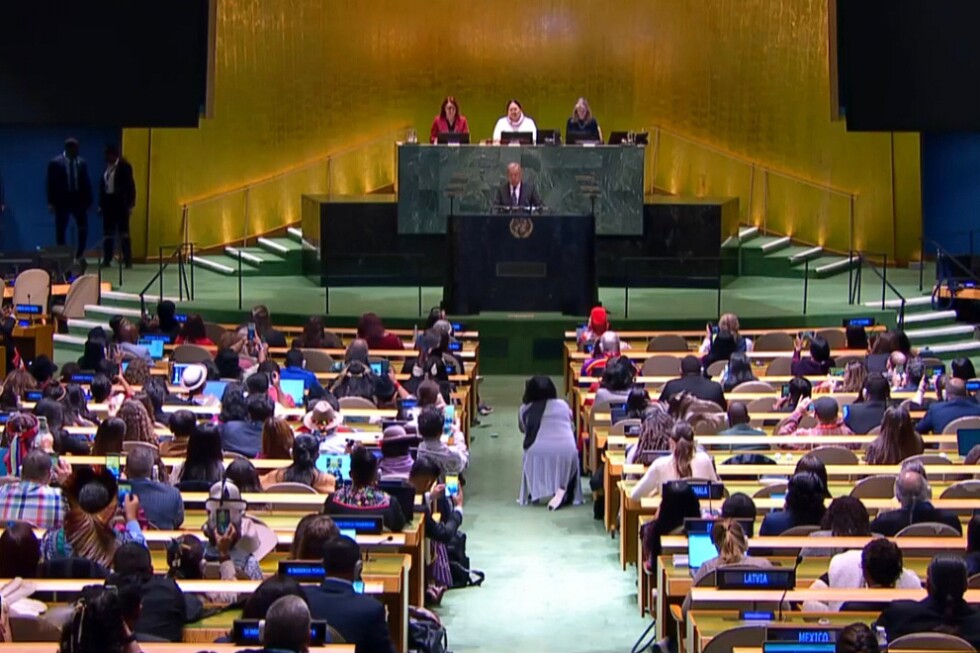
The United States and Iran engaged in a heated diplomatic exchange over Tehran’s nuclear ambitions as the five-year review of the Nuclear Nonproliferation Treaty (NPT) began at the United Nations on Monday. The confrontation set a contentious tone for what promises to be a month of difficult negotiations among the treaty’s 191 member states.
Tensions escalated immediately over Iran’s election as one of the conference’s 34 vice presidents, a position secured through its membership in the “nonaligned movement” bloc of 121 primarily developing nations. The selection drew sharp criticism from Western powers amid ongoing concerns about Iran’s nuclear activities.
Christopher Yeaw, U.S. assistant secretary of state for arms control and nonproliferation, condemned the decision, stating: “Rather than choosing to use this review conference to defend the integrity of the NPT and call Iran to account, we instead elect Iran a vice president. It is beyond shameful and an embarrassment to the credibility of this conference.”
The rebuke comes at a particularly volatile moment in U.S.-Iranian relations. President Trump has repeatedly vowed to prevent Iran from developing nuclear weapons, while Tehran maintains its program serves only civilian purposes despite enriching uranium to near weapons-grade levels. The standoff has recently intensified with Iran offering to reopen the strategic Strait of Hormuz if the United States lifts its blockade of Iranian shipping and ends the ongoing conflict.
A key point of contention involves Iran’s refusal to grant International Atomic Energy Agency (IAEA) inspectors access to nuclear sites that were reportedly bombed by U.S. forces last June. This lack of transparency has amplified international concerns about Iran’s compliance with its treaty obligations.
Several Western allies joined the U.S. position. Australia and the United Arab Emirates voiced direct support, while the United Kingdom, France, and Germany—all signatories to the now-imperiled 2015 nuclear deal that Trump withdrew from in 2018—expressed “concern” about Iran’s actions.
Iran’s ambassador to the UN in Vienna, Reza Najafi, forcefully rejected these criticisms, calling U.S. allegations “baseless and politically motivated.” He countered by highlighting America’s status as the only country to have used nuclear weapons and accused Washington of expanding its nuclear arsenal in violation of the treaty while enabling Israel’s alleged nuclear program.
Najafi specifically condemned recent U.S. and Israeli strikes on what he described as Iran’s “peaceful nuclear facilities,” characterizing them as “a grave violation of international law and a direct assault on the integrity of the global nonproliferation regime.”
Russia’s representative, Ambassador-at-Large Andrey Belousov, objected to singling out Iran and expressed hope that such “politicization” would not undermine the conference’s outcomes. Notably, Russian President Vladimir Putin met with Iranian Foreign Minister Abbas Araghchi on Monday, according to Russian state media. Despite its generally neutral stance in the current conflict, Russia has been suggested as a potential repository for Iran’s highly enriched uranium.
The conference faces significant challenges beyond the U.S.-Iran dispute. At the previous review in 2022, delayed a year by the COVID-19 pandemic, Russia blocked consensus on a final document over references to its invasion of Ukraine and its military activities around the Zaporizhzhia nuclear plant.
UN Secretary-General António Guterres opened the session with an urgent appeal, noting that “for the first time in decades, the number of nuclear warheads is rising and nuclear testing is on the table.” He called on all parties to “stand together and safeguard humanity from the grave threat of nuclear annihilation” while ensuring that “until nuclear weapons are eliminated, humanity never cedes control over their use.”
The NPT, which took effect in 1970, represents a bargain between nuclear and non-nuclear states. The five original nuclear powers—the U.S., China, Russia, Britain, and France—committed to eventual disarmament, while non-nuclear nations pledged not to acquire weapons in exchange for access to peaceful nuclear technology.
Fact Checker
Verify the accuracy of this article using The Disinformation Commission analysis and real-time sources.

8 Comments
The confrontational tone between the U.S. and Iran at the start of the NPT review conference is concerning. Navigating these geopolitical tensions will be crucial for the success of the treaty’s evaluation.
Iran’s election as a vice president for the NPT review conference despite the unresolved issues around its nuclear program is a surprising and controversial move. It highlights the complex dynamics at play.
Iran’s election as a vice president is puzzling, given the ongoing concerns about its nuclear program. The NPT review process will be a test of whether the treaty’s principles can be upheld.
The U.S. criticism of Iran’s selection seems justified. Maintaining the credibility of the NPT review conference is important, even if it leads to confrontation.
The clash between the U.S. and Iran at the start of the NPT review conference sets a contentious tone. Navigating the complex geopolitics around nuclear nonproliferation will be a major challenge.
With the U.S. and Iran in such disagreement, reaching any meaningful consensus at the conference may prove difficult. Diplomacy will be critical to make progress.
Interesting that Iran was elected as a vice president for the NPT review conference despite ongoing concerns about its nuclear program. This highlights the political tensions and differing perspectives at play.
The U.S. criticism of Iran’s selection seems warranted, given the unresolved issues around Tehran’s nuclear ambitions. Maintaining the integrity of the NPT is crucial.