


Listen to the article
White House Press Secretary Draws Criticism for Taking Democrats’ Statements Out of Context
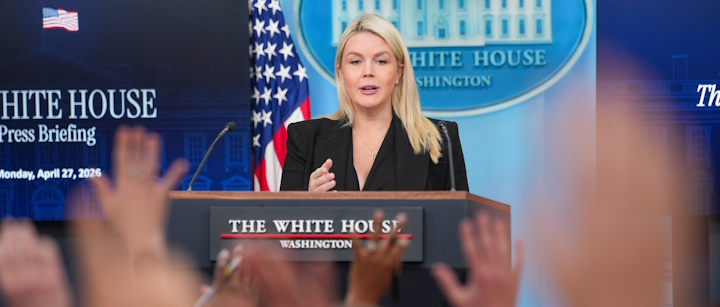
White House Press Secretary Karoline Leavitt has sparked controversy by accusing Democratic politicians of using rhetoric that “inspires violence” against President Donald Trump, two days after an armed man attempted to enter the White House Correspondents’ Association dinner.
During her April 27 press briefing, Leavitt presented a series of quotes from Democratic lawmakers and a late-night television host that she characterized as “hateful and constant and violent rhetoric.” However, House Democratic Leader Hakeem Jeffries quickly challenged her presentation, calling her a “stone-cold liar” and asserting that the statements were “all taken out of context.”
The briefing came in the wake of a serious security incident. On April 25, security personnel prevented an armed individual from accessing the WHCA dinner, which was attended by President Trump and top administration officials. Following Leavitt’s briefing, the man was charged with attempting to assassinate the president.
Among Leavitt’s examples was a comment from Jimmy Kimmel, who joked during his late-night show that First Lady Melania Trump had “a glow like an expectant widow.” Leavitt asked, “Who in their right mind says a wife would be glowing over the potential murder of her beloved husband?” Both the president and first lady later called for Kimmel’s firing, with Trump describing the joke as a “call to violence.”
Kimmel defended himself on his April 27 show, explaining the comment was “obviously” a joke about the age difference between the 79-year-old president and his 56-year-old wife. “It was not — by any stretch of the definition — a call to assassination,” Kimmel said.
The controversy escalated when the Federal Communications Commission issued an order expediting a review of eight local broadcasting licenses held by ABC, raising concerns about potential retaliation against Kimmel’s network.
Leavitt also cited House Democratic Leader Hakeem Jeffries saying “we are in an era of maximum warfare, everywhere, all the time.” However, she omitted crucial context that showed Jeffries was specifically discussing congressional redistricting battles, not physical conflict.
Jeffries later clarified that the phrase originated from a New York Times article quoting an unnamed person close to President Trump describing the “White House’s political strategy” on redistricting as “maximum warfare, everywhere, all the time.”
Pennsylvania Governor Josh Shapiro’s statement that “heads need to roll, certainly, within the administration” was similarly presented without the context that he was calling for the firing of Department of Homeland Security officials over controversial immigration enforcement tactics that led to the deaths of two U.S. citizens.
Senator Alex Padilla’s quote about “people dying because of fear and terror caused by the Trump administration” referenced a specific incident where a farmworker died during an ICE raid in California. His full statement addressed concerns about aggressive immigration enforcement affecting documented immigrants and U.S. citizens.
Illinois Governor JB Pritzker’s comment that “these Republicans cannot know a moment of peace” was part of a broader call for political activism through protests and voting. When previously criticized for these remarks, Pritzker clarified, “I called for people to take out their megaphones and their microphones, to stand up on soapboxes and get to the ballot box… That has nothing to do with violence.”
Similarly, Representative Ayanna Pressley’s statement “we’ll see you in the streets” was excerpted from longer calls for citizens to “litigate, legislate, agitate, and resist” through demonstrations against administration policies.
The heated exchange highlights the intensifying political rhetoric in an already polarized election year, with both sides accusing the other of dangerous language while disputes over context and interpretation further complicate public discourse.
Fact Checker
Verify the accuracy of this article using The Disinformation Commission analysis and real-time sources.

10 Comments
Navigating issues of political rhetoric is tricky, but I’m glad to see an attempt to unpack this situation objectively. Looking at the full picture, rather than isolated quotes, is the responsible approach.
This is a complex and nuanced issue. It’s important to look at the full context of the statements made, not just cherry-picked quotes. Accusations of ‘violent rhetoric’ require a careful examination of the facts.
I’m curious to learn more about the specific context around these comments and how they were actually used. Out-of-context snippets can be misleading, so I’d like to see a more thorough analysis.
Agreed, the full context is crucial here. Dismissing statements as ‘violent rhetoric’ without a deeper look at the intent and surrounding discussion is problematic.
This is a delicate issue that requires careful unpacking. I appreciate the attempt to look beyond surface-level claims and really examine the substance and framing of the statements in question.
Yes, a thorough, impartial analysis is important here. Accusations of ‘violent rhetoric’ shouldn’t be made lightly, and it’s good to see an effort to provide more context.
This seems like a politically charged issue, so I’m glad to see a fact-check approach trying to examine the details objectively. Assessing rhetoric requires nuance and avoiding knee-jerk partisan reactions.
Allegations of ‘violent rhetoric’ are serious and shouldn’t be thrown around lightly. I hope this analysis provides a balanced perspective on the specific statements and their intended meaning.
Yes, it’s commendable that this article is taking a measured, evidence-based approach rather than just repeating partisan accusations. Understanding the full context is key.
While the White House’s concerns about rhetoric may have some merit, it’s also crucial to ensure that context and intent are properly considered. Oversimplifying complex statements is unproductive.