


Listen to the article
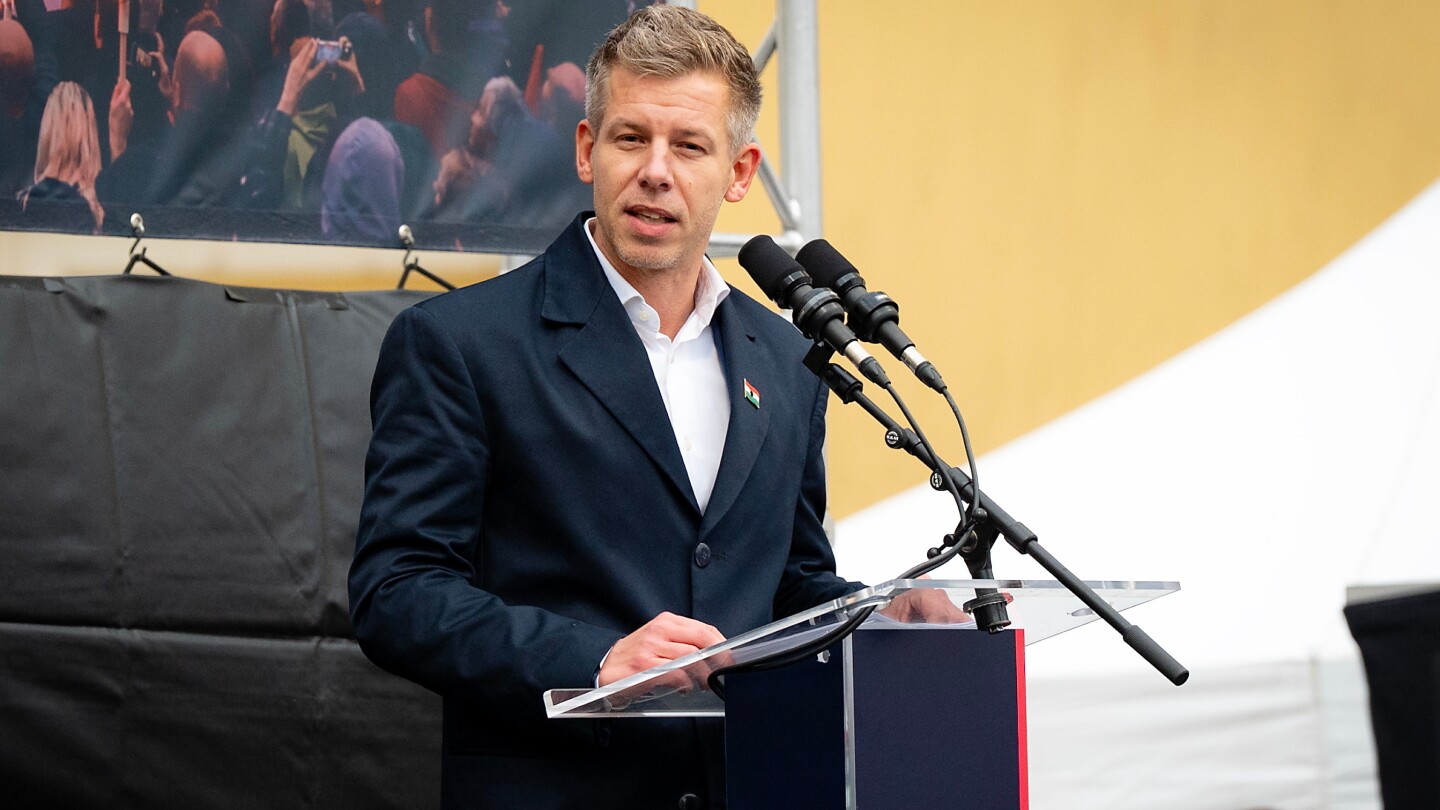
With Hungary’s parliamentary elections still five months away, the country is already immersed in an intense political campaign that promises to be the biggest challenge of Prime Minister Viktor Orbán’s lengthy career. The nationalist leader, who has dominated Hungarian politics for two decades, now faces a formidable opponent in Péter Magyar, a former Fidesz insider whose new Tisza party has surged in the polls.
Orbán, Europe’s longest-serving leader, has held power for a combined 20 years—first elected in 1998 and then continuously since 2010. During this time, he has built a political system that critics say enables his far-right Fidesz party to exercise nearly unchecked power. However, his support is declining amid economic challenges, including persistent inflation and frozen European Union funding.
“Viktor Orbán’s despicable, corrupt government will do everything to preserve their stolen loot and their power, we have no doubt,” Magyar, 44, told The Associated Press. “This power cannot be reformed, it is not able to regain contact with the people. This power has become inhumane.”
Most opinion polls now show Magyar and his Tisza party with a solid lead over Orbán’s Fidesz—a nearly unprecedented achievement for any opposition force in Hungary’s recent political landscape. Political analysts attribute Magyar’s rapid rise to his grassroots campaign strategy, particularly his focus on economic issues that resonate with voters in rural areas traditionally loyal to Orbán.
Magyar has embarked on a nationwide tour called “Road to Victory,” making stops in dozens of small communities across Hungary. During a recent visit to Tab, a town of fewer than 4,000 people in southwestern Hungary, hundreds gathered to hear him speak for nearly two hours.
Among those attending was Erika Bognár, a 76-year-old widow who expressed frustration over her inadequate pension. “Everywhere in the shops people are grumbling they can’t make ends meet,” she said. “We live in misery, we have been pushed completely into misery.”
Such economic discontent has become widespread in Hungary, where the European Union has frozen approximately 14 billion euros ($16.2 billion) in funding over rule-of-law and corruption concerns. This financial shortfall has worsened the country’s already stagnant economic performance.
The Orbán government has attempted to mitigate rising costs through price caps on various products and has introduced voter-friendly measures ahead of the election, including low-interest loans for first-time homebuyers and income tax exemptions for mothers with multiple children. Nevertheless, many voters like Bognár, who says she rarely voted in past elections, blame Orbán’s policies for their economic hardships.
In response to Magyar’s growing popularity, Orbán has portrayed his opponent as an existential threat to Hungary, claiming that Magyar would bankrupt the country and drag it into the war in neighboring Ukraine—allegations Magyar denies. Unlike most EU leaders, Orbán has refused to provide Ukraine with weapons or economic aid, instead labeling countries that support Kyiv as warmongers.
The prime minister has also consistently positioned himself against the European Union, comparing the bloc to the Soviet Union, which dominated Hungary for decades in the 20th century. He alleges that the Tisza party is a Brussels-engineered project designed to overthrow his government and install a puppet regime.
“Whoever thinks that they support a change in government is in reality supporting the war, whether they know it or not,” Orbán stated in a recent speech to tens of thousands of supporters. “There are many Hungarians who believe that they are supporting a good cause when they support Brussels and its puppet government candidates. We must tell them: Brussels today is not a source of help, but a source of danger.”
This messaging is amplified through a vast pro-government media empire that has dominated Hungary’s information landscape for more than a decade, as well as through taxpayer-funded campaigns that criticize Magyar while promoting Orbán’s policies.
András Bíró-Nagy, director of the Budapest-based Policy Solutions think tank, notes that previous Hungarian elections were deemed “free but not fair” by international observers who found a “pervasive overlap” between government and Fidesz messaging. “The situation for the 2026 elections has not changed in any sense,” Bíró-Nagy said. “What we see is that there is no level playing field.”
Magyar acknowledges this resource disparity, describing the contest as a “David and Goliath” struggle where “we’re essentially facing a machine with a full arsenal—propaganda, secret services, unlimited government money.”
Despite these challenges, Tisza has successfully attracted not only traditional opposition voters but also disaffected Fidesz supporters. Magyar says his party transcends ideological divisions, focusing instead on “the image of a functioning and humane Hungary, bringing EU money home, introducing anti-corruption measures and welcoming everyone in our community.”
With five months until the elections and Tisza maintaining its lead in polls, Magyar remains cautiously optimistic but warns against underestimating his opponent. “He is an experienced player and has a lot to lose in this election, perhaps more than just the prime minister’s seat,” Magyar said.
Fact Checker
Verify the accuracy of this article using The Disinformation Commission analysis and real-time sources.

8 Comments
Interesting development in Hungarian politics. Challenger Péter Magyar seems to be gaining traction, especially in rural areas, which could pose a real threat to Orbán’s long-standing rule. Curious to see how the campaign unfolds in the coming months.
Orbán has certainly consolidated a lot of power over the years, but it sounds like his grip may be slipping. Magyar’s criticism of the government’s ‘inhumane’ practices is quite strong.
This is a critical moment in Hungarian politics. Orbán has been a dominant figure for decades, but the economic headwinds and Magyar’s surging popularity suggest his grip on power may be slipping. I’ll be closely following this race in the coming months.
Absolutely. Orbán’s nationalist agenda has drawn a lot of scrutiny, both domestically and internationally. A change in leadership could have significant implications for Hungary and the broader region.
While Orbán has certainly consolidated power, it seems the tide may be turning. Magyar’s criticisms of the government’s ‘inhumane’ practices and disconnection from the people are quite damning. This could be a real test for Orbán’s long-standing rule.
It’s fascinating to see the political dynamics shift in Hungary. Orbán has been a towering figure, but Magyar’s challenge seems to be gaining real traction, especially in rural areas. This could be a pivotal moment in Hungarian politics.
Hungary’s elections are certainly shaping up to be a pivotal moment. Orbán has been in power for a very long time, but the challenges he faces around EU funding and economic issues could open the door for Magyar’s Tisza party. It will be fascinating to watch this race unfold.
I’m glad to see a credible challenger emerge. Orbán’s ‘nationalist’ policies have drawn a lot of scrutiny, so a change in leadership could be significant for Hungary and the broader region.