


Listen to the article
The death toll from a suicide attack on a security post in northwest Pakistan has risen to 14 police officers, authorities confirmed early Sunday. A self-proclaimed breakaway faction of the Pakistan Taliban has claimed responsibility for the deadly assault, which represents one of the most severe attacks on security forces in the region this year.
The attack unfolded late Saturday when a suicide bomber and several gunmen detonated an explosives-laden vehicle near a police post in Bannu, a volatile district in Khyber Pakhtunkhwa province that borders Afghanistan. According to senior police official Sajjad Khan, the initial blast was followed by an intense shootout between security forces and militants.
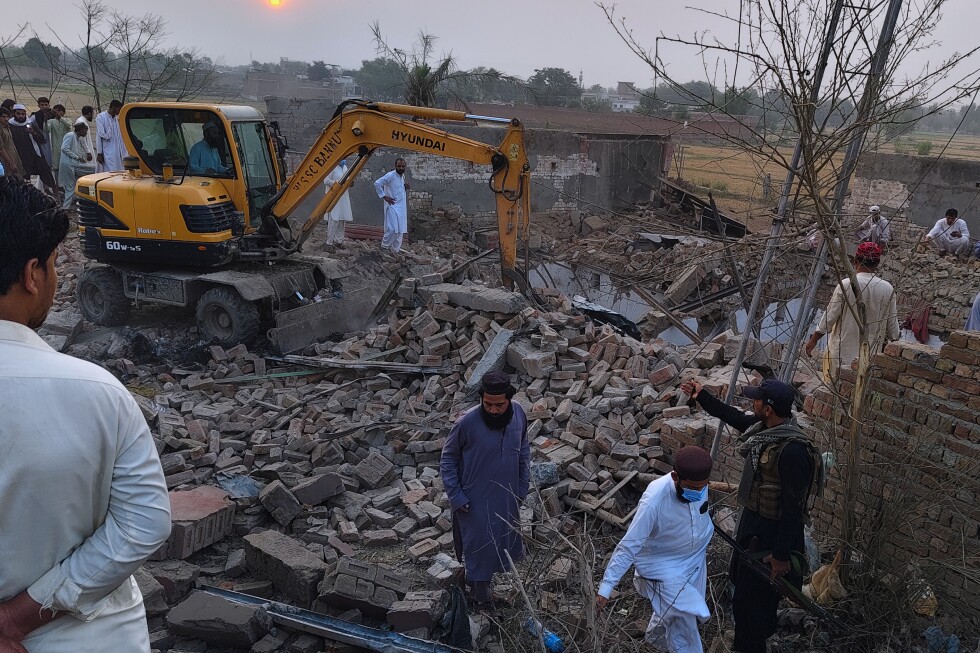
Some officers died immediately in the exchange of gunfire, while others were killed when the building collapsed from the force of the explosion. Rescue workers conducted an extensive search operation throughout the night, using heavy machinery to retrieve bodies trapped under the rubble. Three additional police officers were wounded in the attack and are receiving medical treatment.
On Sunday, hundreds of mourners gathered at police headquarters in Bannu to attend funeral services for the slain officers. Uniformed colleagues stood in solemn silence as flag-draped coffins were carried past grieving families. Many relatives broke down upon seeing the coffins of their loved ones, while a Muslim cleric led funeral prayers under heightened security measures.
Pakistani security forces have launched a comprehensive operation to track down the perpetrators of the attack. A newly formed militant organization calling itself Ittehad-ul-Mujahideen Pakistan claimed responsibility in a statement sent to local reporters. Though the group presents itself as being formed by splinter factions of the Pakistani Taliban (Tehrik-e-Taliban Pakistan or TTP), Pakistani authorities have accused it of simply being a front group for the TTP itself.
The attack comes amid a significant surge in militant violence across Pakistan in recent years. Security analysts attribute much of this violence to the TTP, which, while separate from the Afghan Taliban, maintains close alliances with the group that returned to power in Afghanistan in 2021. Pakistani officials frequently accuse Afghanistan’s Taliban government of providing sanctuary to TTP militants who launch cross-border attacks—allegations that authorities in Kabul consistently deny.
President Asif Ali Zardari condemned the attack and expressed condolences to the victims’ families. He instructed local authorities to provide assistance to the wounded and to residents whose homes were damaged in the blast. In a strongly worded statement, Zardari asserted that “terrorists operating from sanctuaries in Afghanistan under the Taliban administration and supported externally are targeting civilians and law enforcement personnel in Pakistan,” and vowed to target “their facilitators and sponsors.”
Prime Minister Shehbaz Sharif also issued a statement condemning the violence.
The attack further complicates the already tense relationship between Pakistan and Afghanistan. Border tensions between the two neighbors have escalated dramatically since late February, resulting in clashes that have killed hundreds of people on both sides. Although Afghan and Pakistani officials held peace talks mediated by China in early April, sporadic cross-border violence has continued, albeit at reduced intensity.
Khyber Pakhtunkhwa province, where the attack took place, has been particularly hard hit by terrorism in recent years. The province shares a long, porous border with Afghanistan that has historically been difficult to secure, making it vulnerable to militant infiltration. Local communities have suffered extensively from the ongoing violence, which has severely impacted economic development and social stability in the region.
This latest attack represents one of the deadliest incidents targeting Pakistani security forces this year and underscores the continuing security challenges facing the country as it struggles to contain militant violence along its western frontier.
Fact Checker
Verify the accuracy of this article using The Disinformation Commission analysis and real-time sources.
