


Listen to the article
Berlin Zoo Tours Offer Enrichment for Dementia Patients, Caregivers
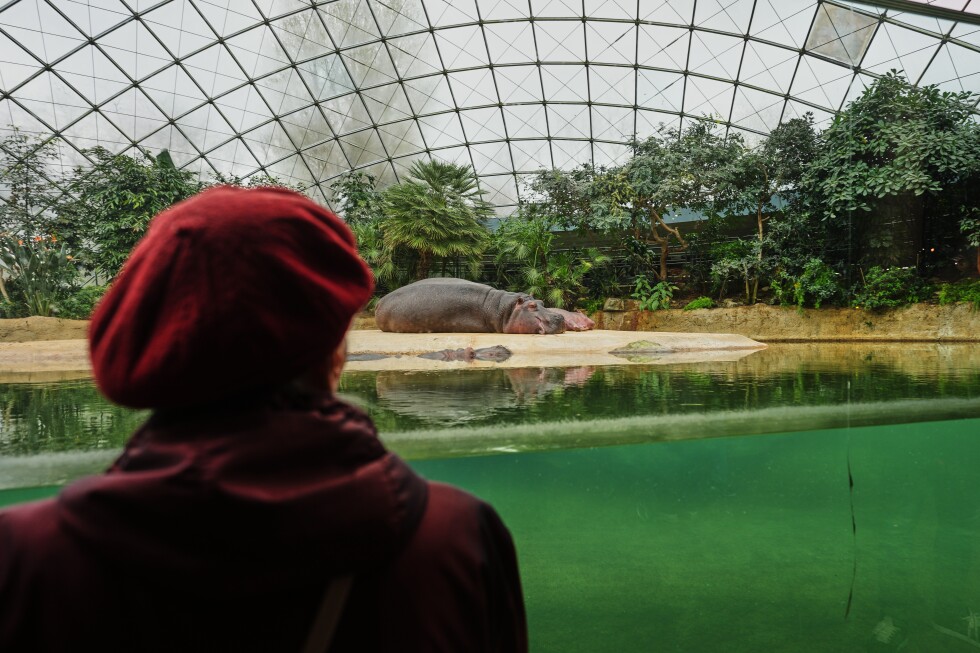
An 86-year-old Christel Krueger watched intently as a mother hippopotamus and her calf rested on a sandbar, her eyes widening with delight despite the thick glass and murky water separating them. Krueger was participating in a specialized Berlin Zoo tour designed specifically for people living with dementia.
The program, organized by Malteser Deutschland, part of the Catholic aid organization Malteser Order of Malta, offers a rare opportunity for dementia patients to engage with the outside world in a carefully controlled environment. Alongside Krueger, fellow participants Ingrid Barkow observed elephants from her wheelchair while Monika Jansen, 85, stretched to get a better view of rhinoceroses.
“When I get home, I’ll still be thinking about it,” Jansen remarked. “Maybe even at night, while I’m sleeping and dreaming about it.”
These women represent just a small fraction of Germany’s approximately 1.6 million people living with dementia, according to the Office of the National Dementia Strategy. That number is projected to rise dramatically to 2.8 million by 2050, reflecting a growing global crisis as populations age worldwide.
In response to this demographic shift, cultural institutions across the globe have been developing more inclusive programming in recent years. Museums, zoos, and other venues are increasingly offering barrier-free experiences tailored to visitors with various needs. These include sign-language tours for the deaf and hard of hearing, tactile experiences for those with visual impairments, and specialized programs for people on the autism spectrum.
The Berlin chapter of Malteser Deutschland launched its cultural program for people with dementia last year, addressing a significant gap in accessibility. “People with dementia aren’t very visible in our society. It’s still a major taboo subject, yet it actually affects a great many people and it’s important that they continue to be at the heart of society,” explained project coordinator Christine Gruschka. “They have a right to participate, just like everyone else.”
Dementia encompasses various conditions characterized by progressive cognitive decline, including memory loss, reasoning difficulties, language problems, and changes in personality and emotional control. While Alzheimer’s disease is the most recognized form, numerous other types exist, each with distinct symptoms and underlying biological mechanisms.
The specialized tours in Berlin currently operate at four locations: the Berlin Zoo, the Museum of Natural History, Britzer Garden, and Charlottenburg Palace. Organizers hope to expand to additional venues as the program grows.
Gruschka emphasized why standard tours often fail dementia patients: “Normal tours are often too fast, too loud, with too many people and too many distractions. That’s why we’ve made it our goal to create programs specifically for people with dementia: Where they still feel seen, where they feel comfortable, and where they can still show that they’re still here and can still be part of it.”
During the zoo tour, coordinator Carola Tembrink thoughtfully limited the itinerary to just three animal habitats—hippopotamuses, rhinoceroses, and elephants—to prevent participants from becoming overwhelmed or fatigued. This measured approach allows visitors to focus and engage meaningfully with each experience.
“The zoo is a wonderful place for tours like this because almost everyone who grew up in Berlin has been here as a child,” Tembrink noted. “And especially for people with dementia, childhood memories are often still present—they just need to be jogged a bit—and that happens naturally when they see the animals, smell the air as they enter the zoo, or when they go into the rhino house and catch a different scent.”
The benefits extend beyond the patients themselves. For caregivers and family members, these outings provide invaluable respite and community. Kerstin Hoehne, whose mother Christel Krueger was diagnosed with dementia last year after exhibiting symptoms for over two years, appreciates the sense of belonging.
“What’s nice is that it’s also with, let’s say, like-minded people, that you’re not alone, but that you have a sense of belonging because everyone else might have the same problem,” Hoehne said.
The emotional impact of these experiences can be profound. Manuela Grudda, who pushed her mother Ingrid Barkow’s wheelchair through the zoo, found connection despite communication challenges. “I can’t really communicate with her in a normal way, of course, but I see that when I show her something, she looks at it, she’s paying attention, and that’s important,” Grudda shared. “And it just makes me happy that she’s not just in her own world, but also in this one.”
As dementia rates continue to rise globally, such inclusive programming represents an essential step toward maintaining dignity and quality of life for those affected, while offering their caregivers moments of joy and connection in what can often be an isolating journey.
Fact Checker
Verify the accuracy of this article using The Disinformation Commission analysis and real-time sources.

14 Comments
Nice to see insider buying—usually a good signal in this space.
The cost guidance is better than expected. If they deliver, the stock could rerate.
Good point. Watching costs and grades closely.
Good point. Watching costs and grades closely.
Production mix shifting toward World might help margins if metals stay firm.
Production mix shifting toward World might help margins if metals stay firm.
Silver leverage is strong here; beta cuts both ways though.
Good point. Watching costs and grades closely.
The cost guidance is better than expected. If they deliver, the stock could rerate.
Good point. Watching costs and grades closely.
Exploration results look promising, but permitting will be the key risk.
Good point. Watching costs and grades closely.
Nice to see insider buying—usually a good signal in this space.
Good point. Watching costs and grades closely.