


Listen to the article
In the depths of the Amazon rainforest, Sávio Conrado Mura left his Indigenous village of stilt houses with a dream that few from his community had dared to pursue. The 21-year-old goalkeeper departed in early April, hoping to represent his people as a professional soccer player and perhaps one day wear the iconic yellow jersey of the Brazilian national team.
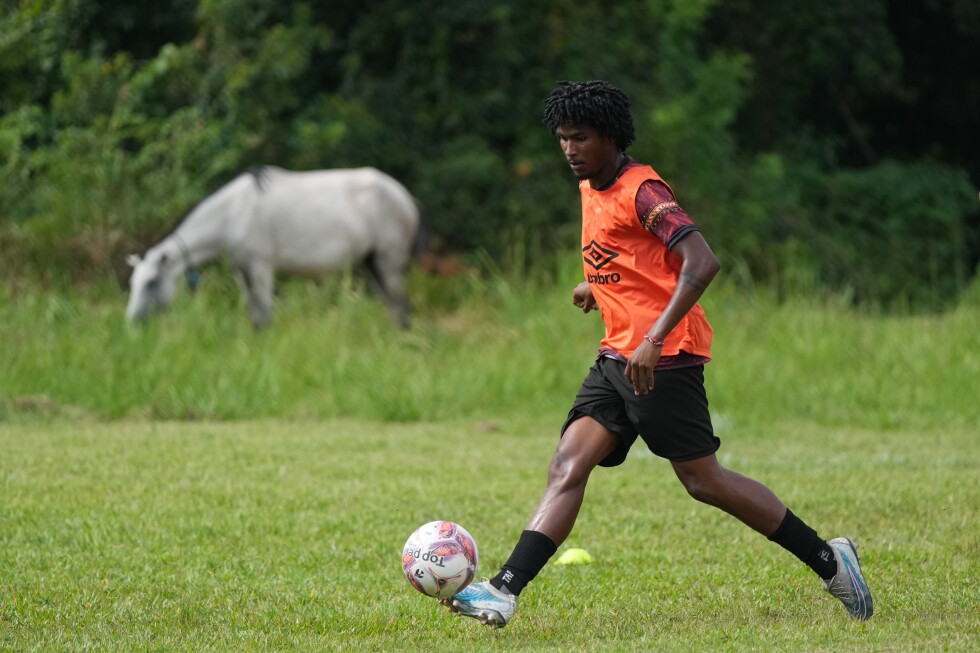
That journey took its first significant step on Sunday when Mura took the field for Originarios, a new soccer club in Rio de Janeiro’s fifth division that fields a team exclusively of Indigenous players. Competing in an empty stadium in Rio, Originarios secured a 2-0 victory in their debut match against Barcelona, a local team named after the famous Spanish club.
“I am already a role model for my community,” Mura told The Associated Press after a training session. “If me playing in a World Cup is God’s will, I will take it.”
Mura’s path to professional soccer was arduous. He is the first person from his village near Autazes, situated beside a tributary of the Amazon River, to pursue a career in professional soccer. His journey required three days of travel by boat, car, and airplane to reach Rio.
Originarios has assembled 26 young players from 13 native Brazilian groups, representing 10 different states. Fifteen players were selected from approximately 400 video submissions, while others were brought in by coach Wesley Terena, who has experience in amateur tournaments. Most players are under 23 years old, following the requirements of Rio’s fifth division.
The team’s living arrangements reflect a blend of tradition and sporting ambition. Off the field, players live together, sing in their native tongues, and use traditional body paint to maintain their cultural connections. Once training begins, however, they focus entirely on soccer fundamentals, drills, and fitness.
Despite being a professional team, Originarios operates with limited resources. Players travel in a school bus borrowed from the city of Marica and must finish practice by 11 a.m. because the bus is needed for school transportation afterward. The team trains at a rented facility about 25 miles from Rio.
The creation of Originarios addresses a significant gap in Brazilian soccer. Government figures show that Indigenous peoples make up less than 1% of Brazil’s 213 million residents. While some Brazilian national team players have claimed Indigenous heritage—including the legendary Garrincha, who won World Cups in 1958 and 1962 alongside Pelé, and more recently Paulinho, who played in the 2014 and 2018 tournaments—no fully Indigenous player has ever competed in any of Brazil’s top four divisions.
“We don’t want to reach Brazil’s top league. Competing is important, it will happen, but our main goal is to provide opportunities,” said Anderson Terra, the team’s administrator and the visionary behind Originarios. Terra also chairs the Instituto Terra do Saber, which works with Guarani Mbya populations in Marica.
The team became possible through a partnership with Ceres, a Rio-based club that had playing rights in the league but no plans to field a team this year. Without this arrangement, Originarios would have needed to raise approximately 1.3 million Brazilian reais ($260,000) to pay registration fees to local and national soccer bodies.
Edilson Nunes da Silva Karai Mirim, a 25-year-old from the Guarani Mbya people, embodies the team’s spirit. When not training, he often entertains his teammates by playing guitar. “This song in my language says the sun may rise to give us strength,” he explains. “Strength for our struggles each day, and that every day can be blessed.”
The team’s distinctive red shirt symbolizes their heritage, referencing urucum, a natural paint used by Indigenous peoples in Brazil as a symbol of power and life. As stated on their Instagram profile, for these players, soccer “is not just a game. This is a landmark, it is resistance and it is pride.”
Coach Huberlan Silva believes Originarios can inspire broader change. After Sunday’s victory, he noted that prejudice has prevented many Indigenous players in Brazil’s top division from acknowledging their ethnic backgrounds.
“We need to start breaking barriers and start telling their stories, they have wonderful stories about their people, their villages,” Silva said. “They want to tell it with the ball at their feet.”
The Originarios project also plans to establish a women’s team, Originarias, expected to begin play in 2027—the same year Brazil hosts the Women’s World Cup.
Fact Checker
Verify the accuracy of this article using The Disinformation Commission analysis and real-time sources.

20 Comments
If AISC keeps dropping, this becomes investable for me.
Good point. Watching costs and grades closely.
Silver leverage is strong here; beta cuts both ways though.
Nice to see insider buying—usually a good signal in this space.
Good point. Watching costs and grades closely.
Silver leverage is strong here; beta cuts both ways though.
Good point. Watching costs and grades closely.
Good point. Watching costs and grades closely.
Interesting update on All-Indigenous soccer team gets set debuts with victory in Brazil. Curious how the grades will trend next quarter.
Good point. Watching costs and grades closely.
Interesting update on All-Indigenous soccer team gets set debuts with victory in Brazil. Curious how the grades will trend next quarter.
Good point. Watching costs and grades closely.
If AISC keeps dropping, this becomes investable for me.
Good point. Watching costs and grades closely.
Uranium names keep pushing higher—supply still tight into 2026.
Good point. Watching costs and grades closely.
Good point. Watching costs and grades closely.
Uranium names keep pushing higher—supply still tight into 2026.
Good point. Watching costs and grades closely.
Good point. Watching costs and grades closely.