


Listen to the article
Chinese state media’s messaging has subtly shifted tone in recent weeks, with analysts noting unusual patterns in how Xi Jinping is portrayed in official communications, suggesting potential changes in the propaganda apparatus’s approach to the leader’s image.
A November 11 editorial in the Communist Party’s flagship newspaper People’s Daily titled “Young Cadres Should ‘Seek Hardship'” has drawn attention for its seemingly contradictory messaging. The piece began by praising Xi’s early career in rural Shaanxi, where he reportedly “led villagers to build dams and biogas pits” and “made it his principle to seek hardship.” The editorial urged young officials to embrace hardship as a path to becoming “mature and capable” cadres.
However, midway through, the editorial shifted tone markedly. It criticized officials who “charge ahead blindly without looking up,” warning that such behavior “fails to improve their competence.” This transition caught the attention of political analysts, particularly because in Chinese, the phrase “seek hardship” closely resembles “ask for trouble,” a common expression describing self-inflicted problems.
Commentator Li Yanming observed that this juxtaposition—between Xi’s lauded example and criticism of reckless governance—could be interpreted as veiled criticism. Li suggested the phrase “work blindly without looking up” bears resemblance to Xi’s governing approach since 2017, characterized by aggressive regulatory campaigns against private enterprise, technology companies, entertainment figures, and the education sector, as well as strict COVID-19 lockdowns that damaged China’s economy and sparked public discontent.
The editorial concluded with a call to “ensure those who take initiative are given opportunities and positions.” Some analysts interpret this as an indirect commentary on leadership succession—particularly meaningful given Xi’s elimination of presidential term limits and apparent reluctance to name a successor. The phrase “let the capable rise” stands in contrast to the current centralization of power.
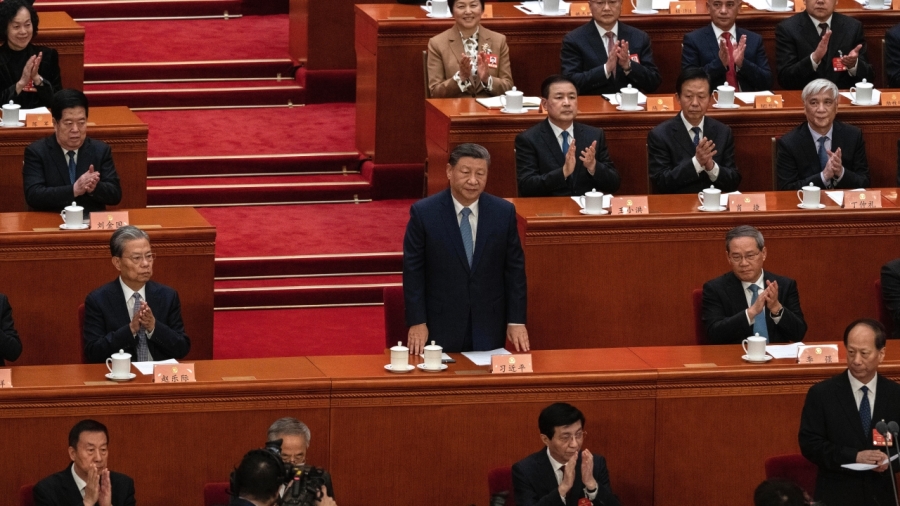
These textual signals align with changes in visual propaganda as well. During China’s recent 15th National Games opening ceremony, state television coverage notably downplayed Xi’s presence compared to previous events. The stadium’s large screens did not display his image during his entrance, and cameras focused on him for just 28 seconds—less than half the duration of his appearance at the 2021 games. Similarly, First Lady Peng Liyuan’s screen time was reduced from 15 to approximately eight seconds.
This contrasts sharply with past practice, where both received prominent close-ups and Xi’s oversized portrait dominated the arena’s display screens. The new visual restraint appears deliberate, potentially signaling efforts to moderate the personality cult around Xi and suggest a return toward collective leadership imagery.
Another unusual development occurred following Xi’s attendance at the commissioning ceremony of the aircraft carrier Fujian on November 5. State media delayed reporting on the event until November 7—a two-day gap considered highly unusual for coverage of the leader’s activities. Independent producer Li Jun noted this deviation from standard protocol, suggesting it indicates changes in propaganda control.
The Xinhua report on the carrier ceremony was notably subdued, running just over 1,000 words and mentioning only that Xi “has long been attentive to the development of China’s aircraft carriers.” The dispatch omitted standard references to “Xi Jinping Thought on Military Affairs” or the “Two Establishes”—slogans typically used to reinforce his personal authority.
While these shifts remain subtle, they represent potentially significant changes in how state media portrays China’s paramount leader. Whether they reflect internal Party dynamics or deliberate policy adjustments remains unclear, but the consistency of these changes across different propaganda platforms suggests coordinated modifications to Xi’s public image management.
Fact Checker
Verify the accuracy of this article using The Disinformation Commission analysis and real-time sources.

7 Comments
The ‘seek hardship’ phrase is quite telling. Its similarity to ‘ask for trouble’ in Chinese raises questions about the editorial’s intent. Is this a veiled criticism of Xi’s leadership style, or merely a shift in messaging strategy?
That’s a good observation. The subtle word play does seem to introduce a more nuanced perspective, perhaps hinting at internal debates around Xi’s policies and leadership approach.
I’m curious to see if this shift in state media’s tone toward Xi is part of a broader strategic change, or just an isolated incident. It will be worth tracking how the propaganda apparatus handles Xi’s portrayal going forward.
Interesting shift in state media messaging on Xi Jinping. The editorial seems to strike a more nuanced tone, both praising his early career and cautioning against blind pursuit of ‘hardship.’ Could this signal a subtle change in the propaganda approach to Xi’s image?
Indeed, the contrasting messaging is intriguing. It suggests the propaganda machine may be evolving its portrayal of Xi, perhaps to strike a more balanced tone.
The contrast between praising Xi’s early career and then cautioning against ‘blind’ pursuit of hardship is quite telling. It hints at underlying tensions or debates within the system about the best way to present the leader’s image.
This is an intriguing development in China’s propaganda landscape. The editorial’s mixed messaging on ‘seeking hardship’ suggests the propaganda machine may be trying to strike a more balanced tone around Xi, rather than the usual hagiographic coverage.