


Listen to the article
The internet revolution that once promised to weaken authoritarian regimes has instead given rise to a more sophisticated form of political control, as governments in China and Vietnam have mastered the art of digital manipulation rather than succumbing to free information flow.
Far from being overwhelmed by the digital age, these authoritarian states have adapted with remarkable agility, developing techniques that go beyond simple censorship. Their approach now centers on flooding citizens with carefully crafted narratives, manipulating online visibility, and leveraging algorithms to maintain political control.
China has emerged as the pioneer of what experts call “digital authoritarianism.” While early efforts focused on the “Great Firewall” to block foreign platforms and censor sensitive information, Beijing’s strategy has evolved significantly over time. The government recognized that simple blocking was insufficient in an era of social media and mobile connectivity.
Research by political scientist Gary King and colleagues reveals that Chinese authorities generate hundreds of millions of social media posts annually through coordinated commentators, often called the “50-Cent Party.” Contrary to common belief, these campaigns rarely aim to directly debate critics. Instead, they distract public attention, amplify patriotic sentiment, and overwhelm political discussions with emotional or nationalistic content.
Beijing has also decentralized its propaganda apparatus. Government agencies, local authorities, police departments, and state-affiliated influencers now function as content creators on platforms like Douyin (China’s TikTok). Nationalist messaging is seamlessly integrated into entertainment, memes, music, lifestyle videos, and short-form content, adopting the language and aesthetics of internet culture itself.
This approach creates a more resilient form of control. China’s objective isn’t necessarily preventing citizens from knowing the truth but preventing them from knowing that others share their knowledge—effectively weakening the potential for collective action. This dynamic exploits what political theorist Timur Kuran described as “preference falsification,” where individuals privately recognize social discontent but remain publicly silent because they believe they’re isolated.
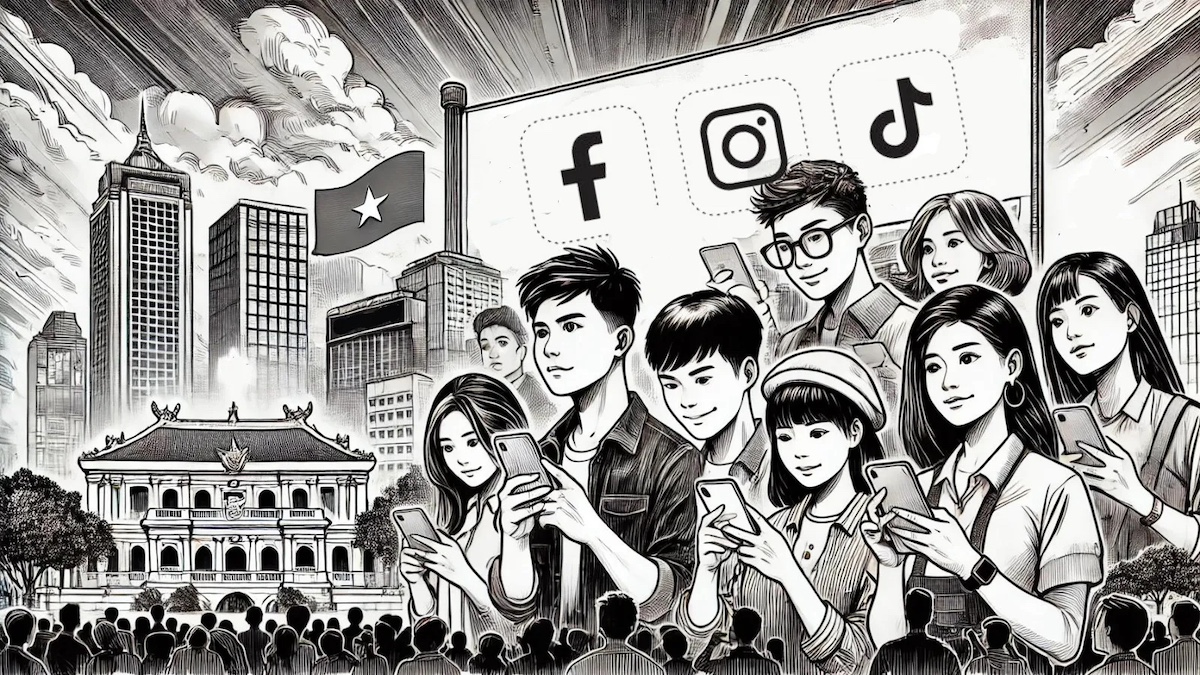
Vietnam has increasingly adopted elements of China’s model while adapting them to its more globally connected internet environment. Unlike China, Vietnam hasn’t completely blocked major international platforms like Facebook, YouTube, and TikTok. Instead, Hanoi employs selective pressure, platform cooperation, surveillance, and narrative flooding.
A key feature of Vietnam’s approach is the growing role of security institutions in cyberspace governance. “Force 47,” a military-linked cyber unit reportedly involving thousands of participants, represents an upgraded version of organized digital opinion management. Working alongside state-affiliated media networks and patriotic influencers, these forces enforce online narratives in a decentralized manner.
This evolution marks a transition from a traditional police state to a “digital police state,” where surveillance, propaganda, online nationalism, and algorithmic amplification merge into a continuous system of governance.
Like China, Vietnam has embraced narrative flooding rather than relying solely on arrests or direct censorship. Authorities promote campaigns centered on “positive content” and patriotic messaging, with official initiatives encouraging “the beautiful to eliminate the ugly”—saturating social media with state-approved narratives while marginalizing critical voices.
This strategy offers political efficiency. While excessive arrests generate international criticism and potential domestic sympathy for dissidents, mobilizing influencers, entertainment content, or patriotic TikTok campaigns creates the appearance of voluntary social consensus, making the state’s role less visible even as its influence expands.
Vietnam has also followed China’s regulatory approach, passing its own Cybersecurity Law in 2018 shortly after Beijing enacted similar legislation. These legal frameworks provide institutional foundations for expanding digital control while pressuring international technology companies to comply with domestic political demands.
The effectiveness of modern digital authoritarianism lies in understanding how social media systems function. Authoritarian regimes recognize that algorithms reward engagement, emotional intensity, and repetition. By mobilizing networks of commentators and content creators, governments can artificially amplify preferred narratives without formally banning opposing viewpoints.
In this environment, visibility itself becomes political power. The state no longer needs to persuade every citizen—it only needs to shape the information environment sufficiently to fragment attention, exhaust outrage, and discourage coordinated dissent.
This model proves particularly effective among younger generations whose political perceptions are increasingly shaped by algorithmically curated short-form video content rather than traditional ideological education.
The adaptation of authoritarian regimes to the digital era presents a far more complex challenge than earlier theories of internet democratization anticipated. China demonstrated that authoritarian governments could survive the internet age, and Vietnam shows these methods can be adapted even within globally connected digital ecosystems.
The danger extends beyond traditional censorship to the normalization of invisible influence systems embedded within entertainment, influencer economies, and algorithmic recommendation systems. When propaganda wears the face of relatable influencers, viral memes, and patriotic entertainment, authoritarian control becomes harder to identify and potentially more effective than ever before.
Fact Checker
Verify the accuracy of this article using The Disinformation Commission analysis and real-time sources.

8 Comments
This article highlights the evolving nature of authoritarian control in the digital age. It’s a sobering reminder that the internet’s promise of greater freedoms has not been fully realized, as governments find new ways to manipulate online narratives.
While I appreciate the technical sophistication involved, the intent behind China and Vietnam’s digital information control strategies is deeply troubling. This type of political manipulation has no place in an open, free society.
I agree. These authoritarian regimes are abusing technology to maintain power and suppress dissent. We must find ways to promote digital freedoms and combat the rise of digital authoritarianism.
This is a concerning development. Digital authoritarianism is a worrying trend that undermines free information flow and democratic principles. We must remain vigilant against such efforts to control and manipulate online narratives.
This article highlights the evolving tactics used by authoritarian states to adapt to the digital age. It’s a sobering reminder that the internet revolution has not automatically led to greater political freedoms, as many had hoped.
While the technical sophistication is impressive, the underlying intent of these digital control strategies is highly problematic. Authoritarian regimes should not be allowed to abuse technology to maintain their grip on power.
The ability of China and Vietnam to leverage digital tools for political control is deeply concerning. This represents a worrying trend that threatens the free flow of information and democratic values. We must be vigilant in addressing this challenge.
Absolutely. Countering digital authoritarianism should be a priority for those who value open and transparent societies. We need to find ways to empower citizens and protect online freedoms.