


Listen to the article
The White House has released an AI-generated video depicting President Donald Trump working at McDonald’s, just days after his appearance at the fast food giant’s conference. The video, styled like a dramatic movie trailer, shows a digitally created Trump serving fries and interacting with customers in scenes that never actually occurred.
Set to tense background music with a deep-voiced narrator, the video presents Trump as a symbolic figure who rose from humble beginnings. “One man had a dream. A dream his life was meant for more than serving fries,” the narrator declares. “Trump didn’t just see grease, he saw greatness. He didn’t just see a fryer, he saw a fresh start… For America.”
The heavily edited footage alternates between shots of the AI Trump wiping his brow while preparing food and waving to crowds from a drive-thru window. At one point, the digital version of the president remarks, “Look at the crowd over there, look how happy everybody is. They’re happy because they want hope. They need hope.”
Despite the implication that Trump once worked at McDonald’s before his rise to political power, the president has no history of employment with the fast food chain. The video dramatically portrays him removing a McDonald’s apron and donning a suit jacket as the narrator continues, “Two sides of the same man. Two chapters of the same story. From the Golden Arches to the Golden Age.”
The White House production references Trump’s campaign stop last October, when he briefly worked behind the counter at a McDonald’s location in Pennsylvania as a photo opportunity during the 2024 election. That event generated significant media attention as part of his outreach to working-class voters.
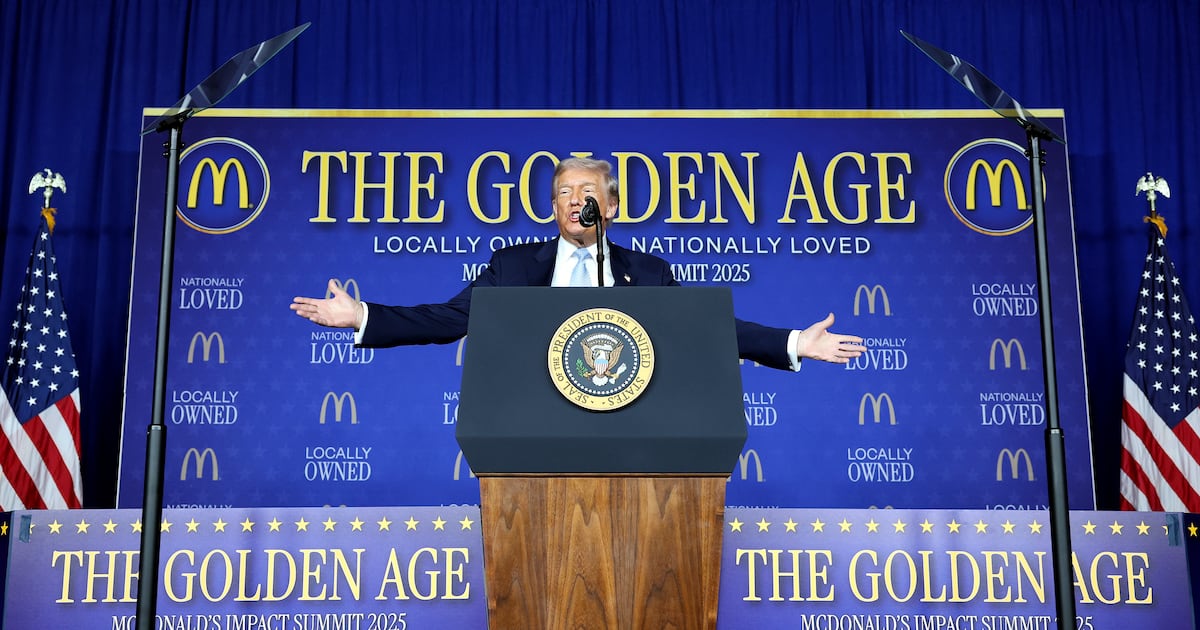
This unusual promotional video follows Trump’s speech at McDonald’s “Impact Summit” in Washington, where he attempted to downplay economic concerns while making a series of disconnected statements. During his address to franchise owners, he claimed, “This is also the golden age of America, because we are doing better than we’ve ever done as a country. Prices are coming down and all of that stuff.”
In the same speech, Trump urged franchise owners to resist minimum wage increases in Democratic-leaning states, telling them he “couldn’t help you there.” The president’s remarks veered into unexpected territory when he discussed his unilateral decision to rename the Gulf of Mexico to the “Gulf of America.”
“Has nothing to do with McDonald’s, but maybe it does,” Trump said regarding the name change. “Because we have 92 percent of the shoreline… Wasn’t that a good change? Seriously, wasn’t that beautiful? And it was done in an instant. Normally, you think a thing like that would take years. This took, like, 10 minutes.”
The administration’s use of artificial intelligence to create fictional scenarios represents a new frontier in political messaging, raising questions about the blurring of reality in official communications. As AI-generated content becomes increasingly sophisticated and accessible, distinguishing between authentic and fabricated political imagery presents growing challenges for voters and media organizations.
Trump concluded his McDonald’s summit appearance by declaring himself “one of your all-time most loyal customers” – a claim now seemingly extended through the White House’s latest AI creation portraying him as not just a patron, but a former employee of the global fast food chain.
The video, captioned “THE TALE OF THE AMERICAN DREAM. TONIGHT 6 PM EST. STAY TUNED,” represents an unusual convergence of presidential messaging, corporate branding, and artificial intelligence – all deployed in service of political narrative-building.
Fact Checker
Verify the accuracy of this article using The Disinformation Commission analysis and real-time sources.

16 Comments
I have to say, this McDonald’s video from the White House is a bit of a head-scratcher. While I appreciate the attempt to connect with voters, the use of AI-generated footage feels like a risky move that could backfire. I’ll be interested to see how this messaging strategy is received by the public.
Agreed. The White House should be cautious about using AI in this way, as it could undermine trust and come across as inauthentic. Voters may view this type of content as a gimmick rather than a genuine attempt at political communication.
The White House’s decision to release this McDonald’s-themed video is certainly an unconventional one. While I understand the intent to present the president as more relatable, the use of AI-generated footage feels like a bit of a stretch. I’ll be curious to see how the public responds to this type of messaging.
You raise a fair point. Relying on AI-created content, even if meant symbolically, could easily come across as disingenuous or misleading. The White House will need to be very careful in how they deploy this type of technology in their political messaging.
The White House’s decision to release this McDonald’s-themed video is certainly an attention-grabbing move. However, I’m not sure it will be an effective political messaging strategy. The use of AI-generated footage feels gimmicky and could undermine the intended message. I’ll be curious to see how the public reacts.
You make a fair point. Relying on AI technology to create this type of content could easily come across as disingenuous or even manipulative. The White House will need to tread carefully with this approach to avoid backlash from voters.
This McDonald’s video is certainly an unconventional approach from the White House. I appreciate the attempt to humanize the president, but the use of AI-generated footage raises concerns about authenticity. It will be interesting to see how voters respond to this type of messaging.
Agreed. While the intent may be to connect with voters, the reliance on AI technology in this video could backfire. The White House should be mindful of how this type of content is perceived, especially in the current political climate.
This McDonald’s-themed video is certainly eye-catching, but I’m not sure it will resonate with most voters. Portraying the president as a fast food worker feels a bit like political theater. I’d be interested to see if this messaging strategy pays off for the White House.
I agree, the video seems more like a publicity stunt than a serious attempt at political messaging. Using AI-generated footage also raises some concerns about authenticity and transparency.
Interesting messaging campaign from the White House. I wonder if this digitally-created footage is meant to portray the president as more relatable or as a ‘man of the people’? Curious to see how the public reacts to this unconventional approach.
You raise a good point. The video does seem to be trying to humanize the president and present him as having humble origins. But the use of AI-generated footage is rather controversial.
As an avid follower of political news, I have to say this McDonald’s-themed video from the White House is a bit puzzling. While I understand the intent to present the president as more relatable, the use of AI-generated footage feels gimmicky. I’ll be interested to see if this messaging strategy resonates with the public.
I share your skepticism. This type of video feels more like a PR stunt than a serious attempt at political communication. The White House should be cautious about using AI in this way, as it could undermine trust in the messaging.
The White House’s decision to release this AI-powered video is definitely a bold move. While it may be intended to connect with voters, the use of fictional footage could backfire and be seen as misleading. I’ll be curious to see how the public responds to this unconventional approach.
You make a fair point. Portraying the president in this way, even if meant symbolically, could easily come across as disingenuous. The White House will need to tread carefully with this type of messaging.