


Listen to the article
Venezuelan Vice President Delcy Rodríguez has assumed the role of interim president amid what Venezuelan officials describe as a failed U.S. “regime change” operation, as tensions between the two nations continue to escalate following President Nicolás Maduro’s alleged kidnapping attempt.
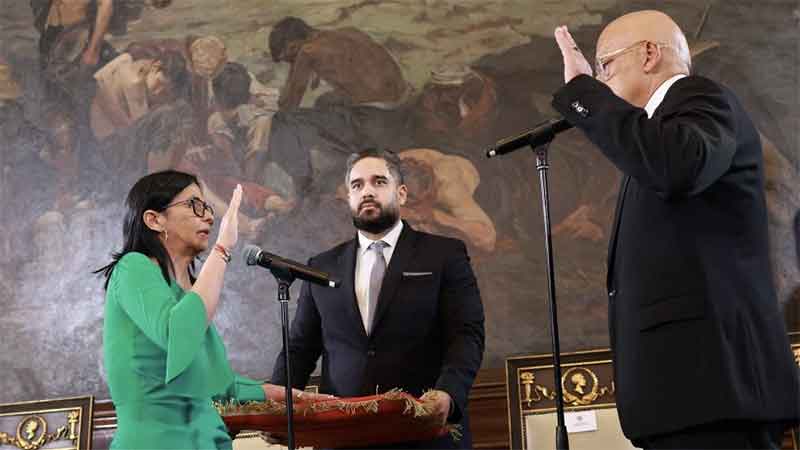
Rodríguez was sworn in as interim president on January 5 in accordance with Venezuela’s constitution, which stipulates that the vice president takes office if the president cannot fulfill his duties. However, major U.S. media outlets, including The Wall Street Journal and The Washington Post, have characterized her ascension differently, suggesting her position resulted from negotiations with the Trump administration.
The Washington Post claimed on January 6 that “the Trump administration appears to have quietly settled on Delcy Rodríguez, Nicolás Maduro’s right hand, as the figure it prefers to lead Venezuela after Maduro’s fall.” Similarly, The Wall Street Journal published an article titled “Venezuelan Regime’s New Strategy: Appease Trump to Survive,” implying Rodríguez was compromising on the legacy of Presidents Maduro and Hugo Chávez.
These narratives gained momentum after former President Trump remarked on January 3 that Rodríguez had spoken with Secretary of State Marco Rubio and appeared “quite courteous,” allegedly saying “we’re going to do whatever you need.” Rodríguez quickly refuted this characterization, appearing on state television to declare that “there is only one president in this country, and his name is Nicolás Maduro Moros.”
The Wall Street Journal further claimed the CIA viewed Rodríguez as the best-positioned short-term successor to Maduro, fueling speculation about potential U.S. influence in Venezuela’s leadership transition. Critics argue these reports constitute a deliberate misinformation campaign designed to sow division within the Chavista movement by suggesting Rodríguez had made a deal with the CIA and Trump administration.
In a formal statement on January 4, Rodríguez addressed the United States directly: “We extend an invitation to the US government to work together on a cooperation agenda aimed at shared development, within the framework of international law, and to strengthen lasting community coexistence.” Some critics interpreted this statement as evidence of compromise, but supporters note her full message emphasized Venezuela’s commitment to sovereign equality and non-interference.
“We consider it a priority to move toward a balanced and respectful international relationship between the United States and Venezuela, and between Venezuela and the countries of the region, based on sovereign equality and non-interference. These principles guide our diplomacy with the rest of the world,” Rodríguez stated.
The diplomatic tension escalated when Trump warned on January 4, “If she doesn’t do what’s right, she is going to pay a very big price, probably bigger than Maduro.” Rodríguez responded defiantly: “The Venezuelan people are a people who do not surrender, and we do not give up… We are ready to defend Venezuela… We will never again be slaves.”
Political analysts note that the Rodríguez family has deep revolutionary credentials in Venezuela. Delcy and her brother Jorge, the President of the National Assembly, are children of Jorge Antonio Rodríguez, a leader of the Socialist League who was tortured and murdered by the Punto Fijo regime in 1976. Both siblings emerged from this tradition of struggle for socialism, sharing political formation with Maduro himself, who was also a cadre of the same organization.
Critics of U.S. foreign policy argue that Washington’s approach represents a continuation of interventionist strategies in Latin America, violating international law by attempting to influence Venezuela’s internal affairs. Meanwhile, the information campaign surrounding Rodríguez’s interim presidency has divided opinion even among traditional critics of U.S. imperialism, with figures like Tariq Ali and media outlets like Consortium News questioning whether an internal coup had occurred.
As Venezuela navigates this latest political crisis, the situation underscores the ongoing geopolitical tensions in the region and the complex interplay between sovereignty, international relations, and media narratives in shaping public perception of political transitions.
Fact Checker
Verify the accuracy of this article using The Disinformation Commission analysis and real-time sources.

9 Comments
The US criticism of Venezuela’s new president is not surprising given the longstanding tensions between the two countries. However, we should be wary of accepting the US government’s portrayal of events at face value. There are likely nuances and alternative perspectives that are being overlooked.
Absolutely. The US has a history of interfering in the internal affairs of other countries, often under the guise of promoting democracy. We should be skeptical of their motivations and look for independent, impartial sources of information on this issue.
The US criticism of Venezuela’s new president is not surprising, given the long history of tensions between the two countries. However, we should be cautious about taking the US government’s portrayal of events at face value. There are likely nuances and alternative perspectives that are worth considering.
Agreed. The US has a track record of interfering in the internal affairs of other countries, often under the guise of promoting democracy. We should be skeptical of their motivations and look for independent, impartial sources of information on this issue.
This situation highlights the ongoing power struggle between the US and Venezuela. It’s important to understand the complex geopolitical and economic factors at play, beyond just the rhetoric from US officials. I’m curious to see how this plays out and what the implications will be for the region.
I share your curiosity. This is a fluid situation and I think it’s wise to withhold judgment until more facts emerge. It’s important to seek out diverse perspectives and avoid simply accepting the dominant narrative.
Interesting developments in Venezuela. It’s important to look at this situation objectively and consider all perspectives, rather than just accepting the US narrative at face value. There seems to be a lot of political maneuvering and competing claims about the legitimacy of the new leadership.
I agree, it’s a complex situation and I think it’s important to be cautious about making assumptions. We should wait for more concrete information to emerge before drawing conclusions.
This situation in Venezuela highlights the ongoing power struggle between the US and the country’s leadership. It’s important to understand the complex geopolitical and economic factors at play, beyond just the rhetoric from US officials. I’m curious to see how this plays out and what the implications will be for the region and global energy markets.