


Listen to the article
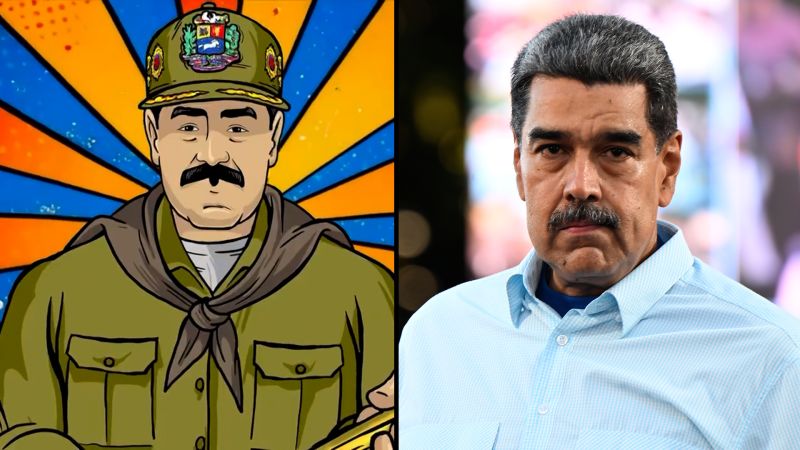
Venezuelan state television has launched an animated propaganda campaign portraying President Nicolás Maduro as a superhero, drawing both criticism and ridicule amid the country’s ongoing economic and political crisis.
The series of short clips, which began airing on state-controlled media outlets last week, feature a cartoon version of Maduro transformed into “Super Bigote” (Super Mustache), a caped crusader battling against foreign intervention and domestic opposition.
In one segment, the animated Maduro character defeats a blond villain resembling former U.S. President Donald Trump, who attempts to sabotage Venezuela’s electrical grid. Another episode shows Super Bigote thwarting economic sanctions with superhuman strength while Venezuelan flags wave triumphantly in the background.
The propaganda campaign comes at a critical moment for Venezuela, where inflation has reached staggering levels and more than six million citizens have fled the country since 2014, according to United Nations data. The once oil-rich nation continues to struggle with widespread food shortages, power outages, and a collapsing healthcare system.
Political analysts view the cartoon series as part of a broader effort to rehabilitate Maduro’s image ahead of potential negotiations with opposition leaders and the international community. The timing coincides with recent diplomatic overtures between Caracas and Washington regarding sanctions relief and humanitarian aid.
“This superhero characterization attempts to create a personality cult in a country where basic services are failing,” explains Maria Fernanda Rodriguez, a political scientist at Universidad Central de Venezuela. “It’s reminiscent of propaganda techniques used in authoritarian regimes throughout history, where leaders are portrayed with almost mythical qualities.”
The Venezuelan government has increasingly turned to multimedia propaganda as traditional support for Maduro’s administration has eroded. State media regularly attributes the country’s economic troubles to foreign “imperial forces” rather than domestic policy failures that have seen the country’s oil production plummet from 3.5 million barrels per day in the late 1990s to less than 500,000 barrels currently.
On social media, Venezuelan citizens have responded to the cartoon with a mixture of mockery and outrage. The hashtag #SuperBigoteRidículo (RidiculousSuperMustache) briefly trended on Twitter in Venezuela before mysteriously disappearing from trending topics, leading opposition figures to allege government manipulation of social media algorithms.
“While hospitals lack basic supplies and children go hungry, our tax money funds cartoons portraying the architect of this disaster as a hero,” said Juan Guaidó, the opposition leader recognized as Venezuela’s legitimate president by numerous countries, including the United States. “This is not only propaganda—it’s an insult to suffering Venezuelans.”
The animation style and production quality of the Super Bigote series suggest significant resources have been allocated to the propaganda effort. Media experts note the animations feature professional voice acting, sophisticated graphics, and distribution across multiple platforms including television, social media, and government-sponsored billboards.
Venezuela’s state television network has defended the cartoon series as “educational content aimed at explaining complex geopolitical situations to all audiences.” Government spokesperson Jorge Rodríguez claimed the animations help citizens understand “the economic war being waged against our homeland.”
This is not the first time authoritarian leaders have been portrayed as superheroes in state propaganda. North Korean state media has depicted Kim Jong Un with supernatural abilities, while Russian state television has shown Vladimir Putin in various heroic scenarios.
International human rights organizations have expressed concern that such propaganda further entrenches authoritarian rule in Venezuela, where independent media has been systematically dismantled. The Committee to Protect Journalists documented the closure of more than 100 media outlets since Maduro took office in 2013.
As Venezuela continues to navigate its complex humanitarian and political crisis, the Super Bigote campaign represents a striking example of how disconnected official narratives have become from the daily reality faced by citizens—a population increasingly skeptical of superhero solutions to very real problems.
Fact Checker
Verify the accuracy of this article using The Disinformation Commission analysis and real-time sources.

32 Comments
I like the balance sheet here—less leverage than peers.
Good point. Watching costs and grades closely.
Good point. Watching costs and grades closely.
Uranium names keep pushing higher—supply still tight into 2026.
Good point. Watching costs and grades closely.
The cost guidance is better than expected. If they deliver, the stock could rerate.
The cost guidance is better than expected. If they deliver, the stock could rerate.
Good point. Watching costs and grades closely.
Silver leverage is strong here; beta cuts both ways though.
Good point. Watching costs and grades closely.
Interesting update on Venezuelan Propaganda Portrays President Maduro as Superhero. Curious how the grades will trend next quarter.
Good point. Watching costs and grades closely.
Good point. Watching costs and grades closely.
The cost guidance is better than expected. If they deliver, the stock could rerate.
Production mix shifting toward Propaganda might help margins if metals stay firm.
Good point. Watching costs and grades closely.
Good point. Watching costs and grades closely.
Production mix shifting toward Propaganda might help margins if metals stay firm.
Good point. Watching costs and grades closely.
Silver leverage is strong here; beta cuts both ways though.
Good point. Watching costs and grades closely.
Exploration results look promising, but permitting will be the key risk.
Good point. Watching costs and grades closely.
Good point. Watching costs and grades closely.
Silver leverage is strong here; beta cuts both ways though.
Good point. Watching costs and grades closely.
The cost guidance is better than expected. If they deliver, the stock could rerate.
Silver leverage is strong here; beta cuts both ways though.
Good point. Watching costs and grades closely.
Silver leverage is strong here; beta cuts both ways though.
Good point. Watching costs and grades closely.
Good point. Watching costs and grades closely.