


Listen to the article
Telangana Government Ramps Up Paddy Procurement Amid Opposition Criticism
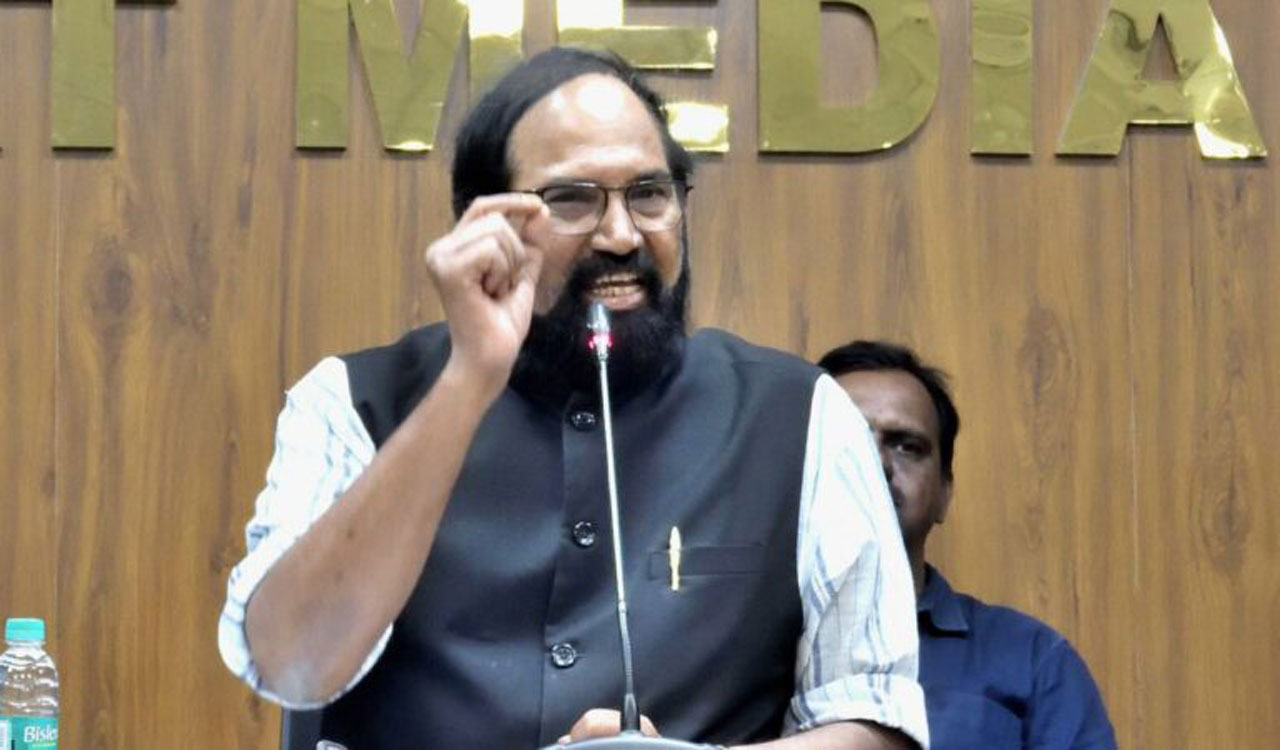
Telangana’s Civil Supplies Minister N. Uttam Kumar Reddy strongly refuted allegations from opposition parties regarding the state’s paddy procurement system on Wednesday, characterizing their claims as “malicious propaganda” designed to mislead farmers.
During a press conference at the Secretariat in Hyderabad, Reddy outlined comprehensive measures implemented by the Congress government to ensure efficient procurement operations across the state. He revealed that a state-level nodal officer has been appointed to continuously monitor procurement centers, while a dedicated control room at the Civil Supplies Department headquarters provides real-time oversight of all operations.
“We have established a special mechanism to deliver timely weather updates to procurement centers, helping them prepare for changing conditions,” Reddy explained. “Additionally, we’ve implemented a token system specifically designed to minimize waiting times for farmers delivering their produce.”
The minister directed particular criticism toward the Bharat Rashtra Samithi (BRS), the former ruling party in Telangana, accusing them of circulating false information about infrastructure at procurement centers. According to Reddy, the current administration has invested in unprecedented improvements to procurement infrastructure.
“Despite facing rejection from voters in the Assembly, Lok Sabha, and municipal elections, BRS leaders continue their misinformation campaign rather than acknowledging reality,” Reddy stated, emphasizing that Telangana has achieved record-breaking crop yields and procurement levels under the Congress government.
The minister provided detailed statistics to support his assertions. The current Rabi season has seen paddy cultivation across approximately 67 lakh acres in Telangana, with projected yields of 141 lakh metric tonnes. To handle this substantial harvest, the state government has allocated ₹21,000 crore (approximately $2.5 billion) and prepared to procure up to 90 lakh metric tonnes of paddy.
Progress reports indicate that authorities have already procured 17.28 lakh metric tonnes and disbursed ₹2,310 crore directly to farmers’ accounts. This represents a significant portion of the expected harvest, with procurement continuing across the state.
Addressing concerns about unseasonal rains affecting crop quality, Reddy detailed protective measures implemented by the government. “We’ve arranged 2.63 lakh tarpaulins to shield harvested paddy from unexpected weather events,” he said. The procurement infrastructure includes 8,575 dedicated centers equipped with 18.75 crore gunny bags for storage.
The state has developed storage capacity for 64.83 lakh metric tonnes, with additional facilities capable of housing another 11.20 lakh metric tonnes. Transportation logistics have been strengthened with approximately 6,200 vehicles deployed specifically to transport grain from procurement centers to mills.
Reddy acknowledged several “unfortunate” farmer deaths at procurement centers but assured that immediate compensation was being provided to affected families. He noted that procurement operations have been extended to both morning and evening shifts to accelerate the process.
The government has also issued safety advisories warning farmers to avoid standing under trees or near electric poles during lightning storms, addressing concerns about weather-related hazards at procurement sites.
This robust defense of procurement operations comes at a critical time for Telangana’s agricultural sector, which remains a cornerstone of the state’s economy. The paddy procurement system directly impacts the livelihoods of millions of farmers across the state, making its efficient operation a political priority for the ruling Congress government.
The exchange highlights ongoing political tensions in Telangana, where agricultural policies remain contentious between the ruling Congress and opposition parties, particularly the BRS, which previously governed the state before losing power in recent elections.
Fact Checker
Verify the accuracy of this article using The Disinformation Commission analysis and real-time sources.

12 Comments
Accusations of ‘malicious propaganda’ are concerning. The government should focus on facts and constructive solutions rather than political attacks, especially when dealing with important agricultural issues.
I agree, a cooperative and fact-based approach is needed to address farmers’ legitimate concerns, not partisan rhetoric.
This seems like a complex issue with competing political narratives. I hope the government can focus on practical solutions that prioritize the needs and interests of the farming community.
Ultimately, the success of the procurement process will be judged by the experiences and satisfaction of the farmers themselves. Transparent and responsive governance is crucial.
Proper monitoring and real-time oversight of procurement operations should help ensure transparency and efficiency. Providing weather updates and minimizing wait times for farmers are good steps.
Implementing a token system to streamline the process is an interesting approach. I wonder how effective it has been in reducing delays for farmers.
This seems like a politically charged issue with allegations and counter-allegations. I hope the government can work transparently with farmers to address their concerns and ensure fair and efficient procurement processes.
Agreed, clear and open communication from officials is crucial to build trust with farmers during this procurement season.
Paddy procurement is a critical issue for many farmers. It’s good to see the government taking steps to improve the process, but they must also be responsive to feedback from the farming community.
Continuous monitoring and a dedicated control room are positive measures, but the real test will be whether they translate to better outcomes for farmers on the ground.
Refuting ‘false information’ is important, but the government should also be transparent about its own actions and open to constructive criticism. Effective procurement policies require a collaborative approach.
Agreed, maintaining open and honest dialogue with farmers is key to addressing their concerns and ensuring the procurement system functions fairly and efficiently.