


Listen to the article
In the shadow of conflict, Gaza battles information war alongside bombardment
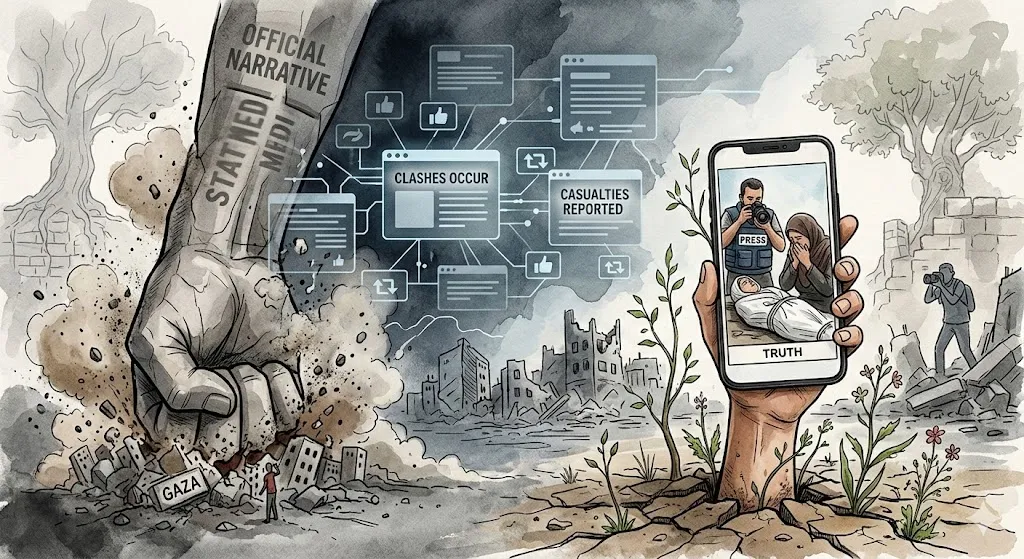
As Gaza’s physical landscape continues to be transformed by conflict, another battle rages in the information space, where competing narratives shape global understanding of events unfolding in the enclave. Media watchdogs and communication experts point to increasingly sophisticated propaganda efforts that blur the lines between victim and perpetrator, leaving distant observers struggling to discern reality.
“In modern warfare, bullets are no longer the only weapons. Narratives are often more lethal,” explains Dr. Leila Khaled, professor of media studies at Columbia University. “The first images that reach global screens often establish the dominant perspective, regardless of what follows.”
Throughout 2025, following thousands of airstrikes on Gaza, Israel’s strategic communications apparatus has operated with remarkable efficiency. Analysis shows a pattern of distributing videos alleging militant activity in civilian areas, while simultaneously releasing imagery of humanitarian aid distribution by military personnel. Critics argue these efforts deliberately redirect sympathy away from Palestinian casualties.
Communication researchers have documented networks of coordinated messaging across social media platforms that amplify a singular narrative: that Gaza’s suffering is self-inflicted rather than the result of military operations. This digital infrastructure works to shape public opinion in real-time as events unfold.
Western media outlets have faced mounting criticism for their framing of the conflict. Media monitoring organizations have identified persistent patterns in coverage, including passive language construction like “Palestinians died in clashes” rather than identifying specific actions and actors. Such phrasing obscures agency and responsibility, critics argue.
“There’s a disturbing tendency to delay reporting on devastating attacks under the justification of verification standards,” says Mohammed El-Kurd, media analyst at the Palestinian Policy Network. “This happens even when real-time footage is circulating globally, creating dangerous information gaps.”
The human cost of this information war extends beyond public perception. Journalists working in Gaza face extraordinary risks. Saleh Aljafarawi, a respected reporter known for his deeply human storytelling, was killed in October 2025 while covering what he described as a fragile ceasefire. Before his death, he had written: “I do not write news—I write the names the world wants to forget.”
Another journalist, Bisan Owda, has gained international recognition for her documentation of daily life under bombardment. Using only her phone camera, she has created an unfiltered window into the reality of war—capturing explosions, grieving families, and moments of resilience. After her home was destroyed in an airstrike, she refused evacuation offers, stating: “If we all leave, who will remain to witness?”
Digital rights organizations have raised alarms about content moderation policies on major social media platforms that appear to disproportionately affect Gaza-related content. Technical analysis shows algorithms suppressing certain keywords, limiting visibility, and flagging posts containing specific terms associated with Palestinian perspectives.
“It’s a sophisticated form of control,” explains Marwa Fatafta, Middle East policy advisor at Access Now. “Not silencing outright, but reducing reach until silence becomes the more convenient choice.”
Despite these challenges, independent documentation continues to emerge from Gaza. Medical personnel at Al-Shifa Hospital have maintained detailed records of casualties, including video evidence contradicting official narratives. International aid workers, though limited in number, provide corroborating accounts of conditions on the ground.
Communications experts note that large institutions may control headlines temporarily, but technological democratization means truth eventually surfaces. Each independent recording from Khan Younis or Gaza City serves as a counterpoint to official narratives.
“What we’re witnessing is an unprecedented battle over who controls information in conflict zones,” says Dr. James Morrison, conflict journalism researcher at NYU. “The technological tools available to both document and distort reality have never been more advanced.”
As this information struggle continues, those closest to events emphasize that propaganda’s effectiveness diminishes with time. Documentary filmmakers, human rights investigators, and historians are already compiling comprehensive records that will likely reshape understanding of this period once immediate political pressures subside.
“History does not remember who controlled the narrative momentarily,” notes Palestinian historian Dr. Rashid Khalidi. “It remembers who remained committed to accuracy when distortion was the easier path.”
Fact Checker
Verify the accuracy of this article using The Disinformation Commission analysis and real-time sources.

13 Comments
This article highlights the troubling reality that in modern warfare, narratives can be as lethal as bullets. The blurring of truth and fiction is deeply concerning and undermines the public’s ability to make informed judgments. Robust fact-checking and media literacy efforts are crucial to combat this.
It’s alarming to see how sophisticated propaganda efforts have become in modern conflicts. The strategic use of visual media and humanitarian narratives to shape global perceptions is highly concerning. We need greater transparency and independent verification to cut through the fog of war.
You’re absolutely right. Fact-based, on-the-ground reporting is essential to hold all sides accountable and understand the true human impact of these conflicts.
The article sheds light on the worrying trend of weaponizing information during conflicts. The strategic use of visual media and humanitarian narratives to shape global perceptions is highly concerning. We need greater transparency and independent verification to cut through the fog of war and understand the true human impact.
You’re absolutely right. Fact-based, impartial reporting is essential to hold all sides accountable and provide a clear picture of the realities on the ground.
This article highlights the troubling trend of weaponizing information during wartime. The blurring of fact and fiction is deeply concerning and undermines the public’s ability to make informed judgments. Robust fact-checking and media literacy efforts are crucial.
This article highlights the complex dynamics of information warfare and propaganda during conflicts. It’s a sobering reminder that narratives can often be as powerful as military action. Fact-checking and media literacy are crucial to cut through the fog of war.
You’re right, the blurring of truth and fiction in modern conflicts is a major challenge. Impartial, rigorous reporting is vital to shed light on the realities on the ground.
This article shines a light on the disturbing trend of using information as a weapon of war. The blurring of truth and fiction is deeply troubling and undermines the public’s ability to make informed judgments. Rigorous fact-checking and media literacy efforts are crucial to combat this.
The strategic use of visual media and humanitarian narratives to sway global opinion is concerning. This tactic seems designed to obscure responsibility and deflect accountability. We need greater transparency and independent verification of claims from all sides.
Agreed. Unbiased, on-the-ground reporting is essential to cut through the propaganda and understand the true human impact of these conflicts.
The strategic use of visual media and humanitarian narratives to sway global opinion is a concerning tactic that seems designed to obscure responsibility and deflect accountability. We need greater transparency and independent verification of claims from all sides to cut through the propaganda.
Exactly. Impartial, on-the-ground reporting is vital to shed light on the realities of these conflicts and their human impact, beyond the competing narratives.