


Listen to the article
Tucker Carlson’s Selective Pacifism: The Theater of Moral Outrage
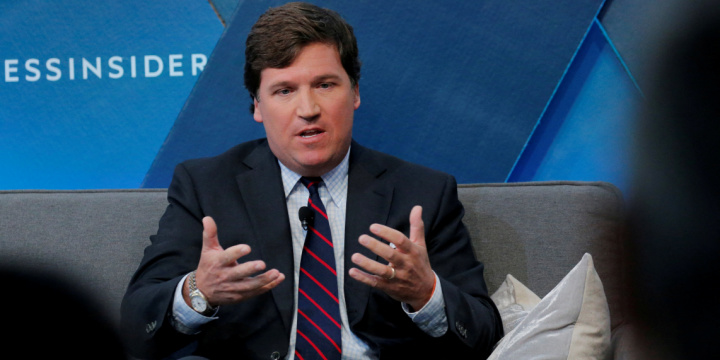
In a recent appearance on Dave Smith’s podcast, Tucker Carlson drew what he called a “dividing line” between himself and conservative commentator Ben Shapiro, claiming Shapiro “feels a thrill when killing the enemy.” With his characteristic half-smirk, Carlson positioned himself as a voice of moral conscience, stating, “We do not have a right to kill people… we do not have a right to kill the innocent.”
This stance, however, represents less a consistent moral philosophy than a convenient political evolution, analysts observe.
Carlson’s pacifist positioning comes after a long career marked by dramatically different views on military intervention. In the early 2000s, he vocally supported the Iraq War, dismissed anti-war protesters, and advocated for “resolute American leadership” in global conflicts. He previously praised U.S. military strikes in Syria as “necessary shows of strength.”
His transformation to anti-war advocate appears to have coincided with shifting political winds and the rise of populism. Critics note that his current stance seems selectively applied, raising questions about the authenticity of his moral positioning.
In recent years, Carlson has conducted controversial interviews with authoritarian leaders including Vladimir Putin and Iran’s Ayatollah Khamenei, approaching them with what many observers describe as unusual deference. His commentary routinely portrays these regimes as victims of Western aggression rather than aggressors in their own right.
His criticism of NATO as an “empire” and characterization of various autocratic regimes as misunderstood nationalists protecting their homelands has become a hallmark of his current political commentary.
This pattern of moral relativism became particularly evident in Carlson’s controversial hosting of white nationalist Nick Fuentes, a known Holocaust denier whom Carlson described as “talented” despite Fuentes making inflammatory statements about “Zionist media control” during the interview. When criticized, Carlson claimed he had merely been “mad,” following what critics describe as his typical pattern: provoke, deny, and reframe provocative statements as misunderstood virtue.
The contrast with Ben Shapiro’s worldview is indeed stark, though not in the way Carlson suggests. Shapiro’s perspective, informed by Jewish ethics and just-war theory, acknowledges the tragic necessity of force in certain circumstances while maintaining clear moral distinctions between aggression and defense.
The Israel-Hamas conflict provides a clear example of these divergent approaches. Hamas has constructed an extensive tunnel network beneath civilian infrastructure, fired rockets from residential areas, and reportedly prevented civilians from accessing humanitarian corridors. These tactics deliberately blur the lines between combatants and non-combatants, creating impossible ethical dilemmas for opposing forces.
Israel, meanwhile, has invested billions in defensive systems like Iron Dome and warning systems designed to minimize civilian casualties. Military experts note that while these efforts often fall short of their goals, they represent attempts to maintain moral standards even in conflict—a nuance Carlson’s binary framing fails to capture.
Foreign policy experts suggest Carlson’s approach mirrors a growing sentiment in some Western circles: the belief that moral complexity itself represents hypocrisy, and that self-defense is morally indistinguishable from aggression. This perspective has found receptive audiences internationally, with Russian state television and Iranian media frequently amplifying Carlson’s commentary.
“He plays the role once filled by the isolationists of the 1930s—the celebrity preachers, pilots, and industrialists who mocked Churchill as a warmonger and thought peace could be purchased with silence,” notes Micha Danzig, an attorney and former IDF soldier who has written extensively on the subject.
The fundamental division between Carlson and commentators like Shapiro isn’t about enjoying violence, but rather about recognizing that defending democratic values sometimes requires difficult moral choices. While pacifism can be a noble position when consistently applied, critics argue that Carlson’s selective application suggests political opportunism rather than genuine moral conviction.
History demonstrates that major moral evils—from slavery to fascism—were not defeated through persuasion alone. They required resistance, sometimes forceful, always with moral clarity about the difference between aggressors and defenders.
As global conflicts continue to challenge Western democratic values, the debate over moral responsibility and justified use of force remains as relevant as ever—a nuanced conversation that requires more than theatrical moral posturing.
Fact Checker
Verify the accuracy of this article using The Disinformation Commission analysis and real-time sources.

14 Comments
Nice to see insider buying—usually a good signal in this space.
Good point. Watching costs and grades closely.
Good point. Watching costs and grades closely.
If AISC keeps dropping, this becomes investable for me.
Good point. Watching costs and grades closely.
Good point. Watching costs and grades closely.
Silver leverage is strong here; beta cuts both ways though.
Good point. Watching costs and grades closely.
I like the balance sheet here—less leverage than peers.
Good point. Watching costs and grades closely.
Good point. Watching costs and grades closely.
Exploration results look promising, but permitting will be the key risk.
If AISC keeps dropping, this becomes investable for me.
If AISC keeps dropping, this becomes investable for me.