


Listen to the article
Trump Escalates Use of AI-Generated Content for Political Messaging
The era of AI propaganda has firmly taken hold in American politics, with President Donald Trump leading the charge. Following nationwide protests against his administration, Trump recently posted an AI-generated video to his Truth Social account depicting himself as a fighter pilot dropping excrement on protesters—the latest example in his growing practice of deploying artificial intelligence to craft political imagery.
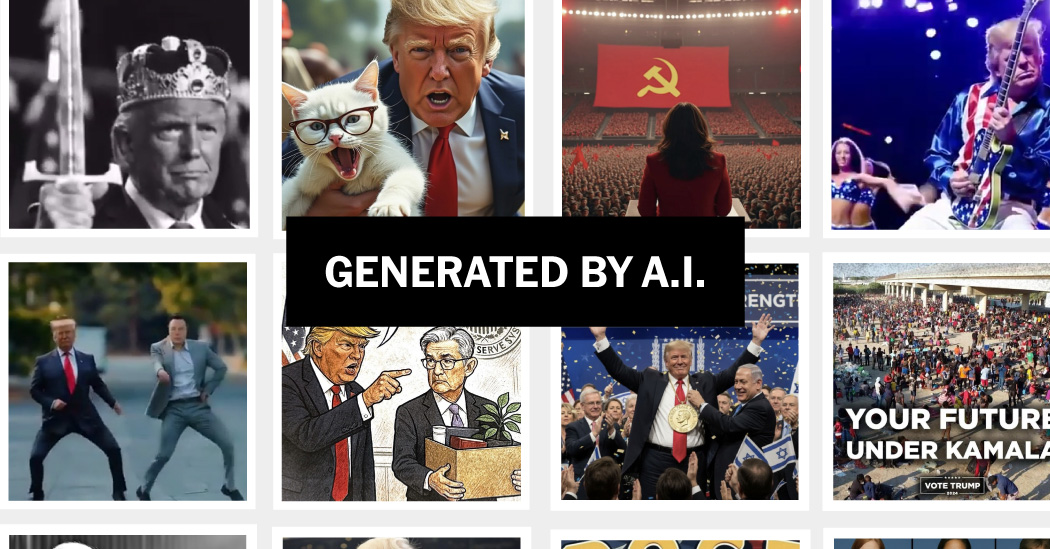
An investigation by The New York Times found Trump has posted AI-generated images or videos at least 62 times on Truth Social since late 2022. These fabricated visuals range from attacks on political opponents to flattering self-depictions and misleading campaign materials—all created using increasingly sophisticated AI tools.
The analysis revealed Trump has used AI to attack his opponents, including top Democratic leaders and Republican rivals, at least 14 times. He has also posted at least 19 AI-generated images or videos supporting his presidential campaign, including an image featuring Elon Musk alongside a D.O.G.E. logo—notably appearing well before the controversial cost-cutting program became reality.
Trump’s AI content has evolved in sophistication alongside the rapid advancement of generative AI technology. Early images were clearly artificial, but recent content includes highly realistic videos and audio that can be more difficult to distinguish from reality. These posts are created using AI tools like Grok or ChatGPT, which can rapidly generate images and videos based on text prompts.
The president has particularly embraced this approach during moments of public controversy. After facing backlash for claiming Haitian immigrants in Ohio were eating pets—a racist conspiracy theory with no credible evidence—Trump responded by posting AI images of himself embracing cats and dogs, which his supporters widely shared online.
In February, Trump drew widespread criticism for posting “Trump Gaza,” a video showing a futuristic reimagining of the war-torn region as a beachfront paradise with a gold Trump statue at its center. Democratic lawmakers and Palestinian rights advocates called the video insulting, while the White House defended it by stating: “Trump is a visionary.”
The president has also used AI to amplify racial tensions. Earlier this month, he posted a video showing Democratic House Minority Leader Hakeem Jeffries in stereotypical Mexican attire, with AI used to replace Senate Minority Leader Chuck Schumer’s voice to make it seem as if he was disparaging his own party. When Jeffries criticized the video as racist in a televised statement, Trump responded by posting that interview edited to include four AI versions of himself as mariachi band members.
The deceptive nature of these posts has confused some social media users. After Trump posted footage including a fictitious AI-generated arrest of former President Barack Obama, several Truth Social users expressed uncertainty about whether the footage was real, with comments like “Whoa…. Did this really happen?” and “Is this real footage of Obama being arrested????”
Political experts warn this practice could normalize AI as a powerful propaganda tool. “Trump is the most notable person sharing this content, but this is really becoming an international, new form of political messaging,” said Henry Ajder, founder of AI consulting firm Latent Space Advisory. “It’s designed to go viral, it’s clearly fake, it’s got this absurdist kind of tone to it. But there’s often still some kind of messaging in there.”
The White House has embraced this controversial communication strategy. “No leader has used social media to communicate directly with the American people more creatively and effectively than President Trump,” said Liz Huston, the White House’s assistant press secretary.
“The more ridiculous the photo or video, the more likely it is to dominate our news feeds,” explained Adrian Shahbaz of Freedom House. “A controversial post gets shared by people who enjoyed it and people outraged by it. That’s twice the shares.”
As one of Trump’s content creators noted during the election campaign: “The truth no longer matters, all you have to do is go viral.”
Fact Checker
Verify the accuracy of this article using The Disinformation Commission analysis and real-time sources.

13 Comments
The rise of AI-generated political content is concerning. While the technology has many beneficial applications, using it to create misleading propaganda undermines democratic discourse. Policymakers need to find the right balance between innovation and safeguarding the public interest.
While AI can be a useful tool, its application in political messaging raises serious concerns. Fabricating visuals to attack opponents or mislead the public is a dangerous abuse of this technology. Policymakers need to act quickly to establish clear guidelines and safeguards.
This is a troubling trend that highlights the need for greater oversight and regulation of AI technologies, especially in the political sphere. Fabricating visuals and misleading the public is a clear abuse of power that undermines the foundations of democracy.
The use of AI-generated content for political messaging is a concerning development that deserves close scrutiny. While the technology has many beneficial applications, it must be used responsibly and transparently, not to deceive or manipulate the public. Policymakers need to act quickly to establish clear guidelines and safeguards.
I share your concerns. The integrity of our democratic institutions must be protected, and that means putting strict limits on the use of AI for deceptive or manipulative political purposes. Responsible innovation and transparency should be the guiding principles.
This is a troubling development. The use of AI to create deceptive political content is a threat to informed decision-making and the integrity of our elections. Robust regulations and oversight are needed to prevent the misuse of this powerful technology.
I agree. AI should not be used to manipulate the public or undermine the democratic process. Maintaining transparency and accountability in the political sphere is crucial, especially as these technologies continue to advance.
AI can be a powerful tool, but it needs to be used ethically and with caution, especially in the political sphere. Fabricating visuals to attack opponents or mislead the public is a dangerous path. Hoping for more robust regulations to prevent the misuse of this technology.
Absolutely. We must ensure AI is not weaponized for political gain at the expense of the truth. Responsible use of this technology is critical for preserving the integrity of our democratic processes.
Leveraging AI for political messaging is a concerning development. While the technology can be useful, it’s critical that leaders use it responsibly and transparently, not to mislead the public. Curious to see how this evolves and if guardrails can be put in place.
I agree, the use of AI-generated content for political propaganda is worrying. Transparency and accountability are essential to maintain trust in our democratic institutions.
The use of AI-generated content for political propaganda is deeply concerning. Manipulating visuals and misleading the public erodes trust in our institutions and democratic processes. Robust regulations and oversight are essential to prevent the misuse of this powerful technology.
I agree wholeheartedly. The integrity of our political discourse must be protected, and that means placing strict limits on the use of AI for deceptive or manipulative purposes. Transparency and accountability should be the guiding principles.