


Listen to the article
A Propaganda Battle Unfolds on the National Mall
A visual propaganda war has erupted on Washington’s National Mall, pitting the Trump administration against activist groups using satirical art to counter the president’s growing presence on federal buildings.
The administration has draped giant banners featuring President Trump’s face from several prominent federal buildings, including the Department of Labor, Department of Agriculture, and Department of Justice. His name now also adorns cultural landmarks like the John F. Kennedy Center for the Performing Arts and the United States Institute of Peace.
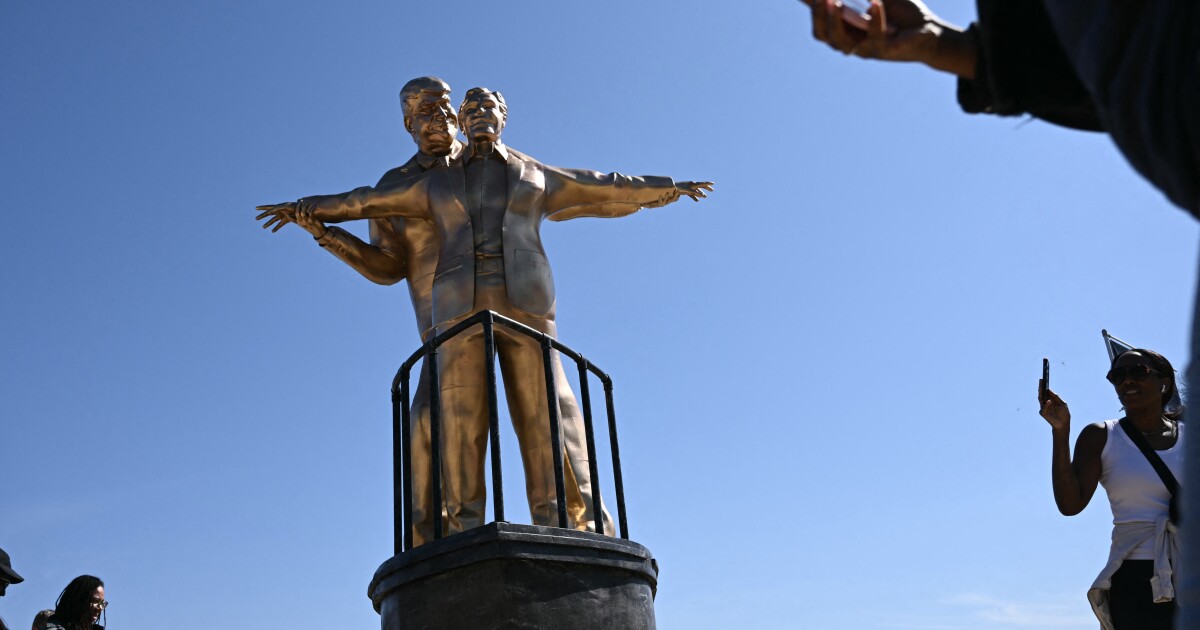
In response, two activist groups have launched counter-campaigns. An anonymous collective called the Secret Handshake has installed satirical statues and art installations across the Mall. One gold-painted statue depicts Trump and the late convicted sex offender Jeffrey Epstein posed like characters from the movie “Titanic,” while another features a gold-painted toilet sculpture titled “A Throne Fit For a King” near the Lincoln Memorial—mocking the president’s controversial renovation of the White House bathroom attached to the Lincoln Bedroom during a government shutdown.
Meanwhile, the Save America Movement, a nonprofit organization, has plastered posters on fences and walls targeting Trump administration officials. One poster shows White House Deputy Chief of Staff Stephen Miller with the caption “Fascism Ain’t Pretty,” while another depicts Attorney General Pam Bondi with the words “Epstein Queen.”
“We think that ridicule is a really important tool in an opposition toolbox to fight authoritarianism,” said Mary Corcoran, who runs the Save America Movement. Corcoran contends the battle is inherently uneven, noting, “They’re using taxpayer dollars to fund their propaganda, and we’re not.”
The White House has rejected accusations that the president is recasting the National Mall in his own image or using federal buildings for self-aggrandizement. “President Trump is focused on saving our country — not garnering recognition,” White House spokesman Davis Ingle told NPR by email. “A variety of organizations are free to share their opinions publicly, even when they lack any basis in reality.”
The National Mall, often described as America’s front yard, has historically been a space celebrating democracy and national unity through its monuments and museums. The current visual confrontation has transformed this symbolic landscape into contested terrain, with both sides competing for public attention and narrative control.
The satirical installations have attracted steady streams of visitors, many laughing and posing for photos, though reactions remain divided along political lines.
“It’s a gross interpretation of our president,” said Andi Lynn Helmy, a high school senior from Jacksonville, Florida, referring to the Trump-Epstein statue. “Even if you don’t agree with his policies … I think it’s just an incredibly disrespectful thing.”
Other visitors expressed concern about the presidential banners adorning federal buildings. Critics have drawn parallels to the personalized imagery associated with authoritarian regimes like China during Mao Zedong’s era or the Soviet Union under Joseph Stalin.
“I just feel like he’s sort of painting himself as the king of America,” said Luke Price, a freshman at the University of Vermont. “I just don’t think that’s what we’re about. America is a democracy, not a dictatorship.”
The battle of images has created striking visual juxtapositions across the Mall. In one notable example, a giant Trump banner hanging from the Department of Labor stands near counter-banners installed by the Secret Handshake that read “Make America Safe Again” alongside images highlighting Trump’s connections to Epstein—a direct response to a similar “Make America Safe Again” banner on the Department of Justice.
The visual standoff represents a broader ideological contest over political imagery in public spaces, with both sides using the National Mall’s prominence to promote competing visions of American leadership and values. As the propaganda battle continues, Washington’s iconic landscape has become a canvas for an unprecedented display of political theater that challenges long-standing norms about how government institutions represent themselves to the public.
Fact Checker
Verify the accuracy of this article using The Disinformation Commission analysis and real-time sources.

9 Comments
I’m curious to see how this plays out. The Trump team is clearly trying to assert their dominance through showy displays, while the activists are responding with biting satire. It will be telling to gauge the public’s reaction.
Given the contentious political climate, I imagine both sides will try to frame the other as disrespectful or unpatriotic. But the satirical art seems like a legitimate way to critique the administration’s actions.
Fascinating power struggle playing out on the National Mall. It’ll be interesting to see how the public reacts to these competing propaganda displays – the satire could resonate, but the administration may try to frame it as disrespectful.
This is a textbook example of a propaganda battle, with both sides vying for public attention and support. The administration’s heavy-handed tactics are concerning, but the activists’ creative response is an intriguing counterpoint.
This is a puzzling move by the Trump administration. Plastering their branding across federal buildings is an abuse of public resources. The activists’ response with satirical installations is a clever way to push back.
The Trump team’s use of federal buildings and landmarks for partisan messaging is concerning. Activists are right to counter this with creative, critical commentary. It’s a classic battle between top-down propaganda and grassroots dissent.
I agree, the administration’s heavy-handed tactics seem inappropriate for public spaces. The satirical art provides an important counterpoint, keeping the discourse lively and democratic.
The propaganda war on the National Mall reflects the deep political divisions in the country. While I may not agree with the administration’s tactics, the activists’ use of satire is an interesting tactic to engage the public and sway public opinion.
The contrast between the administration’s branding efforts and the activists’ satirical displays is quite striking. It will be interesting to see how this public disagreement plays out and what it says about the state of political discourse in the country.