


Listen to the article
Toronto’s CN Tower Documentary Offers One-Dimensional City Portrait
Mark Myers’s documentary “The Tower That Built a City” chronicles the construction and cultural significance of Toronto’s iconic CN Tower with abundant technical detail but fails to deliver a nuanced portrayal of the city it claims to define.
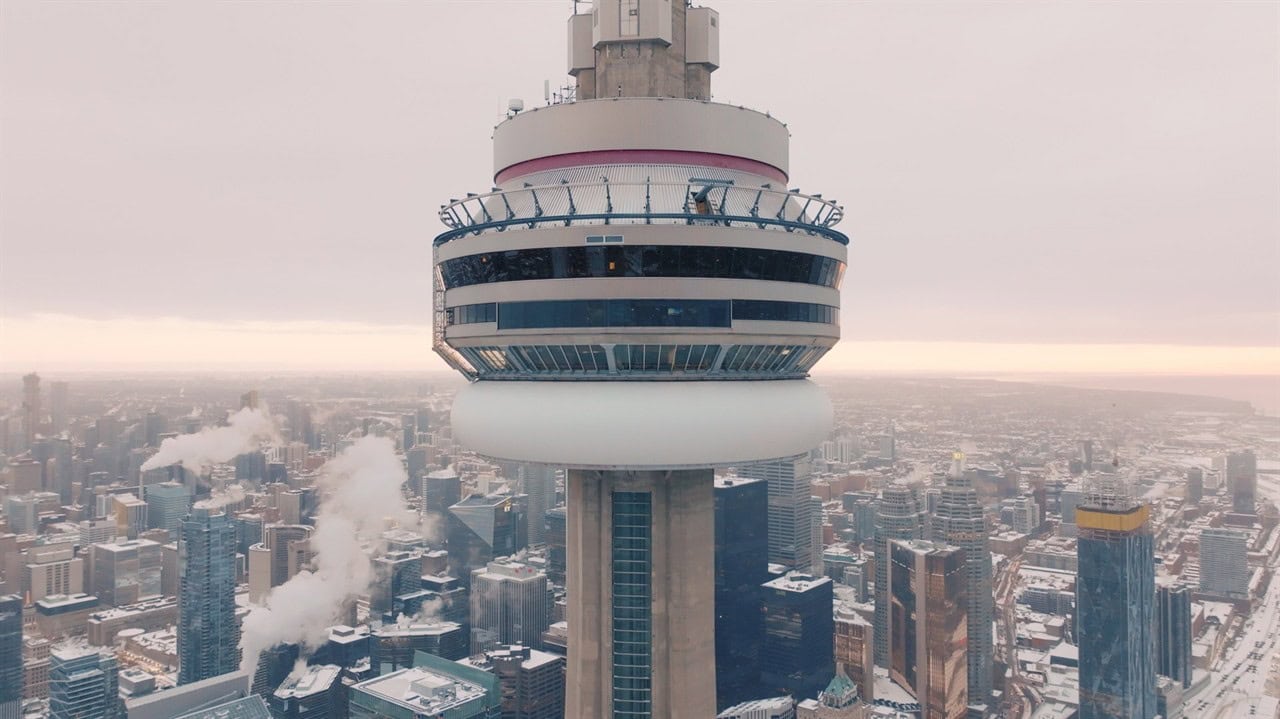
The 90-minute film meticulously documents the 1970s construction of the 553-meter tower through archival footage and interviews with the engineers and architects responsible for the project. Viewers are treated to extensive information about concrete pouring techniques and structural challenges overcome during the building process that made it the world’s tallest freestanding structure until 2004, when it was surpassed by Dubai’s Burj Khalifa.
Myers attempts to position the CN Tower as the catalyst for Toronto’s cultural renaissance and emergence from Montreal’s shadow. The documentary highlights how the tower became central to Toronto’s identity, housing CityTV’s transmitter which launched MuchMusic (Canada’s answer to MTV) and standing adjacent to the SkyDome (now Rogers Centre), home to the city’s professional sports franchises.
The film’s interview subjects—predominantly white male executives, architects, media personalities like George Stroumboulopoulos, and celebrities such as rapper Kardinal Offishall—paint Toronto as a self-conscious metropolis finally coming into its own. Kardinal offers a particularly telling metaphor, comparing Toronto to an attractive girl who spent high school wearing baggy clothes before finally embracing her beauty—suggesting the CN Tower was Toronto’s confidence-building moment.
However, this simplistic narrative reveals the documentary’s fundamental flaw. Myers presents an idealized version of Toronto: diverse, hardworking, and apparently devoid of social problems. This sanitized portrayal reinforces what critics might call a distinctly Canadian mythology—the notion that Canadians are simply modest about their inherent wonderfulness rather than acknowledging complex national challenges.
The documentary’s selective storytelling becomes particularly glaring when contrasting Toronto with American cities. While referencing civil unrest across the United States during the ’60s, ’70s, and ’80s, Myers positions Toronto as a peaceful haven, particularly for American draft dodgers. Conspicuously absent is any mention of Toronto’s documented struggles with inequality, racial tensions, homelessness, or political conflict.
Gender representation in the film is equally problematic. The first female interviewee doesn’t appear until an hour into the 90-minute runtime. Instead, the documentary devotes considerable time to men discussing concrete specifications and sports achievements. In one of the film’s more self-aware moments, an interviewee suggests that landmark skyscrapers are essentially architectural expressions of male competitiveness—likening them to physical manifestations of masculinity.
The few people of color who appear in the film are presented as beneficiaries of Toronto’s economic system rather than voices offering critical perspectives on the city’s development and ongoing challenges. This approach contributes to a narrative that celebrates Toronto’s corporate success story while sidestepping discussions about who may have been marginalized during the city’s transformation.
“The Tower That Built a City” ultimately functions more as promotional material than critical documentary. It presents a carefully controlled narrative that credits business leaders and established institutions for Toronto’s rise while ignoring the diverse voices calling for change within the metropolis. The result is less an authentic exploration of a complex urban center and more a glossy advertisement for a version of Toronto that exists primarily in corporate boardrooms.
For viewers seeking genuine insight into Toronto’s evolution and the true social impact of its most recognizable landmark, this documentary offers limited perspective despite its technical thoroughness.
Fact Checker
Verify the accuracy of this article using The Disinformation Commission analysis and real-time sources.

18 Comments
If AISC keeps dropping, this becomes investable for me.
Silver leverage is strong here; beta cuts both ways though.
Good point. Watching costs and grades closely.
Nice to see insider buying—usually a good signal in this space.
Good point. Watching costs and grades closely.
Good point. Watching costs and grades closely.
The cost guidance is better than expected. If they deliver, the stock could rerate.
Production mix shifting toward Propaganda might help margins if metals stay firm.
Nice to see insider buying—usually a good signal in this space.
Good point. Watching costs and grades closely.
Nice to see insider buying—usually a good signal in this space.
Good point. Watching costs and grades closely.
If AISC keeps dropping, this becomes investable for me.
Nice to see insider buying—usually a good signal in this space.
Good point. Watching costs and grades closely.
Good point. Watching costs and grades closely.
The cost guidance is better than expected. If they deliver, the stock could rerate.
Good point. Watching costs and grades closely.