


Listen to the article
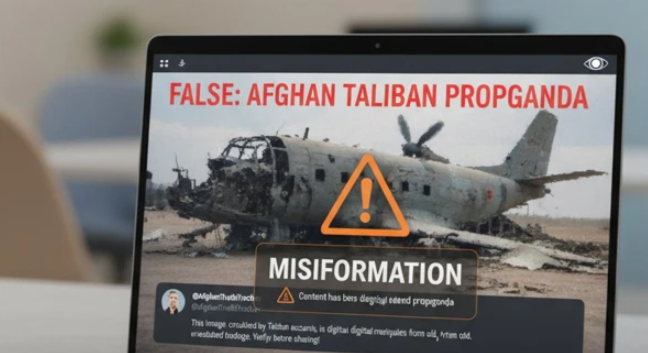
Fact-checking investigations have revealed alleged propaganda efforts by the Afghan Taliban following recent border tensions with Pakistan. Social media platforms have been flooded with misleading content, including a widely circulated image purportedly showing the wreckage of a Pakistani aircraft shot down during border confrontations.
The controversial image, which quickly gained traction across multiple social media channels, was presented as evidence of a successful military operation against Pakistani forces. However, independent verification efforts have determined the image to be falsified and deliberately circulated to shape public perception of the ongoing conflict.
Digital forensic experts consulted in the investigation identified telltale signs of manipulation. The wreckage depicted in the image appears to match photographs of a completely unrelated aircraft incident from several years ago in another region. The metadata analysis further confirmed the image had been altered and repurposed to fit the current narrative.
This incident highlights the growing sophistication of information warfare tactics employed in the Afghanistan-Pakistan border region, where tensions have escalated significantly in recent months. Both nations share a 1,600-mile border known as the Durand Line, which has been a persistent source of dispute since Afghanistan’s refusal to recognize it as an international boundary following Pakistan’s independence in 1947.
Regional security analysts point to the timing of this misinformation campaign, which coincides with increased military movements along the border. “This type of propaganda serves multiple purposes,” explains Dr. Hassan Mehmood, a South Asian security expert at the International Crisis Group. “It rallies domestic support, projects an image of military strength, and potentially sows confusion among the opposing forces.”
The Pakistani government has vehemently denied losing any aircraft in the recent border confrontations. Military spokesperson Major General Ahmed Khan issued a statement condemning what he described as “deliberate efforts to mislead the public and international community through fabricated content.”
This incident is not isolated. The Afghanistan-Pakistan border region has become a hotbed for misinformation, with both sides accusing each other of territorial violations and supporting militant groups. The complex relationship between the Taliban-controlled Afghanistan and nuclear-armed Pakistan has significant implications for regional stability in South Asia.
Digital misinformation experts note that social media platforms have struggled to contain the spread of such content in conflict zones. “The velocity at which false information spreads in politically charged environments presents a significant challenge,” notes Farah Ahmed, director of the Digital Rights Foundation. “By the time fact-checking occurs, the narrative has often already taken hold.”
The border tensions come at a particularly sensitive time as Afghanistan faces severe economic challenges following the Taliban’s return to power in 2021. International humanitarian organizations have expressed concern that escalating military confrontations could further destabilize the region and exacerbate the ongoing humanitarian crisis affecting millions of Afghans.
For Pakistan, which has its own complex relationship with various Taliban factions, maintaining border security while navigating diplomatic channels presents a delicate balancing act. The country hosts over 1.3 million registered Afghan refugees, with estimates suggesting an additional 1 million undocumented Afghans reside within its borders.
Media literacy advocates emphasize that this incident underscores the critical need for digital verification skills among journalists and the general public. “In conflict zones, verification becomes even more challenging but absolutely essential,” says Ibrahim Shah of the Center for Media Integrity. “Without proper fact-checking mechanisms, propaganda can easily fuel further tensions.”
As diplomatic channels between Islamabad and Kabul remain strained, observers warn that unchecked misinformation campaigns could potentially trigger miscalculations with serious consequences for regional security. The international community continues to monitor developments along this volatile frontier with growing concern.
Fact Checker
Verify the accuracy of this article using The Disinformation Commission analysis and real-time sources.

11 Comments
Interesting to see the Taliban’s social media propaganda efforts being called out and debunked through fact-checking. It’s important to scrutinize claims, especially around sensitive border conflicts, to separate truth from disinformation.
The Taliban’s apparent use of sophisticated information warfare tactics is concerning. It underscores the importance of media literacy and cross-checking claims, even from seemingly credible sources, to avoid being misled.
You make a good point. As social media platforms become more prevalent battlegrounds, critical thinking and fact-checking will be essential skills for the public to navigate these issues.
This highlights the need for vigilance against manipulated imagery and content being used to shape public perception of ongoing geopolitical tensions. Fact-checking is crucial to maintain transparency and accountability.
Absolutely. The digital forensic analysis revealing the image as falsified is a valuable example of how to identify and counter such propaganda tactics.
This incident highlights the evolving nature of information warfare and the need for robust fact-checking efforts to counter the spread of misinformation. Kudos to the investigators for their diligence.
This incident is a sobering reminder that misinformation and propaganda can take many forms, including manipulated imagery. Kudos to the fact-checkers for their diligent work in exposing the truth.
The use of doctored imagery to bolster the Taliban’s narrative is a worrying development. It’s a good reminder that we must approach online content, especially around conflicts, with a critical eye.
While the Taliban’s propaganda tactics are concerning, I’m glad to see fact-checkers taking the time to thoroughly investigate and uncover the truth behind these misleading claims. It’s a valuable service to the public.
Agreed. Maintaining transparency and accountability in the face of disinformation campaigns is crucial, especially when it comes to sensitive geopolitical issues.
The Taliban’s social media propaganda efforts seem to be part of a broader trend of using online channels to sway public opinion. It’s heartening to see these claims being rigorously investigated and debunked.