


Listen to the article
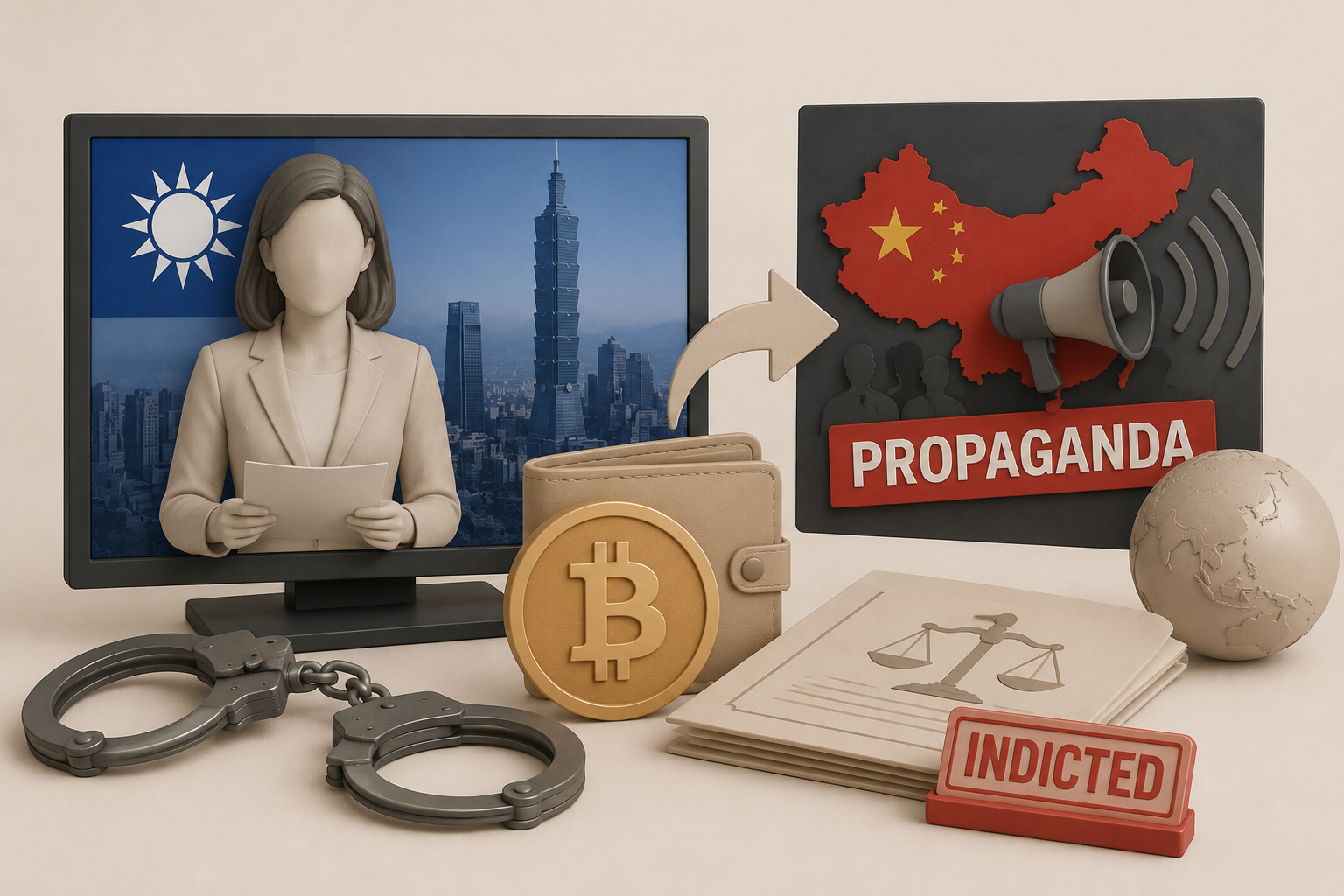
Taiwan has indicted a television anchor accused of accepting cryptocurrency payments to promote pro-China political messaging ahead of elections, revealing new dimensions in the ongoing information warfare between the two governments.
Prosecutors allege the anchor received payments in Tether’s USDT stablecoin as part of a coordinated effort linked to Chinese intelligence activities targeting Taiwan’s media landscape. The arrangement reportedly exploited cryptocurrency’s cross-border efficiency and relative opacity to transfer funds discreetly while influencing public discourse in favor of Beijing’s interests.
This case marks a significant evolution in how digital assets intersect with national security concerns in the Taiwan Strait. While cryptocurrencies have typically drawn regulatory attention for fraud, sanctions evasion, and cybercrime, this indictment highlights their potential role in information manipulation campaigns.
The choice of USDT—the world’s largest stablecoin with a market cap exceeding $90 billion—was strategic, investigators believe. By avoiding traditional banking channels that would trigger compliance alerts or regulatory oversight, the operation maintained lower visibility. The stablecoin’s dollar-pegged value also eliminated volatility concerns that might affect other cryptocurrencies like Bitcoin or Ethereum.
Taiwan’s Ministry of Justice has not released specific details about the amounts involved or the exact content promoted, but officials indicated the case is part of a broader investigation into foreign influence operations targeting Taiwanese media.
The indictment comes amid heightened cross-strait tensions. China considers Taiwan a breakaway province to be reunified, by force if necessary, while Taiwan’s democratic government maintains it is a sovereign nation. This backdrop has created fertile ground for information campaigns, with Beijing regularly accused of attempting to sway Taiwanese public opinion.
For cybersecurity and financial crime experts, the case represents a concerning convergence of technologies. “What we’re seeing is the natural evolution of influence operations leveraging new financial rails,” explained Dr. Ming-Cheng Liu, a digital security researcher at National Taiwan University. “Cryptocurrencies offer speed and reach that traditional covert funding methods simply can’t match.”
Traditional methods of funding influence operations typically relied on shell companies, offshore accounts, or cash intermediaries—all systems with inherent friction and oversight mechanisms. Cryptocurrency introduces a faster, more borderless alternative that can be deployed with greater agility.
The case is likely to intensify regulatory scrutiny of stablecoins globally. Financial authorities in the United States, European Union, and Singapore have already proposed stronger compliance requirements for stablecoin issuers and wallet providers, particularly regarding anti-money laundering protocols and transaction monitoring.
Taiwan’s Financial Supervisory Commission announced it would review existing regulations around virtual asset service providers in light of the case, potentially accelerating planned reforms to align with international standards on cryptocurrency oversight.
Cryptocurrency advocates counter that blockchain transactions remain more traceable than cash-based systems, noting that public ledgers can ultimately provide investigators with forensic visibility unavailable in traditional illicit finance channels. Several blockchain analytics firms have developed sophisticated tools specifically to track suspicious transactions across crypto networks.
As digital assets become more integrated into the global financial system, governments increasingly view blockchain infrastructure as a critical component of national security. Taiwan’s case may become an early example of a broader trend where cryptocurrency regulation, cybersecurity, and information warfare policy converge.
The indictment also underscores how Taiwan has become a frontline in digital influence operations, with its democratic system and free press making it both vulnerable to manipulation and determined to counter it. Taiwanese officials have indicated that more indictments may follow as investigations continue.
Fact Checker
Verify the accuracy of this article using The Disinformation Commission analysis and real-time sources.

11 Comments
The indictment of the TV anchor for accepting cryptocurrency payments to spread Chinese propaganda is a stark reminder of the potential misuse of digital assets. Regulatory oversight of the crypto space will be crucial to combat such information warfare tactics.
Agreed, the opacity and cross-border nature of crypto make it an attractive tool for bad actors looking to circumvent traditional financial controls. Robust KYC/AML measures are essential to mitigate these risks.
The use of USDT to facilitate this propaganda operation is troubling, as it reveals the potential for stablecoins to be misused for illicit activities. Greater transparency and accountability in the crypto sector will be key to mitigating these risks.
This case underscores the need for Taiwan to remain vigilant against foreign influence operations targeting its media landscape. The strategic use of USDT highlights the evolving tactics employed in the information war between Taiwan and China.
Absolutely, Taiwan must continue strengthening its defenses against such propaganda efforts, which can have serious implications for its democratic processes and national security. Proactive measures are crucial.
The indictment sheds light on the darker side of cryptocurrencies, where they can be exploited to enable covert influence campaigns. Policymakers will need to carefully balance innovation and risk mitigation in this rapidly evolving space.
This is a concerning case that highlights the complex intersection of cryptocurrencies, propaganda, and national security. The use of stablecoins like USDT to facilitate covert influence operations is troubling and requires close scrutiny by authorities.
The indictment of the TV anchor highlights the evolving tactics employed in information warfare, where digital assets are being leveraged to circumvent traditional controls. Policymakers must stay vigilant and adapt their responses accordingly.
Absolutely. As cryptocurrency technology continues to develop, so too must our regulatory and security frameworks to ensure they are not exploited for malicious purposes that undermine democratic institutions and national interests.
This case demonstrates the need for robust oversight and regulation of the cryptocurrency ecosystem, particularly in relation to its potential use in information manipulation campaigns and other national security threats. Continued diligence is crucial.
This case is a sobering reminder that the anonymity and cross-border nature of cryptocurrencies can be weaponized for nefarious purposes. Robust regulatory frameworks and international cooperation will be essential to combat such threats to national security.