


Listen to the article
Soviet Nonconformist Artist Erik Bulatov Dies at 90, Leaving Legacy of Philosophical Art
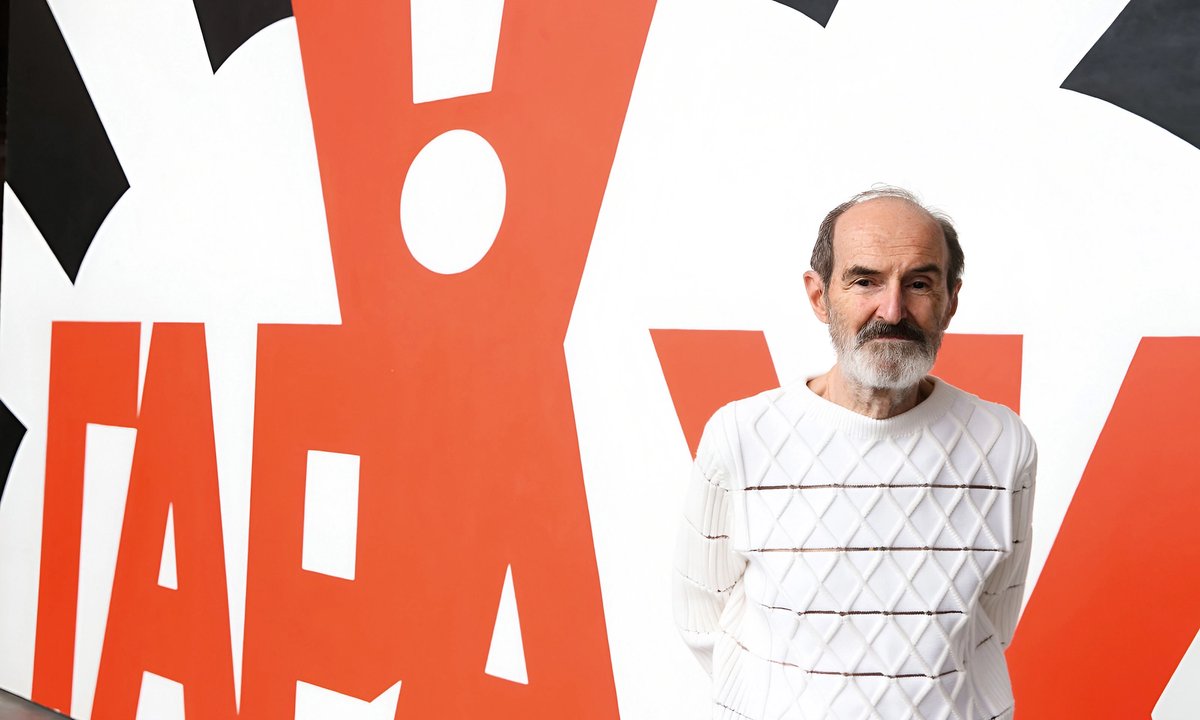
Erik Bulatov, a pivotal figure in Soviet underground art who deftly navigated the boundaries of political expression, died on November 9 in Paris. The 90-year-old artist gained international recognition for his distinctive works that layered Communist Party slogans over luminous landscapes, creating philosophical pieces that allowed multiple interpretations even within restrictive political environments.
Bulatov belonged to a small but significant circle of nonconformist artists in the 1970s and 80s who challenged Soviet artistic constraints while avoiding direct confrontation with authorities. Alongside contemporaries Ilya Kabakov, Oleg Vassiliev, and Viktor Pivovarov, Bulatov found a degree of creative freedom by illustrating children’s books—a strategic compromise that allowed these artists to pursue their true artistic visions. This group became known as the Sretensky Group, named after the Moscow boulevard where their studios were located.
His most celebrated and valuable work, the monumental 1975 canvas “Glory to the CPSU,” exemplifies his signature style. The painting juxtaposes Communist Party of the Soviet Union slogans against a serene blue sky with white clouds, creating layers of meaning that evoke Russian iconography and Soviet symbolism. This masterpiece sold for $2.1 million at Phillips in London in 2008, establishing Bulatov as one of Russia’s most valuable artists. By 2025, The Art Newspaper Russia would rank him as the most expensive living Russian artist.
“Many people do some things for the state and earn the ability to do what they want for themselves,” Bulatov told The New York Times in 1986, revealing the delicate balancing act performed by artists under Soviet control. This interview came during a period when cracks were beginning to appear in the rigid Soviet art system under Mikhail Gorbachev’s leadership.
That same year marked a rare and significant breakthrough when Bulatov’s “Picture with the Mark of Quality” was purchased by a Western collector through Soviet authorities. The transaction represented an unusual exception to the prohibition on foreign sales of Soviet art, signaling the gradual opening of cultural borders.
Born in 1933 in Sverdlovsk (now Yekaterinburg), Bulatov’s early life reflected the complexities of Soviet existence. His father was a party worker, while his mother was a Polish-born supporter of the October Revolution who later developed a more nuanced view of Soviet reality. Like many Soviet citizens, Bulatov grew up with limited knowledge of his family history in a society where social origins were often concealed or erased. His “happy childhood,” as he described it, ended abruptly with the German invasion of the Soviet Union in 1941.
After studying at Moscow’s prestigious Surikov Art Institute, Bulatov was profoundly influenced by graphic artist Vladimir Favorsky and avant-garde painter Robert Falk. These mentors helped shape his artistic philosophy, particularly the concept that space—rather than objects—determines an artist’s worldview. This perspective would become central to Bulatov’s distinctive approach.
In his memoirs, published in 2025 as “Erik Bulatov Tells his Story,” the artist reflected on the deeper meaning of his most famous work, “Glory to the CPSU.” He explained that the text wasn’t written on the sky itself but on the painting’s surface, establishing a boundary beyond which the slogan had no power. “For me, this painting is a formula for freedom,” he wrote, revealing the subtle resistance embedded in his seemingly compliant imagery.
Bulatov and his wife Natalia relocated to New York in 1989 and later settled permanently in Paris in the early 1990s, joining the post-Soviet diaspora of Russian artists. Despite living abroad, he maintained that he never felt like an émigré and retained deep affection for Moscow.
In later years, Bulatov moved away from Soviet symbolism, explaining in a 2018 interview that he had never considered himself a dissident and had simply worked with “the material that my own life offered me.” When that Soviet context ended, he considered it “undignified” to continue exploiting those themes.
Notably, Bulatov did not publicly condemn Russia’s invasion of Ukraine, a silence that allowed him to receive tributes from across the political spectrum upon his death, from dissident outlets abroad to Russian state media.
One of his final series focused on doors as metaphorical passages, emphasizing the light that shines through even the darkest barriers. “The light that shines through the cracks comes from under the black,” he said, articulating a philosophy of hope that characterized his work throughout his remarkable career.
Fact Checker
Verify the accuracy of this article using The Disinformation Commission analysis and real-time sources.

10 Comments
I’m curious to learn more about the specific techniques and approaches Bulatov used to create his philosophical and interpretive pieces. His monumental work ‘Glory to the CPSU’ sounds particularly intriguing.
It’s remarkable that these artists were able to push boundaries and express dissent through their art, even in the face of Soviet constraints. Their legacy is an inspiring example of creative resistance.
Bulatov’s passing is a loss for the art world, but his legacy of philosophical and subversive works will surely continue to inspire and provoke. I’m curious to see how his influence may be reflected in contemporary Russian art today.
The Sretensky Group’s story is a fascinating chapter in the history of Soviet art and the ways in which artists navigated the constraints of their time. Their works offer valuable insights into the power of art to resist and reframe dominant narratives.
Fascinating to learn about this Soviet artist who challenged propaganda through his philosophical art. Bulatov’s works seem to have found a creative way to express dissident views within the restrictive political environment of the time.
It’s interesting how he and his peers were able to pursue their artistic visions by illustrating children’s books, a strategic compromise that allowed them to work within the system.
Bulatov’s signature style of layering Communist slogans over landscapes is a powerful visual metaphor. I wonder how his contemporaries, like Kabakov and Vassiliev, also navigated the constraints of Soviet art to create subversive works.
The Sretensky Group’s ability to find creative freedom within restrictive environments is quite admirable. Their works must have been a revelation to those who experienced them.
This is a great reminder of the power of art to challenge and reframe dominant narratives, even in repressive political contexts. Bulatov’s layered works seem to invite deeper contemplation and multiple perspectives.
I agree, the fact that these artists found ways to pursue their true artistic visions, even through the strategic compromise of children’s book illustrations, is a testament to their creativity and resilience.