


Listen to the article
Iranian Activist Faces Trial on Propaganda Charges in Unconventional Court Setting
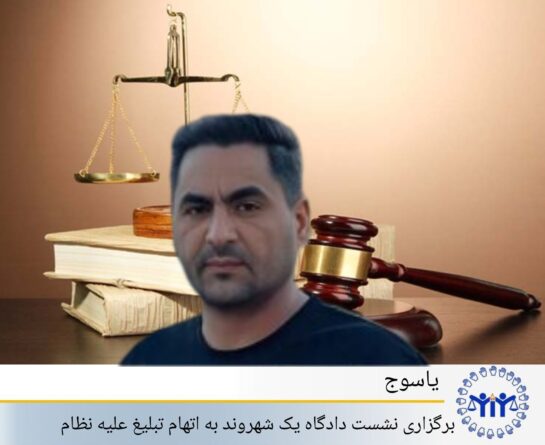
A court hearing for Shahab Mohammadian, a resident of Yasuj in Iran’s Kohgiluyeh and Boyer-Ahmad Province, was held Saturday on charges of “propaganda against the regime,” according to reports from the Kurdistan Human Rights Center (KMMK).
The trial took place in Branch 102 of the Boyerahmad Criminal Court, where Mohammadian presented his defense against the serious political charges. This court venue has raised procedural questions, as such political cases would typically fall under the jurisdiction of Iran’s Revolutionary Courts.
Legal observers note that while Article 302 of Iran’s Criminal Procedure Code explicitly assigns jurisdiction for “propaganda against the regime” cases to Revolutionary Courts, structural limitations in smaller cities and provinces have led to these cases being heard in criminal courts. This procedural anomaly, though legally questionable, has become increasingly common in Iran’s judicial system, particularly in regions with limited judicial infrastructure.
Mohammadian’s legal troubles began earlier when he received a court summons from the First Branch of the Boyerahmad Public and Revolutionary Prosecutor’s Office on November 11, 2025. His initial hearing took place on November 2, presided over by Deputy Prosecutor Nima Ebadinasab.
This is not Mohammadian’s first encounter with Iran’s judicial system. Earlier in 2025, he faced more severe charges, including “membership in a group with the intention of disrupting national security” and “insulting the leadership” – a reference to Supreme Leader Ali Khamenei, criticism of whom is strictly forbidden under Iranian law. A guilty verdict was reportedly issued in May of this year in that separate case.
After a period of detention, Mohammadian was released on bail in May 2024, suggesting his legal troubles have spanned at least a year and a half, though the exact timeline of his detention remains unclear from available information.
Human rights organizations have consistently criticized Iran’s broad interpretation and application of national security charges against activists, journalists, and ordinary citizens. Charges like “propaganda against the regime” are frequently used against individuals who express political dissent or criticism of government policies, particularly in minority regions like Kurdistan.
The Kohgiluyeh and Boyer-Ahmad Province, where Yasuj is located, has seen increased security presence and judicial prosecutions in recent years, particularly following nationwide protests that have periodically swept across Iran since 2019. These protests have often been met with harsh crackdowns, mass arrests, and judicial proceedings against participants.
Iran’s dual court system, comprising civil courts and Revolutionary Courts, has been criticized by international human rights organizations for its lack of transparency and due process, particularly in politically sensitive cases. Revolutionary Courts, established after the 1979 Islamic Revolution, typically handle cases deemed threats to national security, including political offenses.
The KMMK, which reported on Mohammadian’s case, is a human rights organization that documents rights violations particularly affecting Iran’s Kurdish population and other minority groups. The organization regularly publishes reports on detention, trials, and human rights concerns across Iran’s western provinces.
As Mohammadian awaits the court’s decision, his case highlights the ongoing tension between Iran’s judicial system and international human rights standards, particularly regarding freedom of expression and the right to a fair trial. The outcome of his case could have significant implications for how similar cases are handled in regions where Revolutionary Courts are not readily accessible.
Fact Checker
Verify the accuracy of this article using The Disinformation Commission analysis and real-time sources.

13 Comments
This trial seems highly irregular, with political charges being handled in a criminal court rather than the usual Revolutionary Court. I hope Shahab Mohammadian receives a fair hearing despite the procedural questions raised.
You’re right, the court venue is quite concerning. Shifting political cases to criminal courts raises serious issues around due process and judicial independence.
This case raises concerns about the Iranian government’s crackdown on dissent and erosion of civil liberties. I hope the international community closely monitors the trial proceedings.
The procedural questions around this case highlight the need for judicial reforms in Iran to uphold the rule of law and protect the rights of citizens. I hope Shahab Mohammadian receives a fair trial.
Absolutely, the irregularities in venue and jurisdiction are very worrying. Upholding due process and judicial independence should be a priority.
The reported procedural irregularities in this case are highly concerning. Shahab Mohammadian deserves a fair trial in a court with proper jurisdiction over the charges.
It’s troubling to see the Iranian government pursuing charges of ‘propaganda against the regime’ against an activist. Legitimate criticism and dissent should be protected, not criminalized.
I agree, the use of vague ‘propaganda’ charges to target political opponents is a concerning trend in Iran. The judicial system seems to be increasingly politicized.
The apparent shift of this political case to a criminal court raises serious questions about the integrity of Iran’s judicial system. Shahab Mohammadian deserves a fair hearing in the appropriate court.
It’s disturbing to see the Iranian authorities using vague ‘propaganda’ charges to target activists and critics. Fundamental freedoms of expression and association must be protected.
I share your concern. The Iranian government’s efforts to stifle dissent through the judicial system are extremely worrying and unacceptable.
This trial seems to be yet another example of the Iranian government’s repressive tactics against civil society. I hope the international community condemns these actions and calls for reforms.
I agree. The use of vague ‘propaganda’ charges to target activists is a clear violation of human rights and the rule of law. Stronger international pressure is needed.