


Listen to the article
Russia’s school propaganda was highlighted in an Oscar-winning documentary, but questions remain about its effectiveness as a tool for building patriotic support among young Russians.
The documentary “20 Days in Mariupol,” which won an Academy Award earlier this year, contains a particularly revealing scene where Ukrainian journalist Mstyslav Chernov films Russian soldiers distributing propaganda textbooks to schoolchildren in the occupied Ukrainian city.
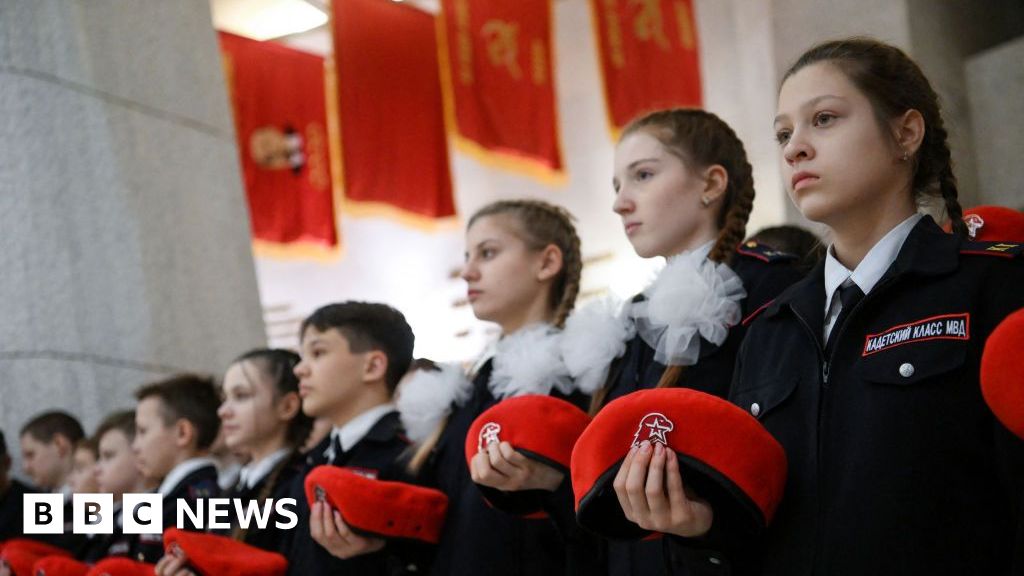
This moment offers a glimpse into a broader strategic effort by the Russian state to shape young minds through classroom education. Since Russia’s full-scale invasion of Ukraine in February 2022, the Kremlin has accelerated its campaign to instill patriotic values in students, introducing new history textbooks and mandatory weekly “patriotic education” classes across Russian schools.
These “Conversations About Important Things” classes, which began in September 2022, have become a cornerstone of Russia’s educational approach. Aimed at students from first grade through university level, the sessions cover topics like Russia’s military operations in Ukraine, which are framed as a defensive response to Western aggression rather than an invasion.
Education experts note that the content often mirrors themes from President Vladimir Putin’s speeches, presenting simplified versions of complex geopolitical narratives. Teachers are provided with detailed lesson plans, slides, and videos that emphasize Russian historical achievements, traditional values, and the portrayal of Western nations as hostile entities.
“The state is making a concerted effort to control the historical narrative,” says Maria Kovalenko, an educational policy analyst based in Latvia who monitors Russian curriculum changes. “These classes represent perhaps the most direct attempt at political indoctrination in Russian schools since Soviet times.”
The new history textbooks introduced last September take a particularly controversial approach to the war in Ukraine. They describe the invasion as a “special military operation” necessary to protect Russian interests against NATO expansion. Critics have pointed out factual inaccuracies and highly politicized content that contradicts established historical consensus.
However, evidence suggests these propaganda efforts face significant challenges in achieving their desired impact. Research by independent Russian sociologists indicates that many teenagers remain skeptical of state messaging, particularly in urban centers where access to alternative information through VPNs and social media remains possible despite government restrictions.
A study conducted by the Levada Center, Russia’s last remaining independent polling organization, found that younger Russians (ages 18-24) express less support for the war than older generations. While official polls show high overall approval for what the Kremlin calls its “special military operation,” this support appears weaker among youth.
“Young people today have grown up in the digital age. They’re naturally more skeptical of official narratives than previous generations might have been,” explains Pavel Baranovsky, a sociologist who left Russia in 2022 and continues to study Russian youth attitudes remotely. “Even when their only source of information is state-controlled, many develop a kind of ‘propaganda literacy’ that helps them identify manipulation.”
Teachers also represent a potential weak link in the propaganda chain. Many educators are uncomfortable with the political content they’re required to deliver. Some reports suggest teachers in more liberal urban areas find ways to minimize ideological components or create space for critical thinking despite official guidelines.
“There’s a long tradition in Russian education of teachers finding ways to navigate between official requirements and their personal educational philosophies,” notes former Moscow teacher Elena Volkova, who now works in Finland. “Some comply with the letter of the requirements while subtly undermining the spirit.”
The long-term effectiveness of Russia’s educational propaganda remains uncertain. Historical precedents suggest that heavy-handed ideological education often produces cynicism rather than genuine belief. The Soviet Union’s extensive political education system ultimately failed to prevent the collapse of communist ideology when economic and social realities contradicted classroom teachings.
As Russia’s conflict in Ukraine continues with no end in sight, the Kremlin appears committed to intensifying its educational propaganda efforts. New patriotic initiatives, including expanded military training in schools and youth organizations modeled after Soviet predecessors, are being implemented nationwide.
While these programs will undoubtedly influence some young Russians, the battle for hearts and minds remains more contested than official narratives suggest. For a generation with unprecedented access to global perspectives, despite government censorship, the effectiveness of classroom propaganda faces significant limitations in an increasingly complex information landscape.
Fact Checker
Verify the accuracy of this article using The Disinformation Commission analysis and real-time sources.

14 Comments
The scenes of Russian soldiers distributing propaganda textbooks in occupied Ukraine are truly chilling. This is a blatant attempt to brainwash children and erase their national identity. It’s a disturbing glimpse into the Kremlin’s playbook.
I’m curious to see how effective this propaganda campaign will be in the long run. While it may succeed in the short term in instilling a sense of patriotism among some students, I suspect many young Russians will ultimately see through the rhetoric and seek out more objective information.
The Oscar-winning film ’20 Days in Mariupol’ provides a chilling glimpse into Russia’s propaganda machine. Distributing textbooks to schoolchildren in occupied territories is a cynical attempt to erase their Ukrainian identity and replace it with a pro-Russian narrative.
Absolutely. This is a clear violation of human rights and a blatant attempt to brainwash children. It’s a disturbing tactic that we’ve seen used by authoritarian regimes throughout history.
This is a concerning development. Indoctrinating children through propaganda in schools is a tactic often used by authoritarian regimes to brainwash the next generation. It’s troubling to see Russia employing such tactics, even if the effectiveness is uncertain.
You’re right, this is a worrying trend. Shaping young minds through biased educational materials is a dangerous path that undermines critical thinking and democratic values.
I wonder how these ‘patriotic education’ classes are actually being received by Russian students. Are they genuinely inspiring loyalty and support for the regime, or are young people seeing through the propaganda and rejecting it?
That’s a great question. The effectiveness of such propaganda efforts is often dubious, especially among younger generations who have access to alternative information sources online.
It’s disheartening to see Russia resorting to such heavy-handed tactics to indoctrinate children. Manipulating young minds through biased educational materials is a hallmark of authoritarian regimes. I hope this backfires and inspires more critical thinking among Russian youth.
It’s deeply troubling to see Russia using its education system as a tool for propaganda and indoctrination. Distributing biased textbooks and forcing students to attend ‘patriotic education’ classes is a blatant attempt to shape young minds and erase alternative perspectives.
The introduction of these ‘patriotic education’ classes is a worrying development. Forcing students to attend sessions that frame Russia’s military actions as a defensive response to Western aggression is a clear attempt to manipulate their understanding of the conflict.
You’re right, this is a concerning trend. Indoctrinating young people with a one-sided, pro-regime narrative undermines critical thinking and democratic values. It remains to be seen whether this propaganda campaign will succeed in the long run.
I’m curious to see if this propaganda campaign actually succeeds in building widespread patriotic support among Russian youth. Forcing students to attend ‘patriotic education’ classes seems more like an act of desperation than a well-thought-out strategy.
That’s a good point. Propaganda often backfires when it’s too heavy-handed. Young people tend to be more discerning and resistant to such overt indoctrination efforts.