


Listen to the article
Ukrainian Drones Strike Deep Inside Russia as War Enters Critical Phase
A stark reversal of fortunes has unfolded in Russia’s war with Ukraine, as long-range Ukrainian attack drones have struck critical infrastructure across Russian territory, bringing the reality of conflict home to a population that had largely remained insulated from its effects.
In the Black Sea port of Tuapse, Ukrainian drone strikes ignited massive fireballs at the local oil refinery, with burning gasoline reaching 15 stories high and rivers of fuel flowing through city streets. Firefighters battled the inferno for three days, creating smoke plumes visible to skiers in the Caucasus mountains more than 60 miles away.
Near Perm in the Ural region, a series of Ukrainian attacks on crude oil facilities and chemical factories created a toxic cloud spanning 80 miles, according to NASA satellite imagery. The strikes prompted regional chemical emergency alerts. Weeks earlier, strategically vital oil and liquefied gas terminals at Ust-Luga on the Baltic Sea faced repeated bombardments.
Perhaps most symbolically damaging for the Kremlin has been the scaling down of Russia’s May 9 Victory Day parade on Red Square. The annual celebration, traditionally showcasing Russia’s military might, will proceed without the customary display of tanks, missiles, and other hardware. Instead, university military reservists will replace active servicemen. Kremlin spokesman Dmitry Peskov cited the “operational situation” for these changes, while condemning Ukraine’s use of what he called “openly terrorist methods.”
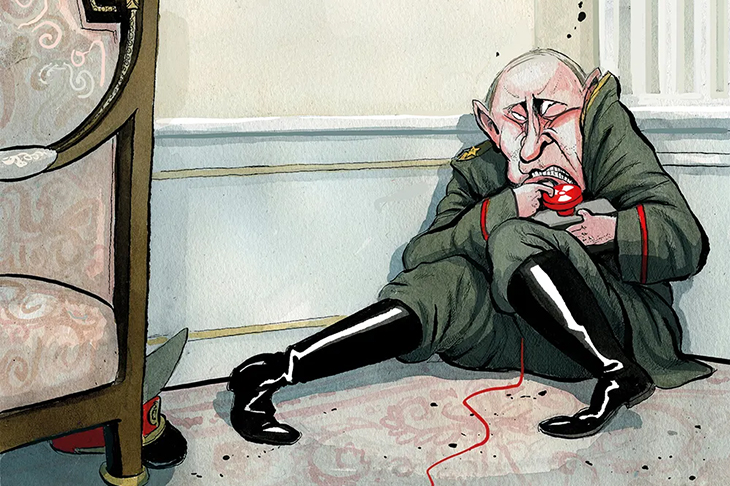
President Vladimir Putin has responded with characteristic deflection. As Perm burned, he appeared on television discussing cabbage preservation techniques with women in traditional Russian headdresses. In cabinet meetings, he assured ministers there had been “no serious damage” from the attacks.
Increasingly, Russians are skeptical of such claims. “Attitudes toward Putin are shifting,” notes Alexander Baunov, Senior Fellow at the Carnegie Russia Eurasia Center. “Economic optimism is fading, along with the everyday patriotism tied to it… there is a growing recognition that the war cannot be won.”
The conflict has now lasted longer than the Soviet Union’s participation in World War II and has claimed at least 220,000 Russian lives, according to monitoring by international NGOs and the BBC. Of the four Ukrainian provinces Russia has claimed since the invasion, only Luhansk has been completely captured. Meanwhile, the economic strain has intensified, inflation is rising, and Ukrainian strikes deep inside Russia have become impossible to ignore.
A notable shift has occurred in Russian social media discourse, with the taboo against criticizing the government rapidly dissolving. Influencers have begun openly blasting authorities over economic downturns, corruption, and internet censorship. “What kind of parade can there be when they’ve completely screwed up everything that was won by our grandfathers and great-grandfathers?” asked one Telegram user in a post that attracted thousands of likes.
More surprising is the change in tone from former government supporters. “We’re fucked, just totally fucked,” said prominent Russian “Z-blogger” Yevgeny Golman, previously known for his passionate support of the Kremlin. “Eighty percent of my friends closed down their businesses. The system failed. They’ve been lying to Vladimir Vladimirovich [Putin] and they keep on lying.”
Economic indicators confirm these concerns. Russia’s GDP has begun contracting for the first time since 2023. Seventy-three out of 89 regions closed last year with fiscal deficits, and nationwide the deficit is five times higher than in 2024. Interest rates remain at a crippling 14 percent after peaking above 20 percent. Business unpaid bills have accumulated to $109 billion, while industrial production declined in early 2025.
Defense industry leaders have also started speaking out. Viacheslav Yakovlev, head of engineering company Kubanzheldormash, publicly complained that corruption in state procurement is killing domestic factories and that Russia’s attempts at import substitution have “completely failed.”
Even Russia’s central bank governor Elvira Nabiullina has warned that “economic activity is slowing down,” noting that temporary increases in oil prices due to Middle East tensions would not offset the war’s economic pressure.
Despite the growing discontent, Putin faces no immediate political threat. While online conspiracy theorists speculate that coordinated criticism from influencers might signal insider plots against the regime, there’s little substantive evidence. The Kremlin’s repressive apparatus continues to function effectively against organized political dissent.
The situation presents a mixed outlook for Ukraine. While Russia’s economy strains under sanctions and war costs, there remains significant resilience in the system. As economists have noted throughout history, “there’s a lot of ruin in a nation.” Putin maintains his grip on power, but increasingly appears to be governing without clear direction – “running on fumes, and without a map.”
Fact Checker
Verify the accuracy of this article using The Disinformation Commission analysis and real-time sources.

5 Comments
The reduction in the annual Victory Day parade is a significant symbolic blow to the Kremlin’s wartime narrative. It suggests the Kremlin is struggling to maintain the veneer of strength and control it has tried to project.
Fascinating to see how public sentiment is shifting in Russia. The Kremlin’s carefully curated war narrative seems to be unraveling as the true costs and impacts of the conflict become harder to conceal from the population.
I wonder how long the Kremlin can maintain its grip on information and propaganda if more and more Russians become skeptical of official claims. Transparency and accountability will be crucial.
The Ukrainian drone strikes on critical Russian infrastructure are a bold and unexpected escalation. It’s clear the war is entering a pivotal phase, with both sides vying for strategic and psychological advantages.
These attacks seem designed to erode public support for the war by directly impacting the Russian populace. It will be interesting to see how the Kremlin responds to this shift in the conflict.