


Listen to the article
In a sweeping propaganda campaign, the Russian government has systematically manipulated language and media to justify its 2022 invasion of Ukraine to its domestic audience, leveraging historical tensions and carefully crafted narratives to build public support for what it calls a “special military operation.”
The Kremlin’s messaging, which flows through state-approved channels from RIA Novosti to TASS and social platforms like Telegram, has centered on several key themes, including the repeated claim that Ukraine had “bombed Donbas for eight years” and the false characterization of Ukrainian leadership as “Nazis.”
While these narratives may appear clumsy to outside observers, they are designed specifically for Russian citizens who rely primarily on state media for information. Understanding how Russia built its case for war provides crucial insight into the conflict’s domestic dimensions.
The propaganda campaign’s foundations were laid years before the invasion, particularly following Ukraine’s 2014 Euromaidan protests. These demonstrations began when then-President Viktor Yanukovych rejected an association agreement with the European Union, sparking brutal police crackdowns that intensified public outrage. At the time, Ukraine ranked lowest in Europe for confidence in government institutions, with deep ethno-linguistic divisions between its regions.
In southeastern Ukraine, including Odessa, Russian-speaking populations had largely supported Yanukovych. After his flight to Russia and Russia’s annexation of Crimea, polling showed 70 percent of southeastern Ukrainians still favored remaining in Ukraine, though many desired a federalized structure with greater regional autonomy.
Russian strategy during this period embraced what Colonel General Vladimir Zarudnitsky of Russia’s General Staff Military Academy described as hybrid warfare, noting that “it is easier to divide a state from within rather than conquer it with arms.” This approach included cyber operations, disinformation, and economic pressure.
Language itself became a weapon in Russia’s arsenal. Russian media deliberately uses the preposition “na Ukraine” (on Ukraine) rather than “v Ukraine” (in Ukraine) – a subtle but significant distinction that frames Ukraine as a region rather than a sovereign nation. This linguistic choice reflects deeper historical attitudes dating back to Soviet-era Russification policies that systematically undermined Ukrainian national identity.
Following the invasion, Russian officials and media employed euphemistic language to soften military realities. The invasion became a “special military operation” with the stated goal of “denazification.” Bombing campaigns were rebranded as “preemptive strikes,” and destroyed cities like Bakhmut (which Russian media referred to by its Soviet-era name Artemovsk) were declared “liberated.”
The May 2, 2014, tragedy in Odessa represents a critical turning point in Russian public opinion. When clashes between pro-Maidan and anti-Maidan groups led to a fire at the House of Trade Unions, resulting in 42 deaths, Russian Foreign Minister Sergei Lavrov characterized it through TASS as evidence of Ukrainian “fascism,” claiming that “unarmed people including women were burned alive” while others “were fired upon” as they tried to escape.
This selective framing ignored the complex reality documented by independent investigators from the Council of Europe and the UN, who found both sides shared responsibility for the violence. Nevertheless, the “Odessa Massacre” became a powerful justification for supporting separatist movements in Donetsk and Luhansk, and later for the full-scale invasion.
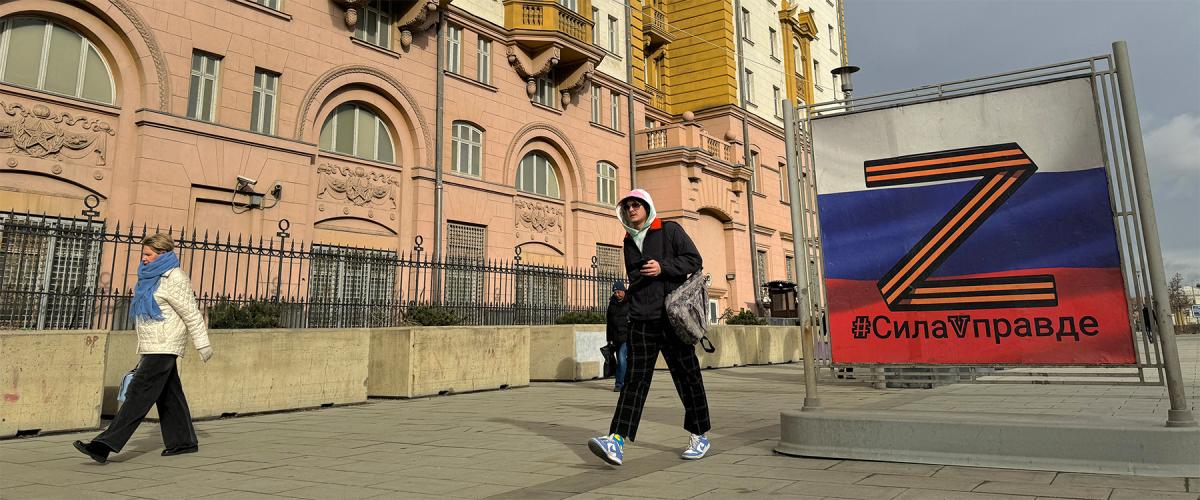
The Russian government has further sought to popularize the war through cultural channels, coopting artists and promoting symbols like the letter “Z.” Originally a tactical marking indicating western movement (Zapad means “West” in Russian), the symbol evolved into a civilian display of patriotic support, appearing on vehicles and replacing the Cyrillic “З” in government communications – though critics have compared it to Nazi symbology.
Many prominent Russian cultural figures faced stark choices: support the war or face severe consequences. Vladimir Urin resigned after a decade leading the Bolshoi Theater after signing an anti-war letter, while Valery Gergiev, who was dismissed from his position with the Munich Philharmonic for refusing to condemn the invasion, was named Urin’s successor.
Despite these propaganda efforts, there are signs of growing discontent, particularly among soldiers. Pavel Filatyev, who participated in the invasion before fleeing Russia, pointedly questioned why children of media personalities and political elites promoting the war were absent from the frontlines.
Unlike the widely popular annexation of Crimea, Russia’s full-scale invasion has required increasingly draconian measures to suppress dissent, including new laws criminalizing criticism of the military. The Russian Orthodox Church has also played a significant role, with Patriarch Kirill framing the conflict as a “holy war” against Western “degeneracy.”
The extensive nature of these propaganda efforts suggests the Kremlin recognizes potential vulnerability to domestic unrest as the war continues – a sign that, despite outward displays of unity, Russian public support may not be as monolithic as officially portrayed.
Fact Checker
Verify the accuracy of this article using The Disinformation Commission analysis and real-time sources.

16 Comments
It’s concerning to see how the Russian government has systematically manipulated information to justify the invasion of Ukraine. Understanding these propaganda tactics is crucial to countering the Kremlin’s narrative.
Absolutely. The report highlights how the Kremlin built a carefully crafted case for war, even though the justifications seem flimsy to outside observers. Monitoring state media narratives is key.
This study is a stark reminder of how information can be weaponized to manufacture public support, even for an unjustified military action. Analyzing Russia’s propaganda tactics is crucial for understanding the conflict’s domestic dimensions.
The analysis of Russia’s propaganda campaign underscores the power of information warfare and the importance of media literacy. Challenging disinformation and ensuring access to objective sources is critical moving forward.
This report provides valuable insight into the domestic dimensions of the conflict in Ukraine, highlighting the Kremlin’s use of carefully crafted historical narratives to build public support for the invasion. Monitoring state media is key.
The findings of this report underscore the importance of media literacy and access to objective information, especially in times of heightened geopolitical tensions. Countering disinformation is a critical task moving forward.
Agreed. This analysis demonstrates the Kremlin’s sophisticated use of state media to push a specific, self-serving narrative. Challenging these tactics is essential for ensuring the public has access to reliable information.
This analysis of Russia’s propaganda campaign provides valuable insight into the conflict’s domestic dimensions. It’s a stark reminder of how information can be weaponized to manufacture public support.
You’re right. The findings underscore the importance of media literacy and access to objective information, especially in times of heightened geopolitical tensions.
It’s alarming to see how the Russian government has systematically manipulated information to justify its invasion of Ukraine. This report underscores the need for greater media literacy and access to reliable sources.
The report highlights the Kremlin’s skillful use of language and carefully crafted narratives to justify the invasion of Ukraine to its own citizens. It’s a sobering example of the power of propaganda.
It’s concerning to see how the Russian government has systematically manipulated language and media to justify its invasion of Ukraine. Understanding these propaganda tactics is crucial for countering the Kremlin’s narrative.
This analysis of Russia’s propaganda campaign provides valuable insight into the domestic dimensions of the conflict in Ukraine. Understanding these tactics is key to challenging the Kremlin’s narrative.
Absolutely. Monitoring state-approved media channels and identifying the historical narratives used to build public support is crucial for countering disinformation.
The report highlights the Kremlin’s sophisticated use of language and historical narratives to shape the public’s perception of the Ukraine invasion. It’s a sobering example of the power of propaganda.
Agreed. This study demonstrates how Russia has leveraged its state media apparatus to push a specific, self-serving version of events. Countering disinformation is crucial moving forward.